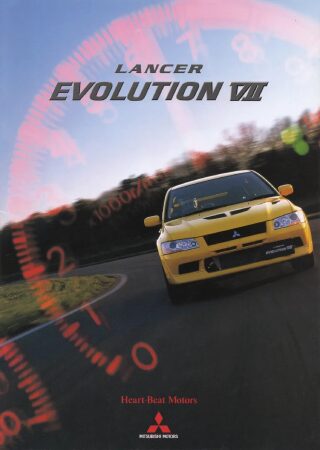
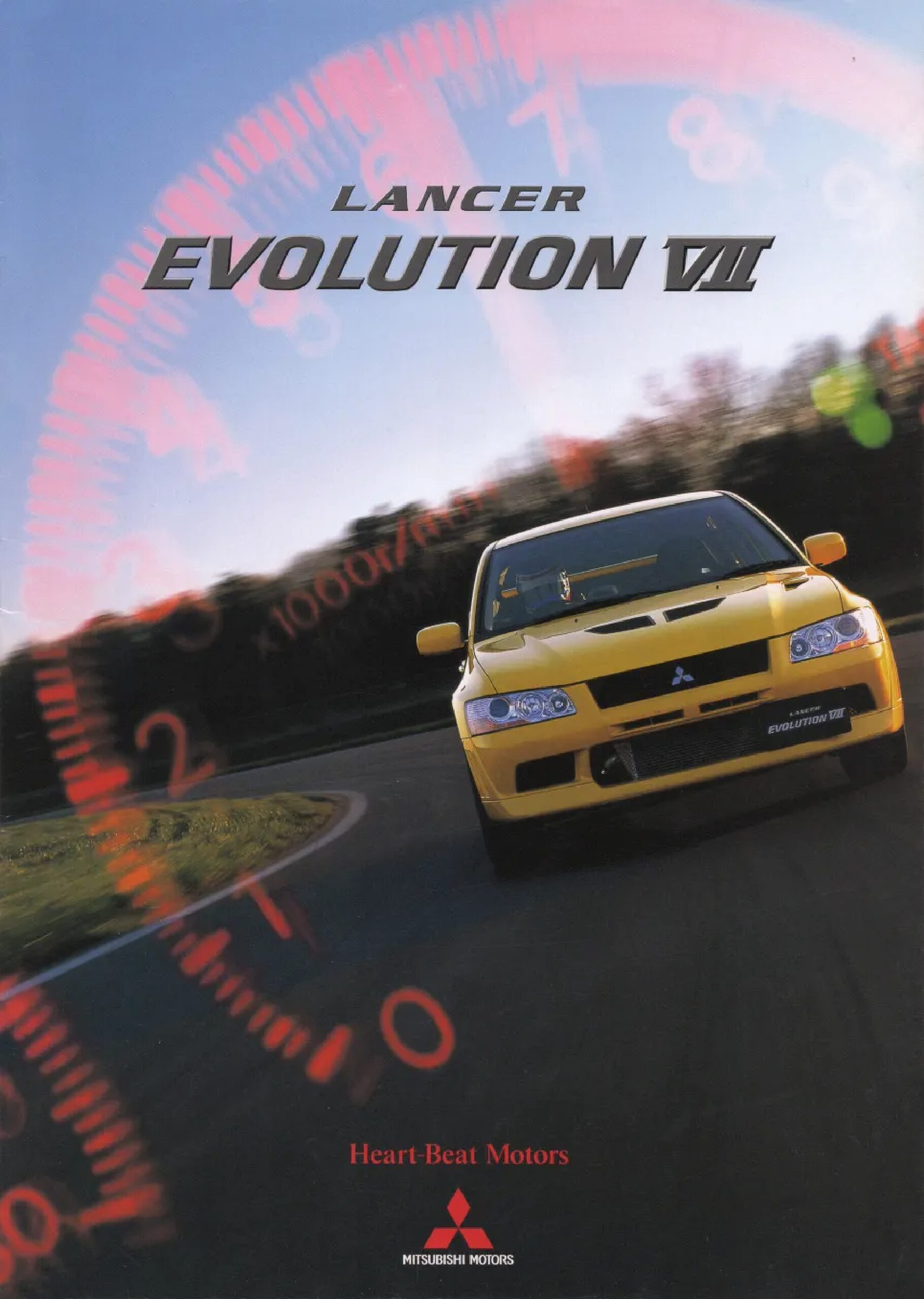
LANCER EVOLUTION VII
Heart-Beat Motors
MITSUBISHI MOTORS
Your trusted source of JDM parts shipped direct from Japan

Japan · January 2001
Turn for full screen
Nothing to translate on this page.
Heart-Beat Motors
MITSUBISHI MOTORS
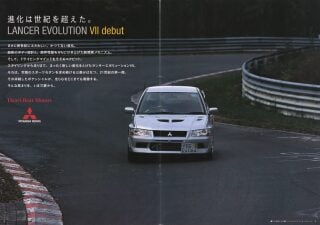
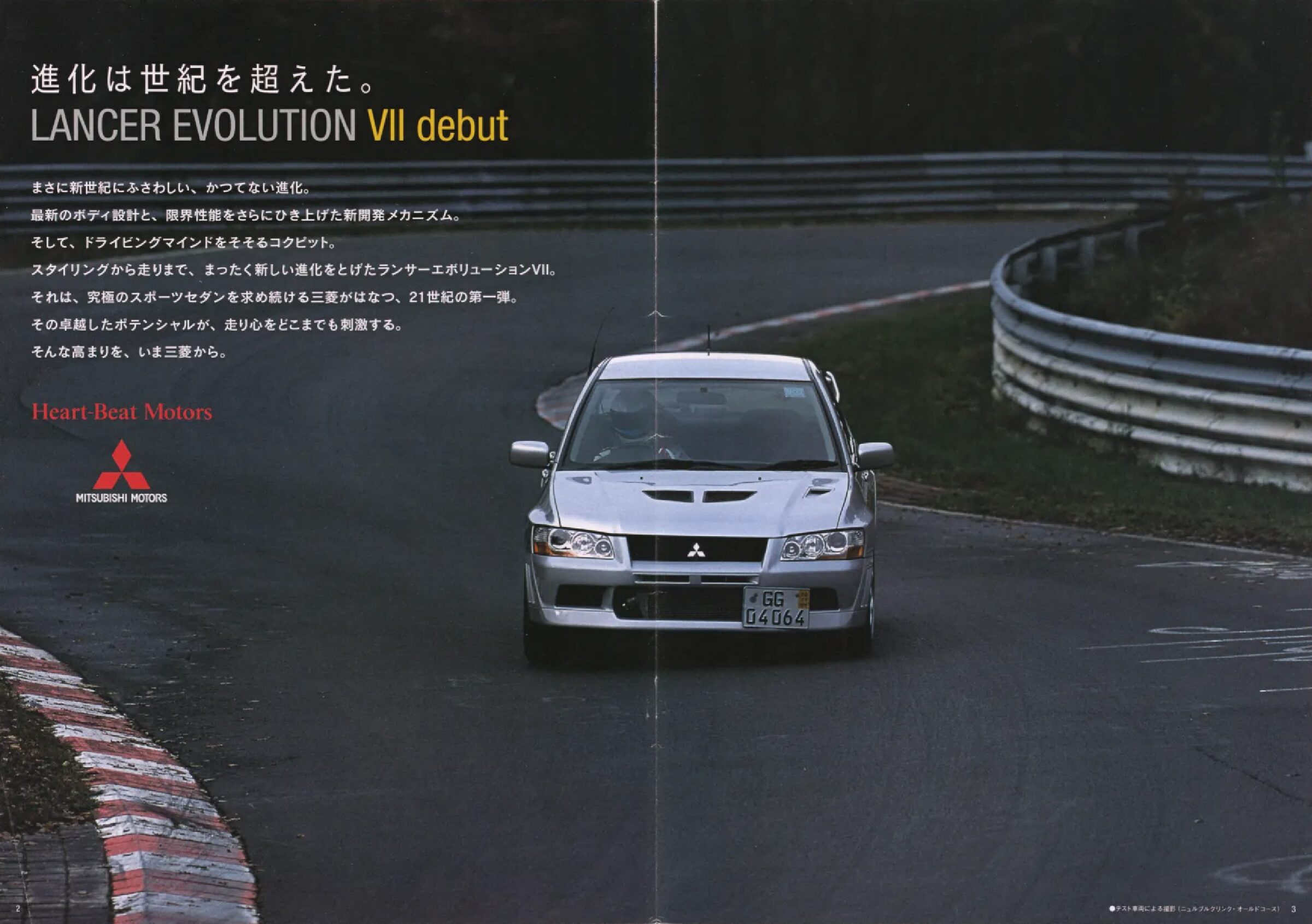
LANCER EVOLUTION VII debut
An evolution like never before, truly fitting for a new century. The latest body design, and newly developed mechanisms that raise the limits of performance even further. And a cockpit that stirs the driving mind. From styling to driving, the Lancer Evolution VII has evolved into something entirely new. It is the first shot of the 21st century from Mitsubishi, which keeps pursuing the ultimate sports sedan. Its outstanding potential stirs the driving spirit without end. That excitement, now from Mitsubishi.
Heart-Beat Motors
MITSUBISHI MOTORS
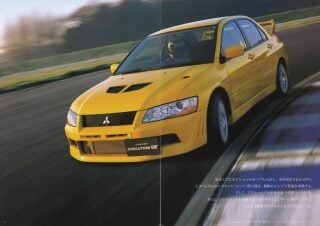
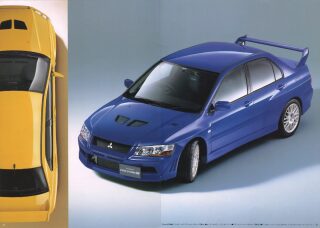
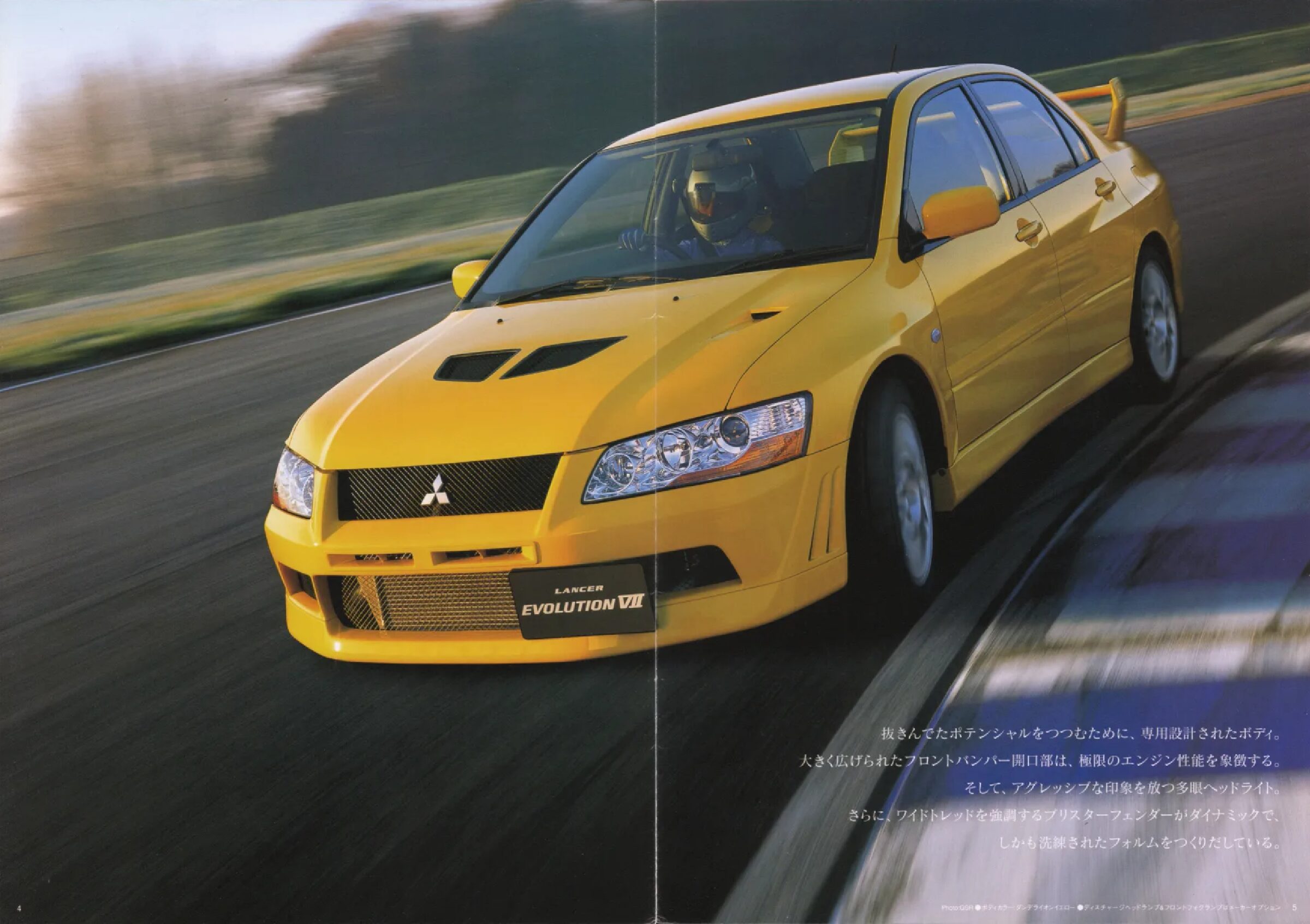
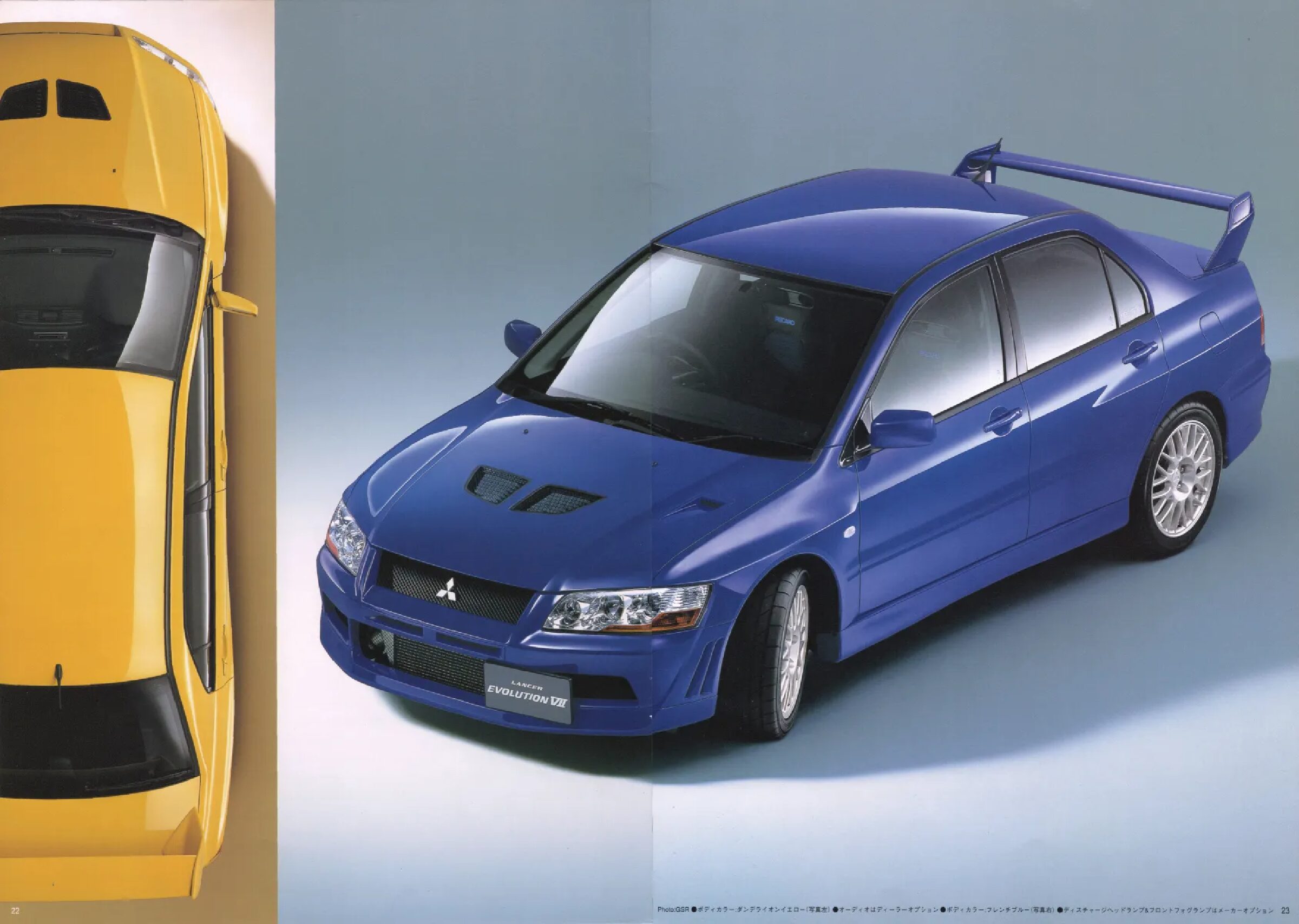
A body designed exclusively to contain outstanding potential. The widely opened front bumper opening symbolizes the engine's ultimate performance. And multi-lens headlights that give an aggressive impression. Blister fenders that emphasize the wide track create a form that is dynamic, and refined too.
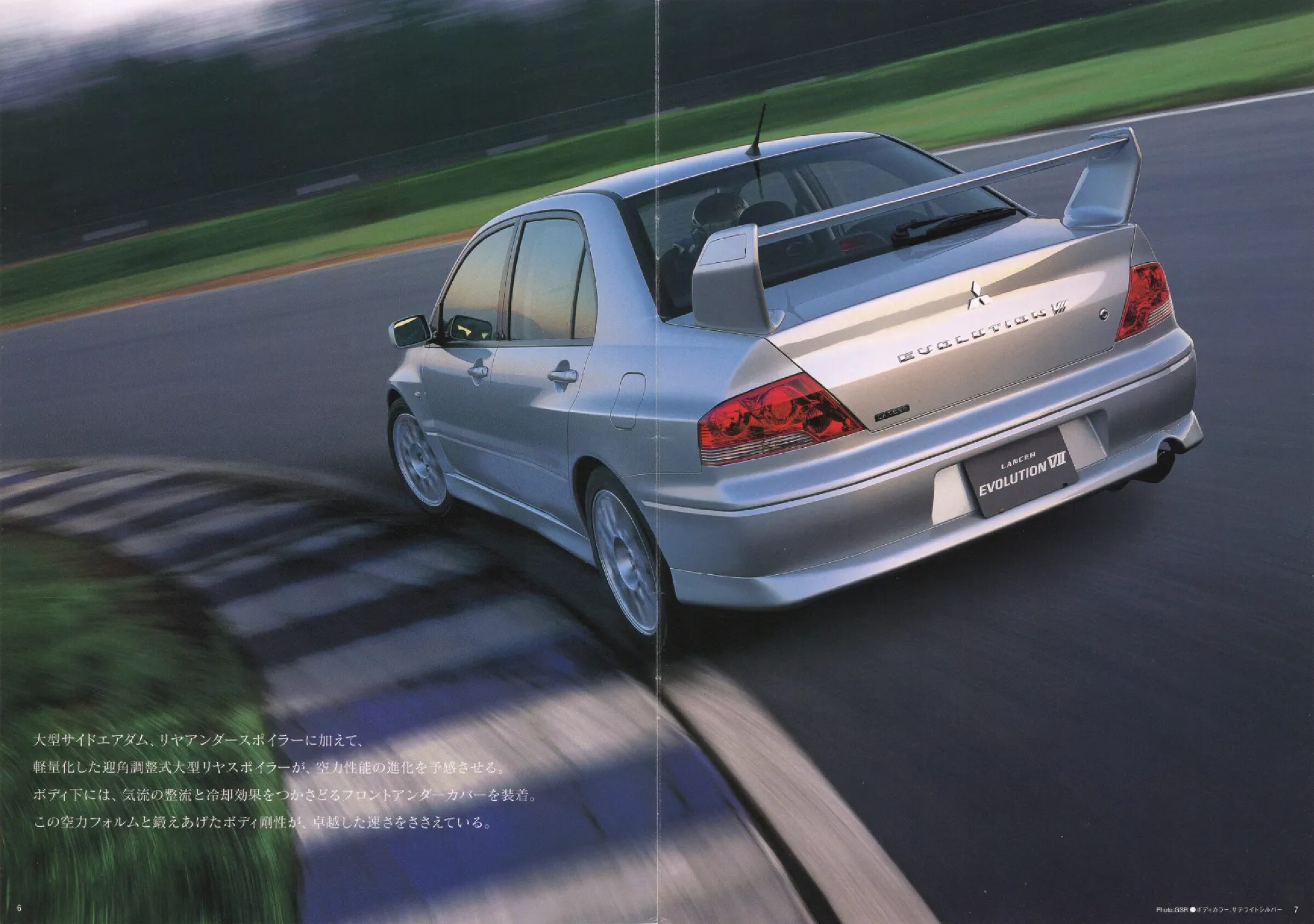
Photo: GSR
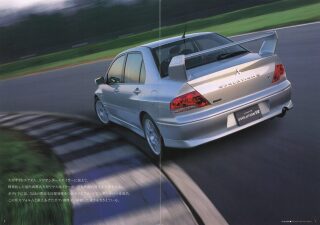
In addition to large side air dams and a rear under spoiler, a lightened, angle-adjustable large rear spoiler hints at the evolution in aerodynamic performance. Under the body is a front under cover that smooths the airflow and provides cooling. This aerodynamic form and the thoroughly strengthened body rigidity support outstanding speed.
Photo: GSR
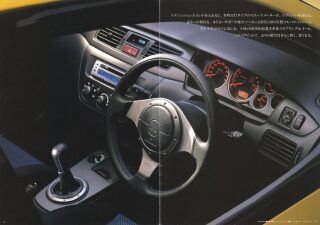
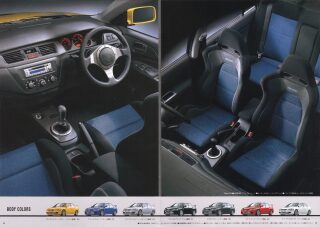
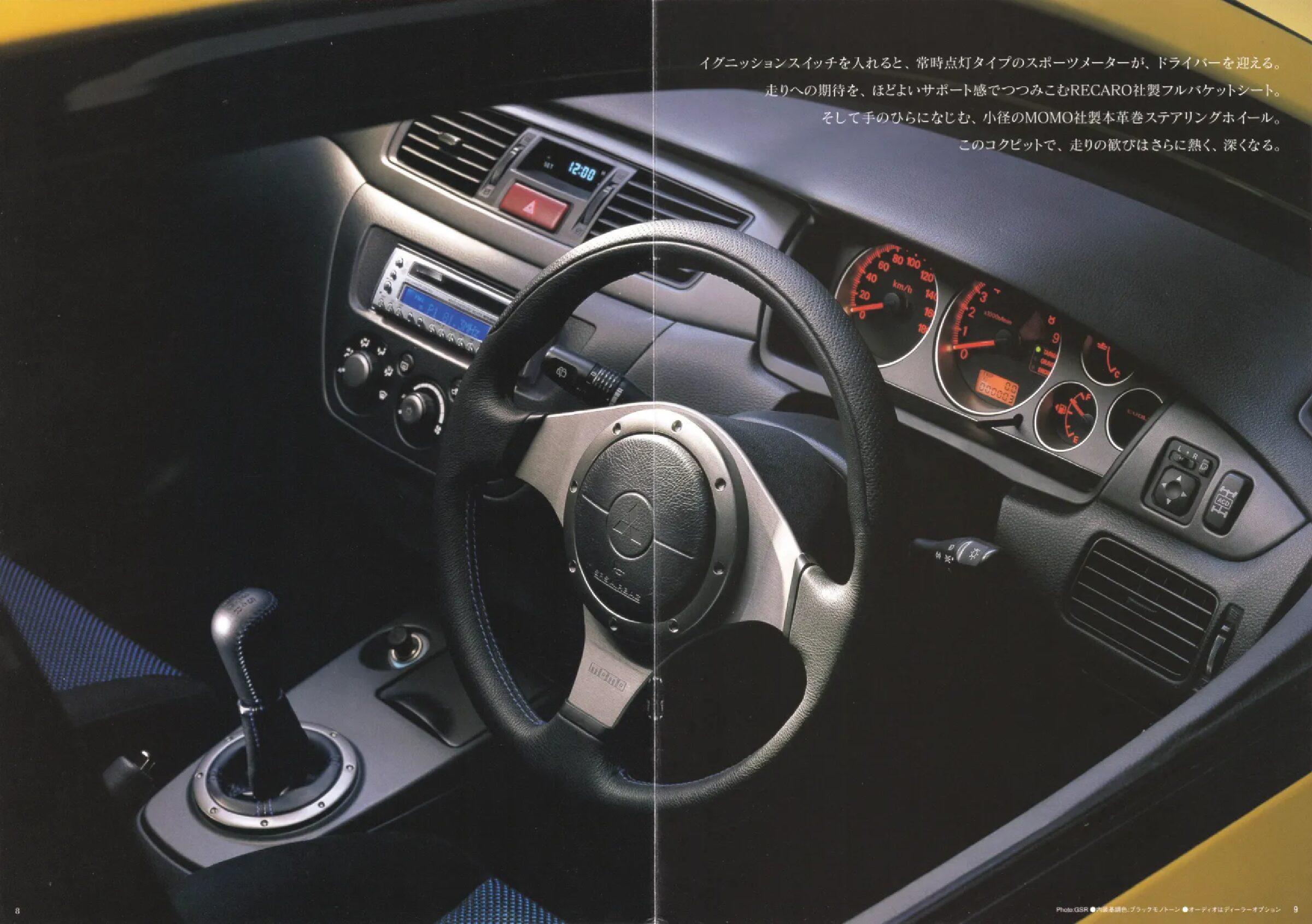
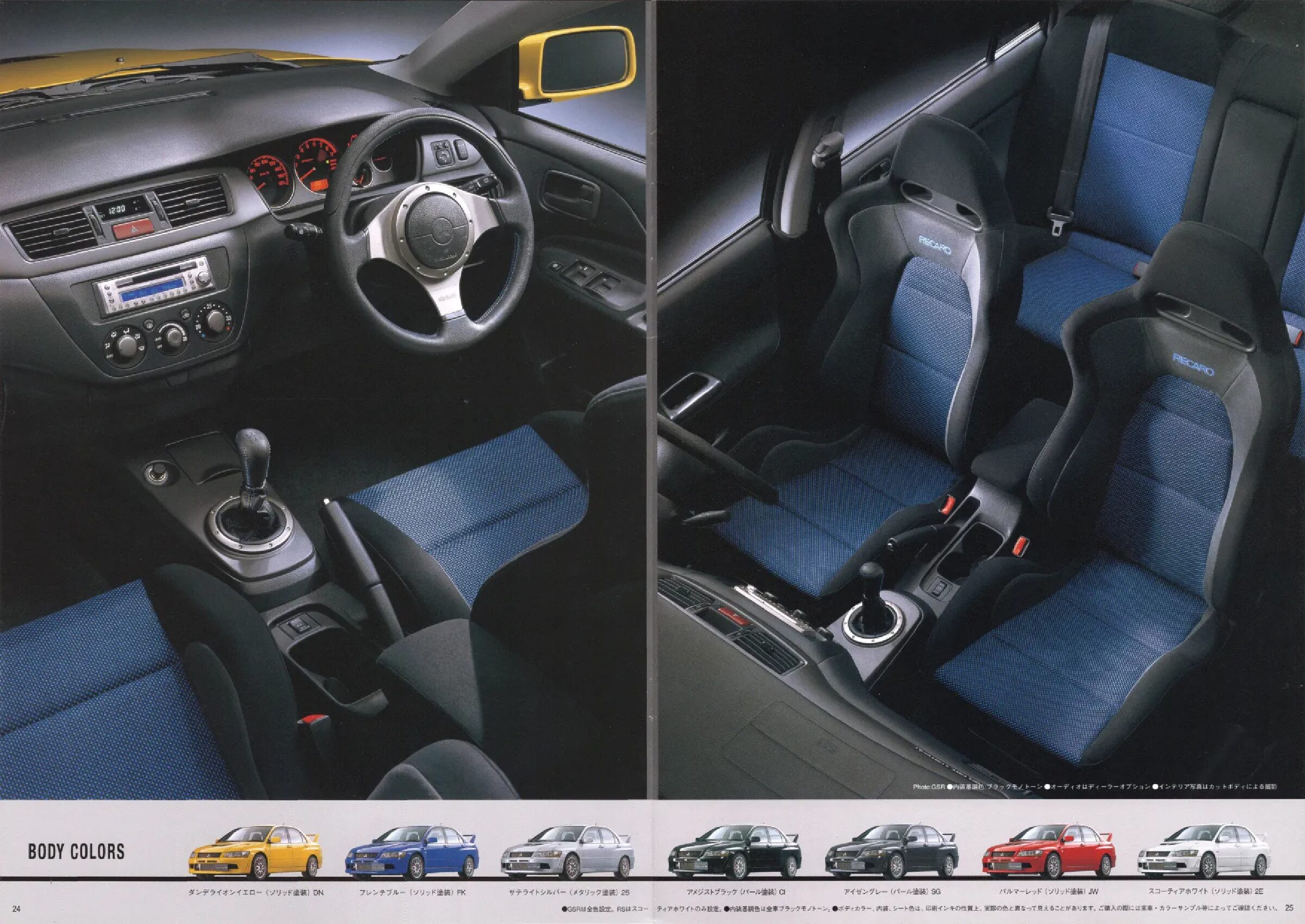
Turn on the ignition switch and the always-lit sport meters greet the driver. RECARO full bucket seats wrap your anticipation of driving with just the right sense of support. And a small-diameter MOMO genuine leather steering wheel that fits the palm of your hand. In this cockpit, the joy of driving grows hotter and deeper still.
Photo: GSR
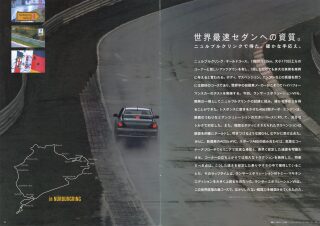
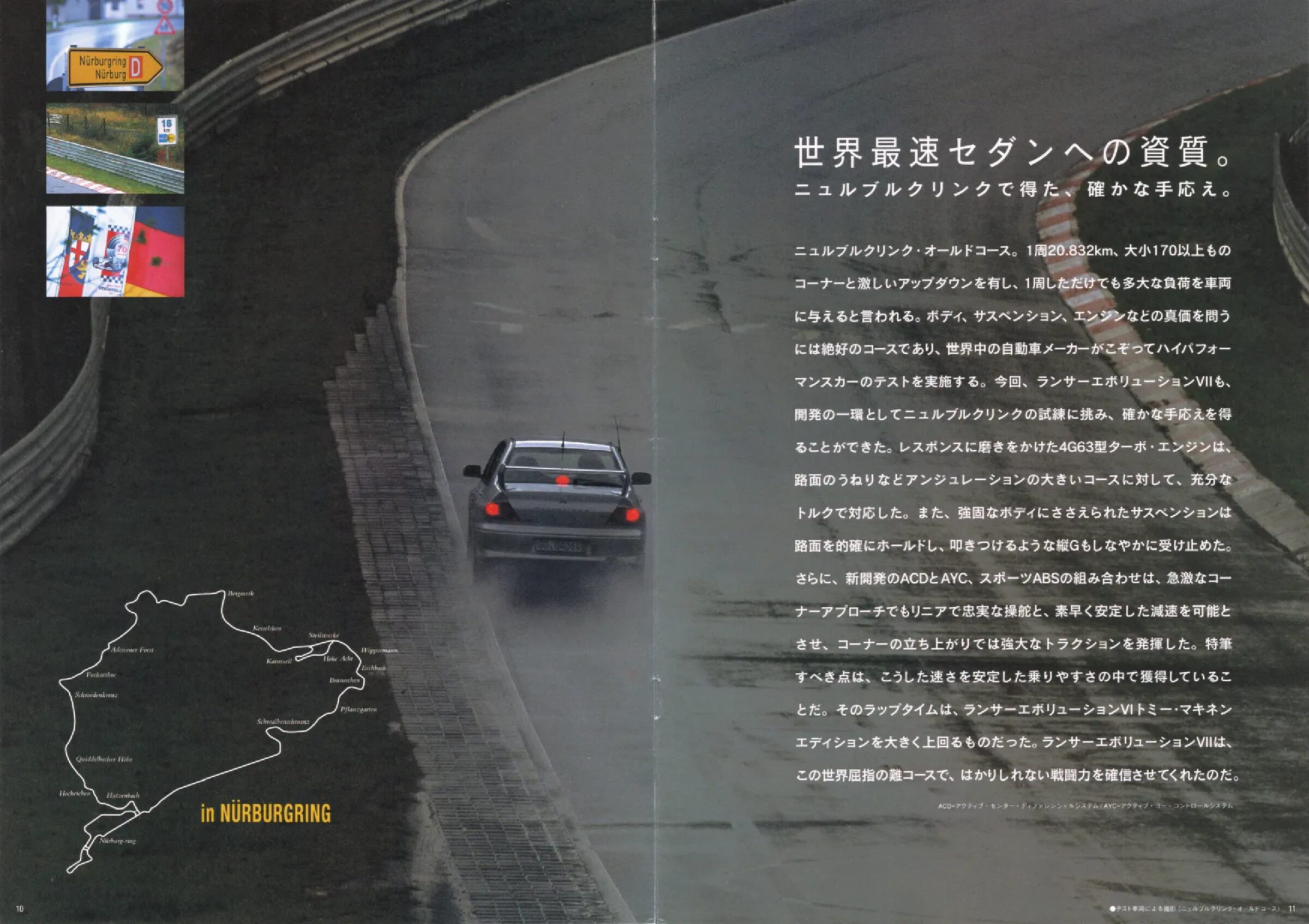
The Nürburgring Old Course. 20.832 km a lap, with more than 170 corners large and small and steep climbs and drops, it is said to put a heavy load on a car in just one lap. It is the ideal course to test the true worth of a body, suspension and engine, and car manufacturers from all over the world test their high-performance cars there. This time, the Lancer Evolution VII also took on the trials of the Nürburgring as part of development, and gained a sure response. The 4G63 turbo engine, honed for response, met a course of great undulation, such as the waves in the road surface, with ample torque. The suspension, backed by a strong body, held the road surface precisely and supplely absorbed the pounding vertical G. In addition, the combination of the newly developed ACD and AYC with Sports ABS made linear, faithful steering and quick, stable deceleration possible even on a sharp corner approach, and delivered powerful traction on the exit of the corners. What deserves special mention is that this speed was gained with stable, easy driveability. The lap time was far better than the Lancer Evolution VI Tommi Makinen Edition's. On one of the world's most difficult courses, the Lancer Evolution VII proved immeasurable fighting power.
ACD = Active Center Differential system / AYC = Active Yaw Control system
in NÜRBURGRING
The circuit map names:
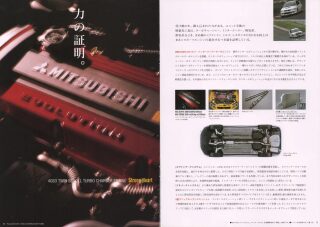
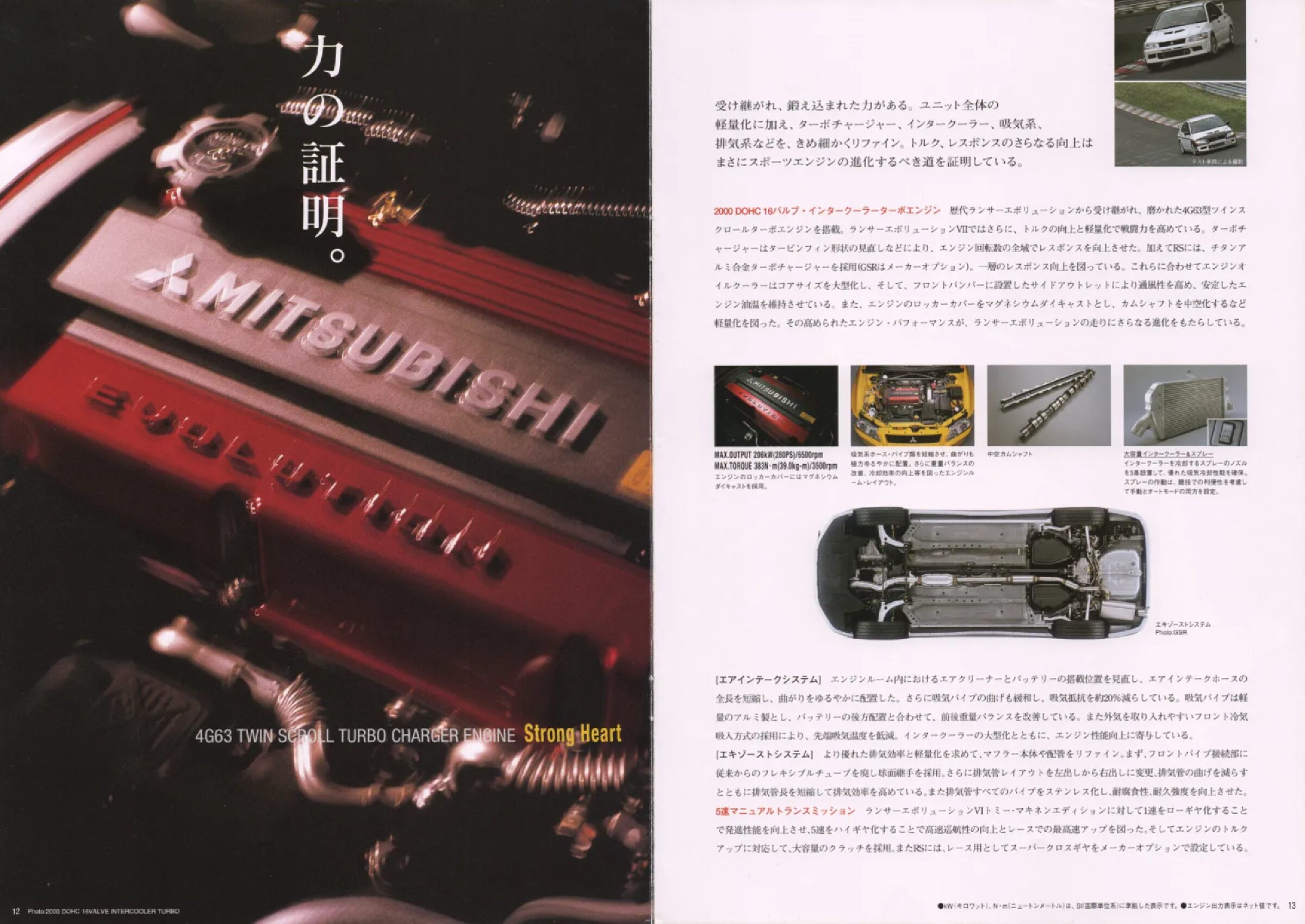
4G63 TWIN SCROLL TURBO CHARGER ENGINE Strong Heart
Photo: 2000 DOHC 16VALVE INTERCOOLER TURBO
Here is power that has been inherited and forged. As well as lightening the whole unit, the turbocharger, intercooler, intake and exhaust have been meticulously refined. Further gains in torque and response truly prove the path a sports engine should evolve along.
The 4G63 twin-scroll turbo engine, inherited from every Lancer Evolution before and honed. The Lancer Evolution VII raises fighting power further with more torque and less weight. The turbocharger's response has been improved across the whole engine speed range by revising the shape of the turbine fins, among other changes. In addition, the RS has a titanium-aluminum alloy turbocharger (a maker option on the GSR) for even better response. To match, the engine oil cooler has a larger core, and side outlets in the front bumper improve airflow to keep the engine oil temperature stable. The engine's rocker cover is also die-cast magnesium, and the camshafts are hollow, among other weight savings. This higher engine performance brings a further evolution to the Lancer Evolution's driving.
Photo captions:
[Air intake system] The positions of the air cleaner and battery in the engine bay have been revised, shortening the whole length of the air intake hose and routing it with gentle bends. The bends of the intake pipe have also been eased, reducing intake resistance by about 20%. The intake pipe is lightweight aluminum, and together with moving the battery rearward, improves the front-to-rear weight balance. A front cold-air intake that takes in outside air easily also lowers the intake air temperature at the inlet. Together with the larger intercooler, this contributes to better engine performance.
[Exhaust system] Seeking better exhaust efficiency and lower weight, the muffler and piping have been refined. First, the flexible tube used until now at the front pipe joint has been replaced with a spherical joint. The exhaust layout has also changed from a left-side exit to a right-side exit, reducing the bends in the exhaust pipe and shortening the pipe for better exhaust efficiency. Every pipe of the exhaust is now stainless steel, improving corrosion resistance and durability.
Compared with the Lancer Evolution VI Tommi Makinen Edition, 1st gear is lower for better standing starts, and 5th gear is higher for better high-speed cruising and a higher top speed in racing. A high-capacity clutch is used to handle the engine's increased torque. The RS also has a super cross gear for racing as a maker option.
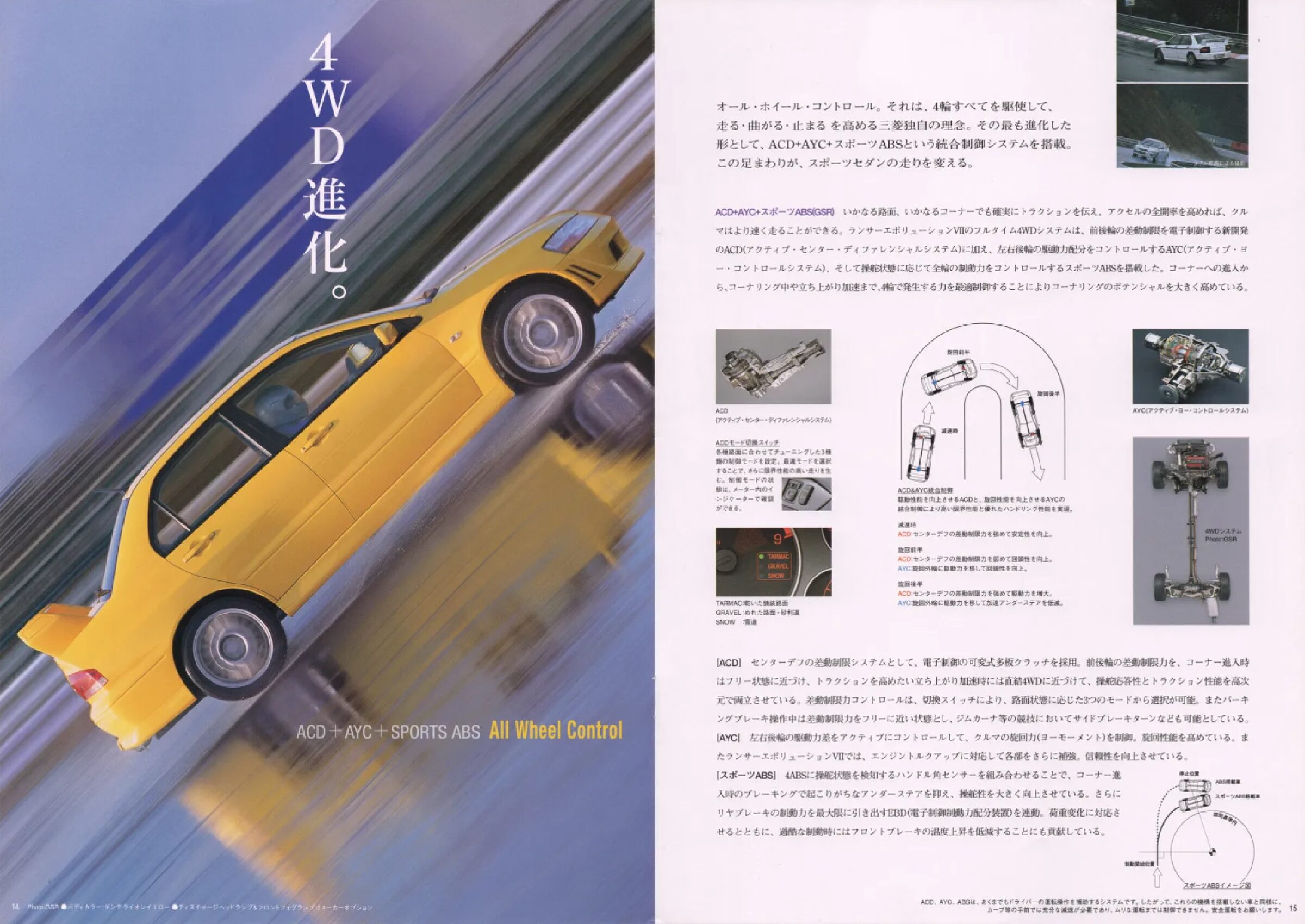
ACD+AYC+SPORTS ABS All Wheel Control
Photo: GSR
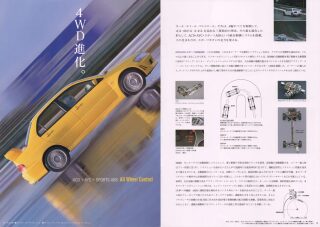
All Wheel Control. It is Mitsubishi's philosophy of raising the ability to go, turn and stop by making full use of all four wheels. In the most evolved form, it brings an integrated control system: ACD + AYC + Sports ABS. This chassis changes the way a sports sedan drives.
If traction is delivered surely on any road surface and in any corner, and the throttle can be fully open more of the time, a car can go faster. The Lancer Evolution VII's full-time 4WD system has the newly developed ACD (Active Center Differential system), which electronically controls the limited slip between the front and rear wheels, together with AYC (Active Yaw Control system), which controls the distribution of driving force between the left and right rear wheels, and Sports ABS, which controls the braking force of every wheel according to the steering. By optimally controlling the forces at all four wheels from corner entry, through mid-corner to acceleration out, cornering potential is greatly raised.
Photo captions:
ACD&AYC integrated control: integrated control of ACD, which improves driving performance, and AYC, which improves turning performance, achieves high limits and excellent handling.
[ACD] An electronically controlled variable multi-plate clutch is used as the limited-slip system for the center differential. The limiting force between the front and rear wheels is brought close to free when entering a corner, and close to direct-coupled 4WD when accelerating out, where traction is wanted, achieving both steering response and traction at a high level. The limiting force can be selected with a switch from three modes to suit the road surface. While the parking brake is applied, the limiting force is brought close to free, making side-brake turns possible in competitions such as gymkhana.
[AYC] Actively controls the difference in driving force between the left and right rear wheels to control the car's turning force (yaw moment), improving turning performance. On the Lancer Evolution VII, every part has also been further strengthened to handle the increased engine torque, improving reliability.
[Sports ABS] Combining a 4-channel ABS with a steering angle sensor that detects the steering suppresses the understeer that tends to occur under braking on corner entry, greatly improving controllability. It also works with EBD (electronic brake-force distribution), which draws out the maximum braking force from the rear brakes. As well as adapting to changes in load, it also helps reduce the rise in front brake temperature under severe braking.
Sports ABS image diagram:
ACD, AYC and ABS are only systems that assist the driver's operation. So, as with a car without these mechanisms, enough deceleration is needed before curves, and they cannot control unreasonable driving. Please drive safely.
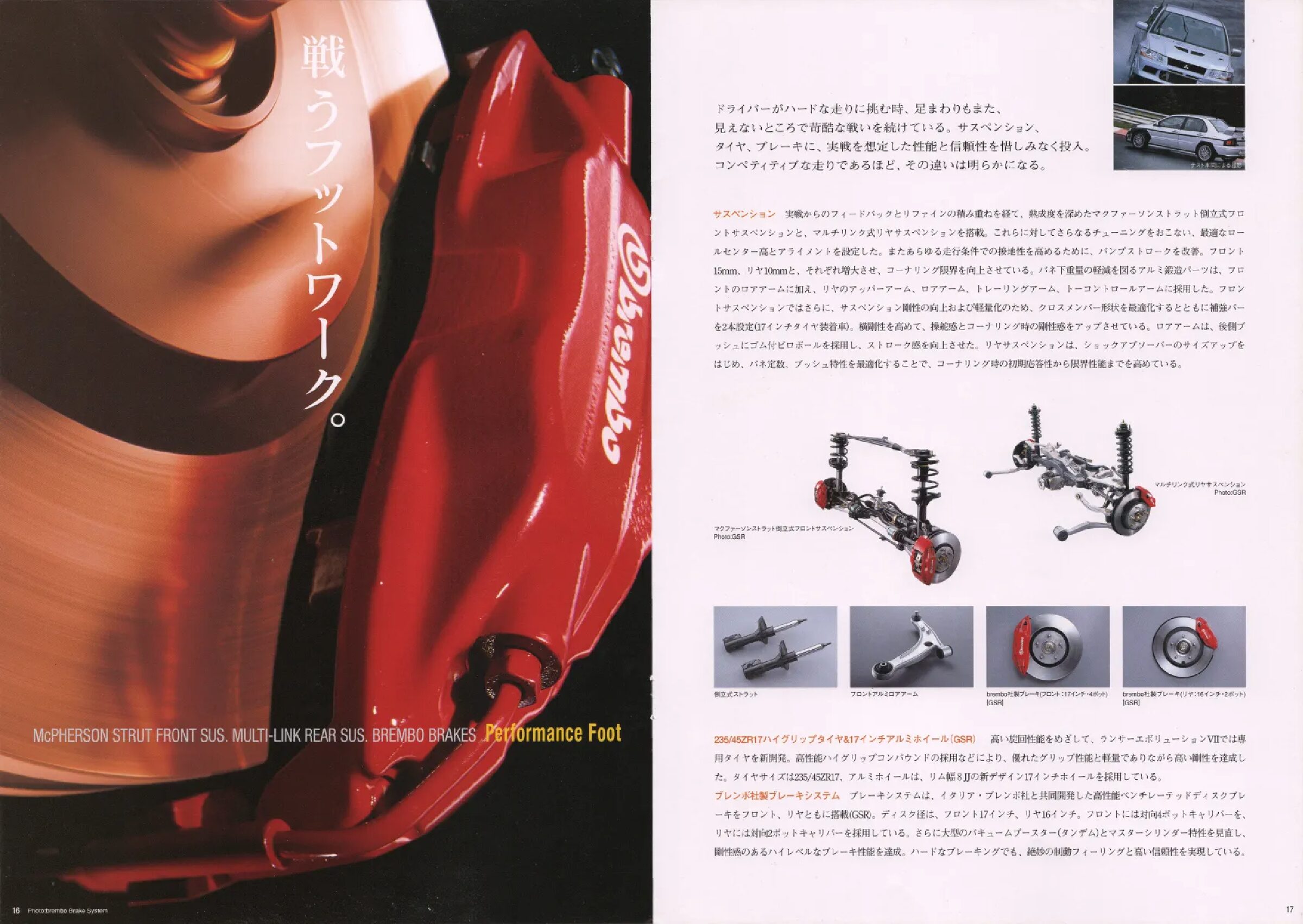
McPHERSON STRUT FRONT SUS. MULTI-LINK REAR SUS. BREMBO BRAKES Performance Foot
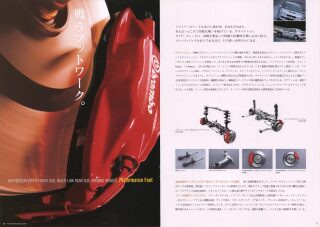
Photo: brembo Brake System
When the driver takes on hard driving, the suspension too keeps fighting a fierce battle where it cannot be seen. Performance and reliability built for real competition are put without reserve into the suspension, tires and brakes. The more competitive the driving, the clearer the difference becomes.
Through repeated feedback from real competition and refinement, it has a matured MacPherson strut front suspension with inverted struts and a multi-link rear suspension. Further tuning sets the optimum roll center height and alignment. To improve grip in every driving condition, bump stroke has been increased, by 15 mm at the front and 10 mm at the rear, raising cornering limits. Forged aluminum parts that reduce unsprung weight are used for the front lower arms, and at the rear for the upper arms, lower arms, trailing arms and toe control arms. At the front, the crossmember shape has also been optimized to raise suspension rigidity and save weight, and two reinforcement bars are fitted (cars with 17-inch tires), raising lateral rigidity for a better feel of steering and of rigidity when cornering. The lower arms have a rubber-mounted pillow ball in the rear bush, improving the feel of the stroke. At the rear, larger shock absorbers and optimized spring rates and bush characteristics raise performance from initial response in cornering up to the limit.
Photo captions:
Aiming for high turning performance, the Lancer Evolution VII has newly developed exclusive tires. A high-performance high-grip compound, among other things, achieves excellent grip and high rigidity while being light. The tire size is 235/45ZR17, and the aluminum wheels are a new design of 17-inch wheel with an 8JJ rim width.
The brake system has high-performance ventilated disc brakes developed jointly with Brembo of Italy, at the front and the rear (GSR). The disc diameter is 17 inches at the front and 16 inches at the rear. The front has opposed 4-pot calipers and the rear opposed 2-pot calipers. A large vacuum booster (tandem) and revised master cylinder characteristics also achieve high-level braking performance with a feel of rigidity. Even under hard braking, it gives an exquisite braking feel and high reliability.
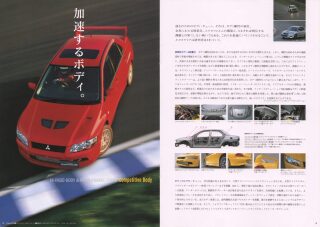
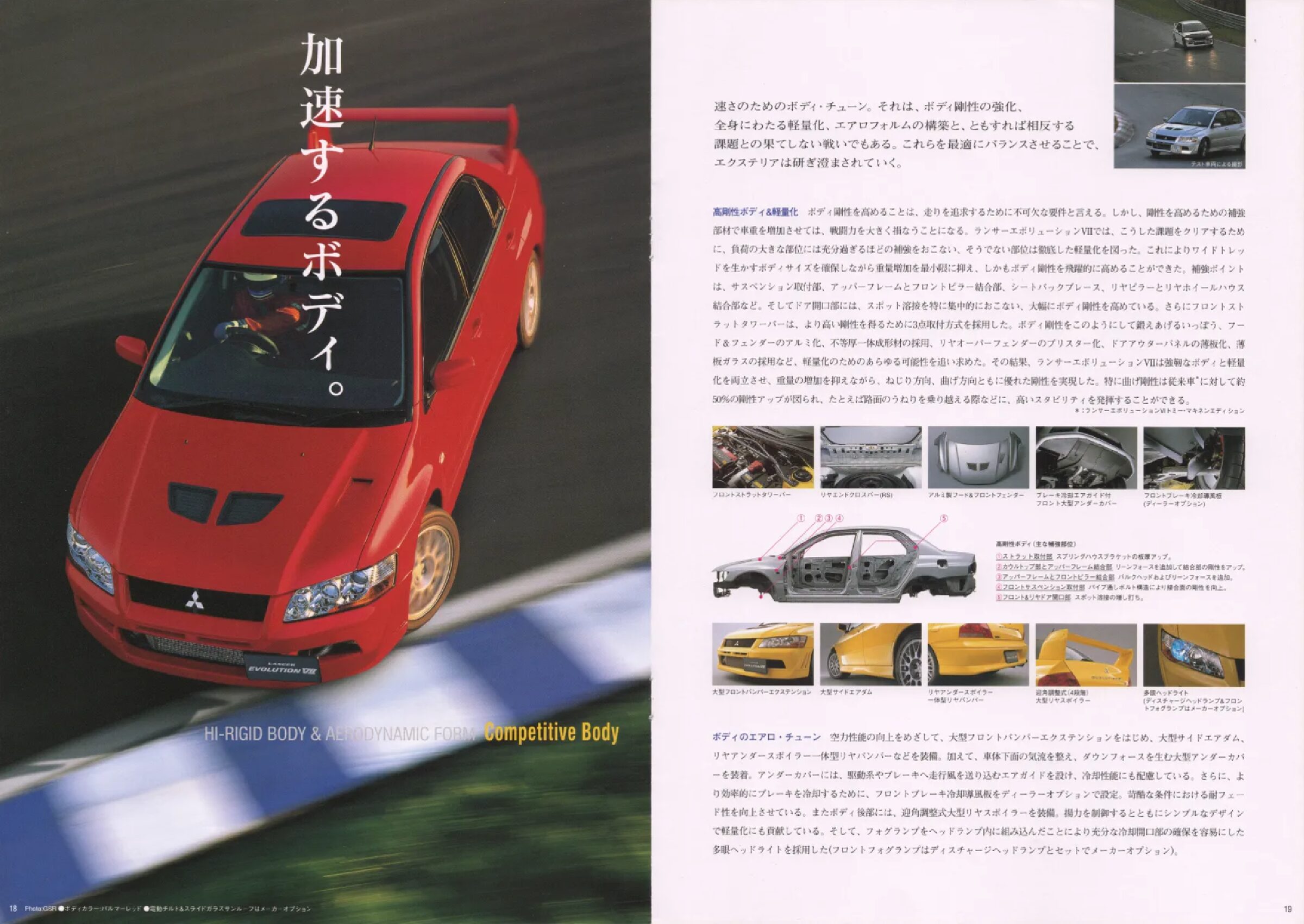
HI-RIGID BODY & AERODYNAMIC FORM Competitive Body
Photo: GSR
Body tuning for speed. It is also an endless battle with demands that so easily conflict: stronger body rigidity, weight saving throughout, and building an aerodynamic form. By balancing these optimally, the exterior is honed.
Raising body rigidity can be called an essential requirement in the pursuit of driving. But adding weight with reinforcing members to raise rigidity would greatly harm fighting power. In the Lancer Evolution VII, to clear this problem, areas under heavy load were reinforced more than enough, and other areas were thoroughly lightened. This kept the weight increase to a minimum while securing a body size that makes the most of the wide track, and raised body rigidity dramatically. The reinforcement points include the suspension mounts, the joint between the upper frame and front pillar, the seatback brace, and the joint between the rear pillar and rear wheelhouse. At the door openings, spot welds are concentrated, greatly raising body rigidity. The front strut tower bar also has three-point mounting for higher rigidity. While strengthening the body in this way, every possibility for saving weight was pursued: aluminum hood & fenders, one-piece formed panels of unequal thickness, blistered rear over-fenders, thinner door outer panels, thin glass and more. As a result, the Lancer Evolution VII combines a strong body with light weight, achieving excellent rigidity in both torsion and bending while limiting the weight increase. Bending rigidity in particular is about 50% higher than the previous car*, giving high stability, for example when going over undulations in the road surface.
Photo captions:
High-rigidity body (main reinforcement points):
Photo captions:
To improve aerodynamic performance, it has a large front bumper extension, large side air dams, a rear bumper with integrated rear under spoiler and more. In addition, it has a large under cover that smooths the airflow under the body and generates downforce. The under cover has air guides that send driving wind to the drivetrain and brakes, also taking care of cooling. To cool the brakes still more efficiently, front brake cooling air deflectors are offered as a dealer option, improving fade resistance in severe conditions. At the rear of the body is an adjustable-angle large rear spoiler, which controls lift while the simple design also helps save weight. And with the fog lamps built into the headlamps, multi-lens headlights make it easier to secure enough cooling openings (front fog lamps are a maker option, together with discharge headlamps).
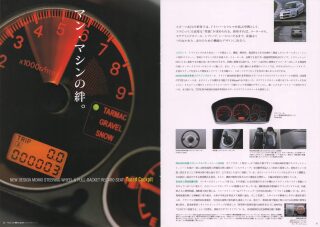
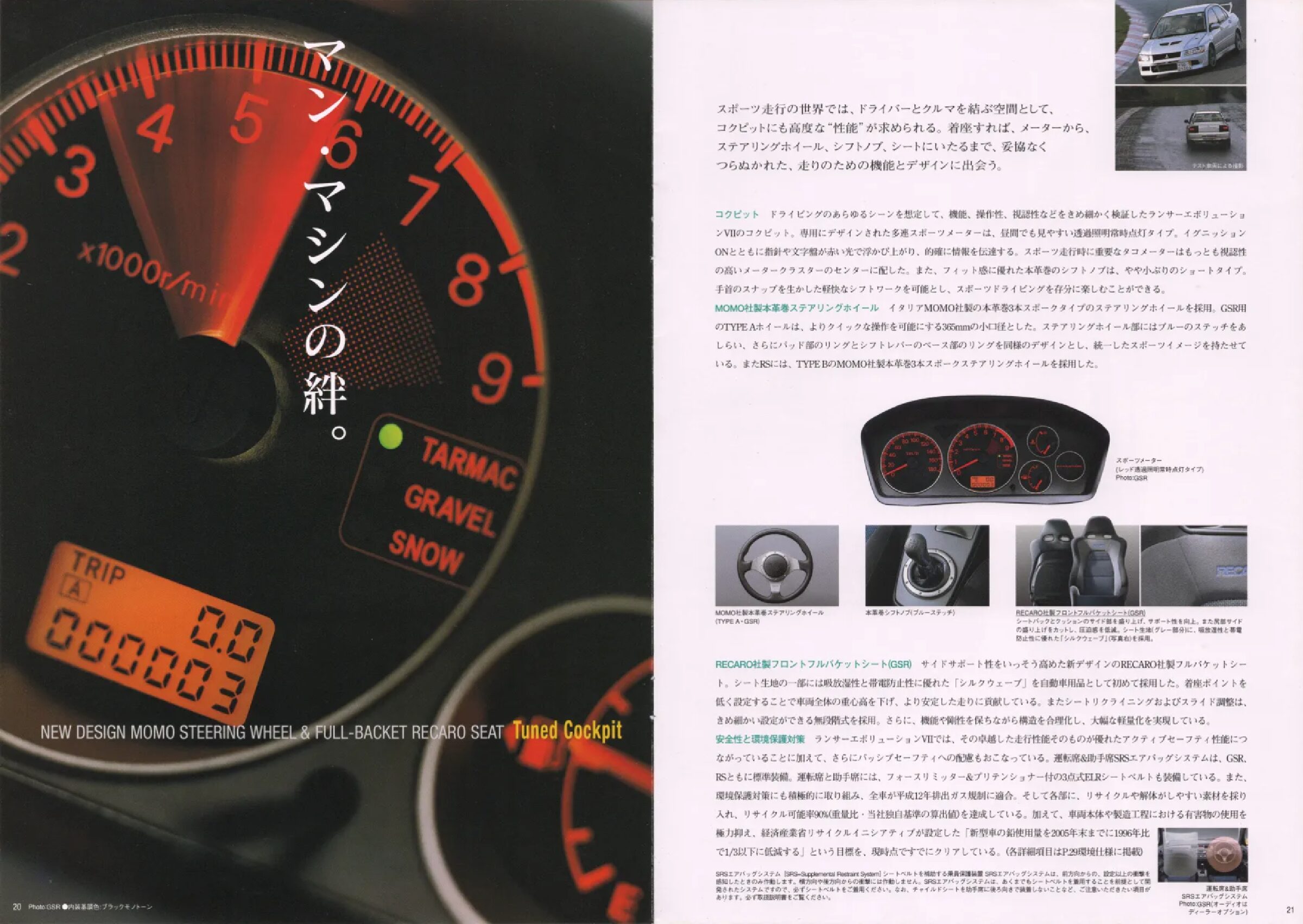
NEW DESIGN MOMO STEERING WHEEL & FULL-BACKET RECARO SEAT Tuned Cockpit
Photo: GSR
In the world of sports driving, the cockpit, as the space that joins driver and car, also demands a high level of "performance". Sit down and you meet function and design for driving, carried through without compromise, from the meters to the steering wheel, shift knob and seats.
The Lancer Evolution VII's cockpit has been meticulously checked for function, operability, visibility and more, with every driving scene in mind. The exclusively designed multi-gauge sport meters are a transmitted-light, always-lit type, easy to see even in daytime. When the ignition is turned ON, the needles and dials rise up in red light and convey information precisely. The tachometer, most important in sports driving, is placed in the center of the meter cluster, where it is easiest to see. The genuine leather shift knob, with an excellent fit, is a slightly smaller short type. It allows light shifting using the snap of the wrist, so you can fully enjoy sports driving.
A genuine leather 3-spoke steering wheel by MOMO of Italy. The GSR's TYPE A wheel has a small 365 mm diameter for quicker operation. The wheel has blue stitching, and the ring on the pad and the ring at the base of the shift lever share the same design, for a unified sporty image. The RS has a TYPE B MOMO genuine leather 3-spoke steering wheel.
Photo captions:
Newly designed RECARO full bucket seats with even more side support. Part of the seat fabric is "Silk Wave", excellent at absorbing and releasing moisture and at preventing static, used for the first time in an automotive product. The low hip point lowers the center of gravity of the whole car, contributing to more stable driving. Seat reclining and slide adjustment are stepless, for fine adjustment. The structure has also been rationalized while keeping function and rigidity, achieving a large weight saving.
In the Lancer Evolution VII, the outstanding driving performance itself leads to excellent active safety, and care is also taken over passive safety. Driver and front passenger SRS airbag systems are standard on both GSR and RS. The driver and front passenger seats also have 3-point ELR seat belts with force limiters & pretensioners. Environmental protection is also actively addressed, and every car meets the 2000 exhaust emission regulations. Materials that are easy to recycle and dismantle are used throughout, achieving a recyclability rate of 90% (by weight, calculated to Mitsubishi's standard). In addition, the use of hazardous substances in the car and in manufacturing is kept to a minimum, and the target set by the Ministry of Economy, Trade and Industry's Recycle Initiative, "reduce the lead used in new cars to one third or less of 1996 levels by the end of 2005", is already met. (Details are listed in the environmental specifications on P.29)
SRS airbag system [SRS = Supplemental Restraint System]: an occupant protection device that supplements the seat belts. The SRS airbag system works only when it detects a frontal impact above a set level. It does not work in an impact from the side or the rear. The SRS airbag system is designed on the premise that seat belts are worn, so always wear your seat belt. There are also points to take care over, such as not fitting a child seat facing rearward in the front passenger seat. Always read the owner's manual.
Photo caption: driver & front passenger SRS airbag system (Photo: GSR; audio is a dealer option)
Photo: GSR
Photo: GSR
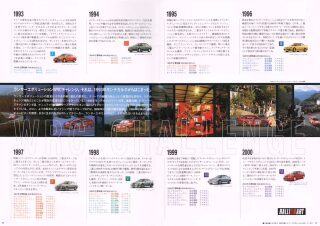
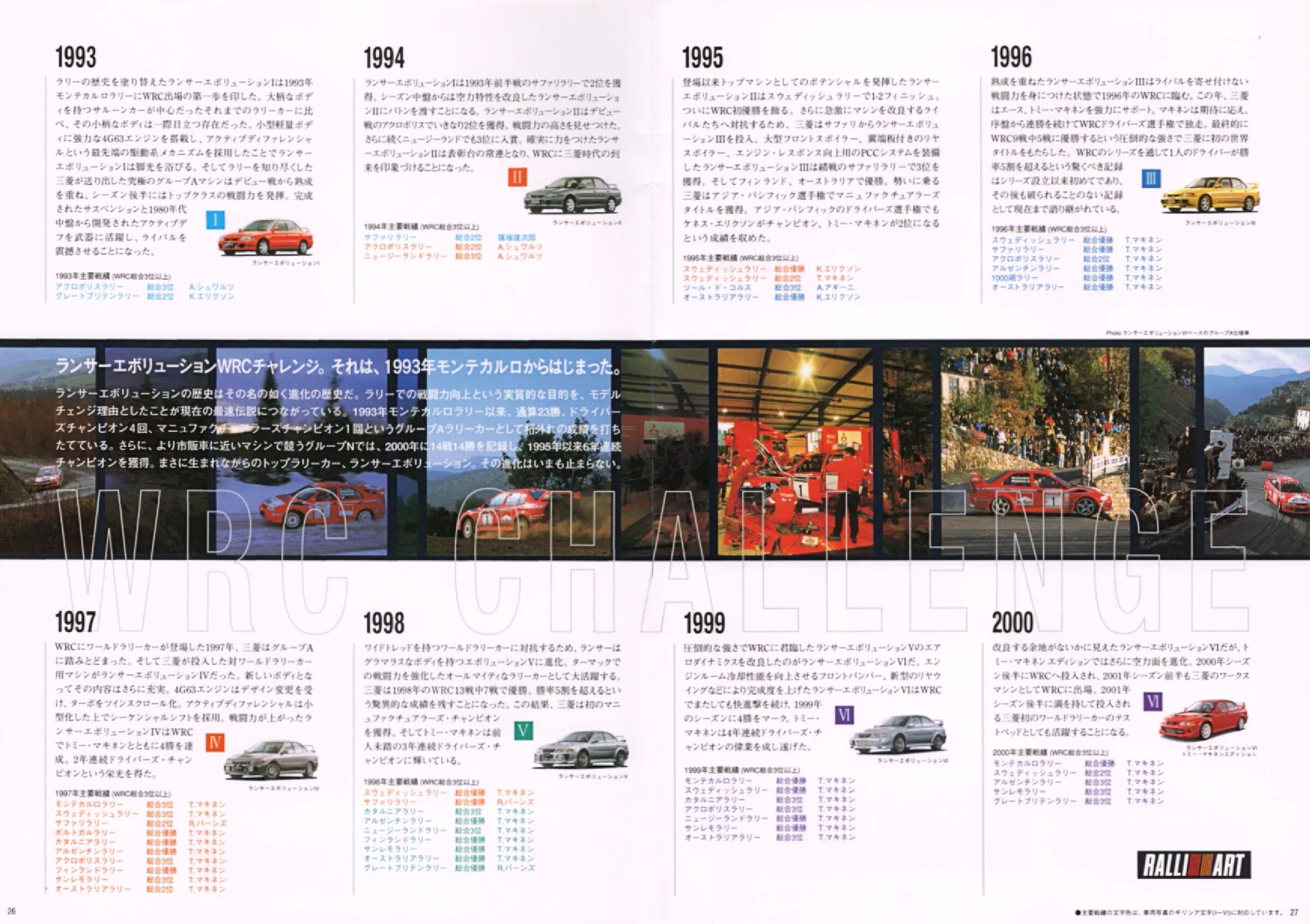
The history of the Lancer Evolution is, as the name suggests, a history of evolution. Making the practical goal of more fighting power in rallying the reason for each model change has led to today's legend of speed. Since the 1993 Monte Carlo Rally it has set exceptional results as a Group A rally car: 23 wins in total, 4 drivers' championships and 1 manufacturers' championship. In Group N too, where cars closer to the production car compete, it won 14 of 14 events in 2000, taking the championship six years running since 1995. A born top rally car, the Lancer Evolution. The evolution goes on even now.
WRC CHALLENGE
Photo: Group A specification car based on the Lancer Evolution VI
The Lancer Evolution I, which rewrote rally history, took the first step into the WRC at the 1993 Monte Carlo Rally. Among the rally cars of the time, mainly saloons with large bodies, the small body stood out. With the powerful 4G63 engine in a small, light body and an advanced drivetrain mechanism, the active differential, the Lancer Evolution I took the spotlight. The ultimate Group A machine from Mitsubishi, which knows rallying inside out, matured from the debut event onward and showed top-class fighting power in the second half of the season. With refined suspension and the active diff developed from the mid-1980s as weapons, it went on to shake its rivals.
Photo: Lancer Evolution I
Main results in 1993 (WRC, 3rd overall or better):
| Rally | Result | Driver | Car |
|---|---|---|---|
| Acropolis Rally | 3rd overall | A. Schwarz | I |
| Great Britain Rally | 2nd overall | K. Eriksson | I |
The Lancer Evolution I took 2nd at the Safari Rally in the first half of 1993. From mid-season it handed the baton to the Lancer Evolution II, with improved aerodynamics. The Lancer Evolution II took 2nd straight away on the debut event, the Acropolis, showing how strong it was. It went on to 3rd place in New Zealand too. Steadily gaining strength, the Lancer Evolution II became a regular on the podium, making a strong impression that the Mitsubishi era had arrived in the WRC.
Photo: Lancer Evolution II
Main results in 1994 (WRC, 3rd overall or better):
| Rally | Result | Driver | Car |
|---|---|---|---|
| Safari Rally | 2nd overall | Kenjiro Shinozuka | I |
| Acropolis Rally | 2nd overall | A. Schwarz | II |
| New Zealand Rally | 3rd overall | A. Schwarz | II |
Showing potential as a top machine since the debut, the Lancer Evolution II finished 1-2 at the Swedish Rally, finally taking a first WRC win. To counter rivals rapidly improving their machines, Mitsubishi brought in the Lancer Evolution III from the Safari. With a large front spoiler, a rear spoiler with wing end plates and the PCC system for better engine response, the Lancer Evolution III took 3rd on the first event, the Safari Rally, then won in Finland and Australia. On a roll, Mitsubishi won the manufacturers' title in the Asia-Pacific championship. In the Asia-Pacific drivers' championship too, Kenneth Eriksson became champion and Tommi Makinen finished 2nd.
Main results in 1995 (WRC, 3rd overall or better):
| Rally | Result | Driver | Car |
|---|---|---|---|
| Swedish Rally | Overall win | K. Eriksson | II |
| Swedish Rally | 2nd overall | T. Makinen | II |
| Tour de Corse | 3rd overall | A. Aghini | III |
| Australia Rally | Overall win | K. Eriksson | III |
The matured Lancer Evolution III went into the 1996 WRC with fighting power no rival could come near. That year Mitsubishi strongly backed the ace, Tommi Makinen. Living up to expectations, Makinen won event after event from early in the season and ran away with the WRC drivers' championship. In the end, with the overwhelming strength of 5 wins in 9 WRC events, he brought Mitsubishi a first world title. One driver winning more than half the events in a WRC season was an astonishing record, the first since the series began, and is still talked about today as a record never since broken.
Photo: Lancer Evolution III
Main results in 1996 (WRC, 3rd overall or better):
| Rally | Result | Driver | Car |
|---|---|---|---|
| Swedish Rally | Overall win | T. Makinen | III |
| Safari Rally | Overall win | T. Makinen | III |
| Acropolis Rally | 2nd overall | T. Makinen | III |
| Argentina Rally | Overall win | T. Makinen | III |
| 1000 Lakes Rally | Overall win | T. Makinen | III |
| Australia Rally | Overall win | T. Makinen | III |
In 1997, when World Rally Cars appeared in the WRC, Mitsubishi stayed with Group A. The machine Mitsubishi entered against the World Rally Cars was the Lancer Evolution IV. With a new body, it became even more complete. The 4G63 engine was redesigned and the turbo became twin-scroll. The active differential was made smaller and given a sequential shift. With more fighting power, the Lancer Evolution IV took 4 wins in the WRC with Tommi Makinen, earning the honor of a second straight drivers' championship.
Photo: Lancer Evolution IV
Main results in 1997 (WRC, 3rd overall or better):
| Rally | Result | Driver | Car |
|---|---|---|---|
| Monte Carlo Rally | 3rd overall | T. Makinen | IV |
| Swedish Rally | 3rd overall | T. Makinen | IV |
| Safari Rally | 2nd overall | R. Burns | IV |
| Portugal Rally | Overall win | T. Makinen | IV |
| Catalunya Rally | Overall win | T. Makinen | IV |
| Argentina Rally | Overall win | T. Makinen | IV |
| Acropolis Rally | 3rd overall | T. Makinen | IV |
| Finland Rally | Overall win | T. Makinen | IV |
| Sanremo Rally | 3rd overall | T. Makinen | IV |
| Australia Rally | 2nd overall | T. Makinen | IV |
To take on the wide-track World Rally Cars, the Lancer evolved into the Evolution V with a glamorous body. An all-round rally car with more fighting power on tarmac, it was a great success. Mitsubishi won 7 of the 13 WRC events in 1998, an astonishing record of winning more than half. As a result, Mitsubishi won a first manufacturers' championship. And Tommi Makinen shone with an unprecedented third straight drivers' championship.
Photo: Lancer Evolution V
Main results in 1998 (WRC, 3rd overall or better):
| Rally | Result | Driver | Car |
|---|---|---|---|
| Swedish Rally | Overall win | T. Makinen | IV |
| Safari Rally | Overall win | R. Burns | IV |
| Catalunya Rally | 3rd overall | T. Makinen | V |
| Argentina Rally | Overall win | T. Makinen | V |
| New Zealand Rally | 3rd overall | T. Makinen | V |
| Finland Rally | Overall win | T. Makinen | V |
| Sanremo Rally | Overall win | T. Makinen | V |
| Australia Rally | Overall win | T. Makinen | V |
| Great Britain Rally | Overall win | R. Burns | V |
The Lancer Evolution VI improved the aerodynamics of the Lancer Evolution V, which had reigned over the WRC with overwhelming strength. Made even more complete with a front bumper that improves engine bay cooling and a new rear wing, among other things, the Lancer Evolution VI kept up the winning run in the WRC, taking 4 wins in the 1999 season. Tommi Makinen achieved the great feat of four straight drivers' championships.
Photo: Lancer Evolution VI
Main results in 1999 (WRC, 3rd overall or better):
| Rally | Result | Driver | Car |
|---|---|---|---|
| Monte Carlo Rally | Overall win | T. Makinen | VI |
| Swedish Rally | Overall win | T. Makinen | VI |
| Catalunya Rally | 3rd overall | T. Makinen | VI |
| Acropolis Rally | 3rd overall | T. Makinen | VI |
| New Zealand Rally | Overall win | T. Makinen | VI |
| Sanremo Rally | Overall win | T. Makinen | VI |
| Australia Rally | 3rd overall | T. Makinen | VI |
The Lancer Evolution VI seemed to leave no room for improvement, but the Tommi Makinen Edition evolved the aerodynamics further. Entered in the WRC in the second half of the 2000 season, it also competes in the WRC as Mitsubishi's works machine in the first half of the 2001 season. It will also play a part as the test bed for Mitsubishi's first World Rally Car, to be entered in earnest in the second half of the 2001 season.
Photo: Lancer Evolution VI Tommi Makinen Edition
Main results in 2000 (WRC, 3rd overall or better):
| Rally | Result | Driver | Car |
|---|---|---|---|
| Monte Carlo Rally | Overall win | T. Makinen | VI |
| Swedish Rally | 2nd overall | T. Makinen | VI |
| Argentina Rally | 3rd overall | T. Makinen | VI |
| Sanremo Rally | 3rd overall | T. Makinen | VI |
| Great Britain Rally | 3rd overall | T. Makinen | VI |
RALLIART
*With door mirror power folding control, sunroof (maker option) control, and hazard & room lamp answer-back functions
Shows a wide range of information on the display, including the latest navigation functions compatible with VICS*.
Screen captions:
Photo captions:
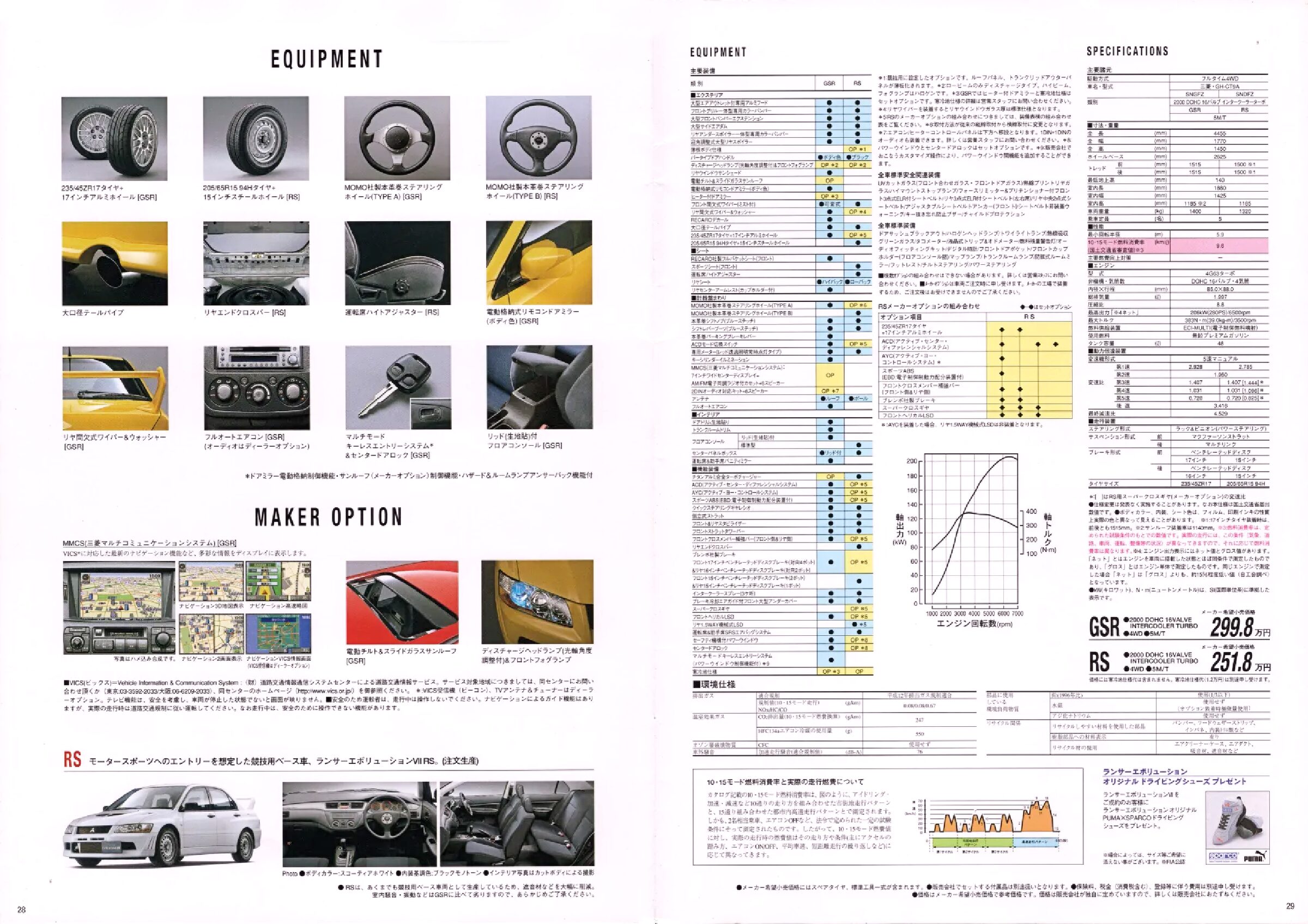
A competition base car intended as an entry into motorsport: the Lancer Evolution VII RS. (Built to order)
Photo
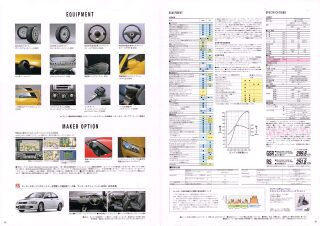
Main equipment:
| Item | GSR | RS |
|---|---|---|
| Exterior | ||
| Exclusive aluminum hood with large air outlets | Standard | Standard |
| Exclusive body-color bumper with integrated front grille | Standard | Standard |
| Large front bumper extension | Standard | Standard |
| Large side air dams | Standard | Standard |
| Exclusive body-color bumper with integrated rear under spoiler | Standard | Standard |
| Adjustable-angle large rear spoiler | Standard | Standard |
| Thin-gauge body specification | — | OP *1 |
| Bar-type door handles | Standard (body color) | Standard (black) |
| Discharge headlamps (with beam angle adjustment) & front fog lamps | OP *2 | OP *2 |
| Rear window sunshade | Standard | — |
| Power tilt & slide glass sunroof | OP | — |
| Power folding remote-control mirrors (body color) | Standard | — |
| Heated door mirrors | OP *3 | — |
| Front intermittent wipers (with mist) | Standard (variable) | Standard |
| Rear intermittent wiper & washer | Standard | OP *4 |
| RECARO decal | Standard | — |
| Large-bore tail pipe | Standard | Standard |
| 235/45ZR17 tires + 17-inch aluminum wheels | Standard | OP *5 |
| 205/65R15 94H tires + 15-inch steel wheels | — | Standard |
| Seats | ||
| RECARO full bucket seats (front) | Standard | — |
| Sport seats (front) | — | Standard |
| Driver's seat height adjuster | — | Standard |
| Rear seat | Standard (high back) | Standard (low back) |
| Rear center armrest (with cup holder) | Standard | — |
| Instruments and controls | ||
| MOMO genuine leather steering wheel (TYPE A) | Standard | OP *6 |
| MOMO genuine leather steering wheel (TYPE B) | — | Standard |
| Genuine leather shift knob (blue stitch) | Standard | Standard |
| Shift lever boot (blue stitch) | Standard | Standard |
| Genuine leather parking brake lever | Standard | — |
| ACD mode switch | Standard | OP *5 |
| Exclusive meters (red transmitted-light, always-lit type) | Standard | Standard |
| Key cylinder illumination | Standard | — |
| MMCS (Mitsubishi Multi-Communication System): 7-inch wide center display + AM/FM electronic tuning radio with cassette + 6 speakers | OP | — |
| 2DIN audio fitting kit + 6 speakers | OP *7 | — |
| Antenna | Standard (roof) | Standard (pole) |
| Full-auto air conditioner | Standard | — |
| Interior | ||
| Door trim with fabric | Standard | — |
| Trunk room trim | Standard | — |
| Floor console: with lid (fabric-covered) | Standard | — |
| Floor console: standard type | — | Standard |
| Center panel box | Standard (with lid) | Standard |
| Driver & front passenger vanity mirrors | Standard | — |
| Functional equipment | ||
| Titanium-aluminum alloy turbocharger | OP | Standard |
| ACD (Active Center Differential system) | Standard | OP *5 |
| AYC (Active Yaw Control system) | Standard | OP *5 |
| Sports ABS (with EBD: electronic brake-force distribution) | Standard | OP *5 |
| Quick steering gear ratio | Standard | Standard |
| Inverted struts | Standard | Standard |
| Front & rear stabilizers | Standard | Standard |
| Front strut tower bar | Standard | Standard |
| Front crossmember reinforcement bars (front & rear) | Standard | OP *5 |
| Rear end cross bar | — | Standard |
| Brembo brakes: front 17-inch ventilated disc brakes (opposed 4-pot) & rear 16-inch ventilated disc brakes (opposed 2-pot) | Standard | OP *5 |
| Front 15-inch ventilated disc brakes (2-pot) & rear 15-inch ventilated disc brakes (1-pot) | — | Standard |
| Intercooler spray (3 nozzles) | Standard | Standard |
| Large front under cover with brake cooling air guides | Standard | Standard |
| Super cross gear | — | OP *5 |
| Front helical LSD | Standard | OP *5 |
| Rear 1.5-way mechanical LSD | — | Standard *5 |
| Driver & front passenger SRS airbag system | Standard | Standard |
| Power windows with safety mechanism | Standard | OP *8 |
| Central door locking | Standard | OP *8 |
| Multi-mode keyless entry system (with power window control) *9 | Standard | — |
| Cold-climate specification | OP *3 | OP |
*1: An option set for competition. The roof panel and trunk lid outer panel are made thinner. *2: Discharge type for the low beam only; the high beam and fog lamps are halogen. *3: On the GSR, heated door mirrors and the cold-climate specification are a set option. For details of the cold-climate specification, please ask our sales staff. *4: With the rear wiper fitted, the rear window glass thickness is the standard specification. *5: For combinations of RS maker options, see the equipment combination table. *6: The mounting changes from the usual vertical bolting to horizontal bolting. *7: The air conditioner/heater control panel is moved down. 1DIN+1DIN audio can also be fitted. For details, please ask our sales staff. *8: Power windows and central door locking are a set option. *9: A power window opening and closing function can be added by a customizing operation carried out by the dealer.
UV-cut glass (laminated front glass, front door glass) / heat-ray printed rear glass / high-mount stop lamp / front 3-point ELR seat belts with force limiters & pretensioners / rear 3-point ELR seat belts (left and right) / rear center 2-point seat belt / adjustable seat belt anchors (front) / seat belt reminder warning / key reminder buzzer / child protection
Door sash blackout / halogen headlamps / twilight lamps / heat-absorbing green glass / tachometer / LCD trip & odometer / low fuel warning lamp / audio fitting kit / digital clock / front door pockets / front cup holder (in the floor console) / map lamp / trunk room lamp / anti-glare room mirror / footrest / tilt steering / power steering
◆—◆ marks a set option.
| Option item | Set 1 | Set 2 | Set 3 | Set 4 |
|---|---|---|---|---|
| 235/45ZR17 tires + 17-inch aluminum wheels | ◆ | ◆ | ||
| ACD (Active Center Differential system) | ◆ | ◆ | ◆ | |
| AYC (Active Yaw Control system) * | ◆ | |||
| Sports ABS (with EBD: electronic brake-force distribution) | ◆ | |||
| Front crossmember reinforcement bars (front & rear) | ◆ | ◆ | ||
| Brembo brakes | ◆ | ◆ | ||
| Super cross gear | ◆ | ◆ | ◆ | |
| Front helical LSD | ◆ | ◆ | ◆ |
*: With AYC fitted, the rear 1.5-way mechanical LSD is not fitted.
Performance curves:
Main specifications:
| Item | Unit | GSR | RS |
|---|---|---|---|
| Drive system | Full-time 4WD | Full-time 4WD | |
| Name and model | Mitsubishi GH-CT9A | Mitsubishi GH-CT9A | |
| SNGFZ | SNDFZ | ||
| Type | 2000 DOHC 16-valve intercooler turbo | 2000 DOHC 16-valve intercooler turbo | |
| GSR | RS | ||
| 5M/T | 5M/T | ||
| Dimensions and weight | |||
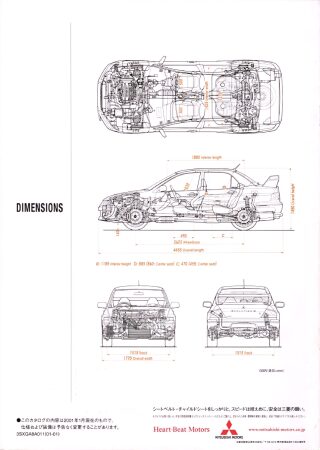
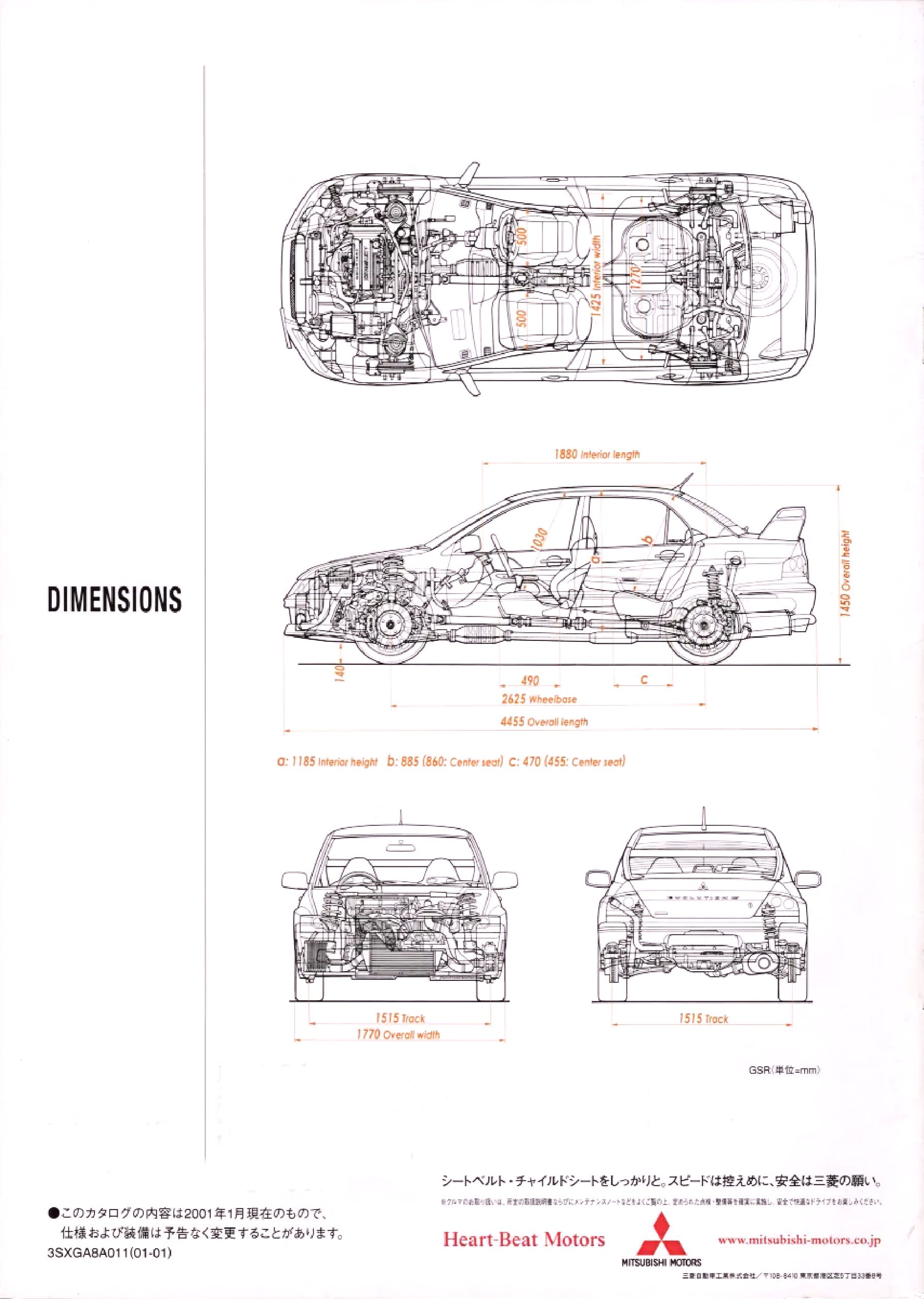
| Overall length | mm | 4,455 | 4,455 |
| Overall width | mm | 1,770 | 1,770 |
| Overall height | mm | 1,450 | 1,450 |
| Wheelbase | mm | 2,625 | 2,625 |
| Track, front | mm | 1,515 | 1,500 ※1 |
| Track, rear | mm | 1,515 | 1,500 ※1 |
| Minimum ground clearance | mm | 140 | 140 |
| Interior length | mm | 1,880 | 1,880 |
| Interior width | mm | 1,425 | 1,425 |
| Interior height | mm | 1,185 ※2 | 1,185 |
| Vehicle weight | kg | 1,400 | 1,320 |
| Seating capacity | persons | 5 | 5 |
| Performance | |||
| Minimum turning radius | m | 5.9 | 5.9 |
| 10-15 mode fuel consumption (Ministry of Land, Infrastructure and Transport figure) ※3 | km/L | 9.6 | 9.6 |
| Main fuel economy measures | — | — | |
| Engine | |||
| Type | 4G63 turbo | 4G63 turbo | |
| Valve train, cylinders | DOHC 16-valve, 4 cylinders | DOHC 16-valve, 4 cylinders | |
| Bore × stroke | mm | 85.0×88.0 | 85.0×88.0 |
| Displacement | L | 1.997 | 1.997 |
| Compression ratio | 8.8 | 8.8 | |
| Maximum output (※4 net) | 206kW(280PS)/6500rpm | 206kW(280PS)/6500rpm | |
| Maximum torque | 383N·m(39.0kg-m)/3500rpm | 383N·m(39.0kg-m)/3500rpm | |
| Fuel system | ECI-MULTI (electronically controlled fuel injection) | ECI-MULTI (electronically controlled fuel injection) | |
| Fuel | Unleaded premium gasoline | Unleaded premium gasoline | |
| Tank capacity | L | 48 | 48 |
| Drivetrain | |||
| Transmission | 5-speed manual | 5-speed manual | |
| Gear ratio, 1st | 2.928 | 2.785 | |
| Gear ratio, 2nd | 1.950 | 1.950 | |
| Gear ratio, 3rd | 1.407 | 1.407 [1.444]* | |
| Gear ratio, 4th | 1.031 | 1.031 [1.096]* | |
| Gear ratio, 5th | 0.720 | 0.720 [0.825]* | |
| Gear ratio, reverse | 3.416 | 3.416 | |
| Final drive ratio | 4.529 | 4.529 | |
| Chassis | |||
| Steering | Rack & pinion (power steering) | Rack & pinion (power steering) | |
| Suspension, front | MacPherson strut | MacPherson strut | |
| Suspension, rear | Multi-link | Multi-link | |
| Brakes, front | Ventilated disc, 17-inch | Ventilated disc, 15-inch | |
| Brakes, rear | Ventilated disc, 16-inch | Ventilated disc, 15-inch | |
| Tire size | 235/45ZR17 | 205/65R15 94H |
*: [ ] is the gear ratio of the RS super cross gear (maker option).
Manufacturer's suggested retail price: ¥2,998,000
Manufacturer's suggested retail price: ¥2,518,000
Prices do not include the cold-climate specification. The cold-climate specification (¥12,000) is charged separately.
| Item | Detail | Unit | Figure |
|---|---|---|---|
| Exhaust emissions | Regulations met | 2000 exhaust emission regulations | |
| Regulated values (10-15 mode driving) NOx/HC/CO | g/km | 0.08/0.08/0.67 | |
| Greenhouse gas | CO2 emissions (converted from 10-15 mode fuel consumption) | g/km | 247 |
| HFC134a air conditioner refrigerant used | g | 550 | |
| Ozone-depleting substances | CFC | Not used | |
| Exterior noise | Acceleration noise (regulated value) | dB-A | 76 |
| Item | Detail | Figure |
|---|---|---|
| Environmentally hazardous substances used in parts | Lead (compared with 1996) | Used (1/3 or less) |
| Mercury | Not used (traces used when options are fitted) | |
| Sodium azide | Not used | |
| Recycling | Parts using materials that are easy to recycle | Bumpers, hood weatherstrip, instrument panel, interior trims, etc. |
| Material markings on plastic parts | Yes | |
| Use of recycled materials | Air cleaner case, air duct, sound absorbers, sound insulation, etc. |
The 10-15 mode fuel consumption in the catalogue is measured, as in the chart, with an urban driving pattern combining 10 kinds of driving such as idling, acceleration and deceleration, and an urban expressway driving pattern combining 15 kinds. It is also measured under set test conditions laid down by law, such as a load equivalent to 2 people and the air conditioner OFF. So actual fuel consumption differs from the 10-15 mode figure according to how and in what conditions you drive (mainly how you use the accelerator, air conditioner ON/OFF, average speed, repeated short trips, etc.).
Chart labels:
Customers who sign a contract for a Lancer Evolution VII receive original Lancer Evolution PUMA×SPARCO driving shoes.
※ In some cases we may not be able to meet requests for size, etc. ※ FIA approved
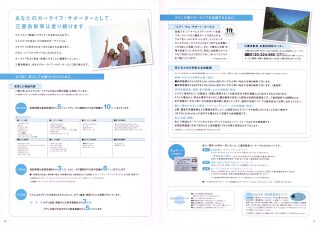
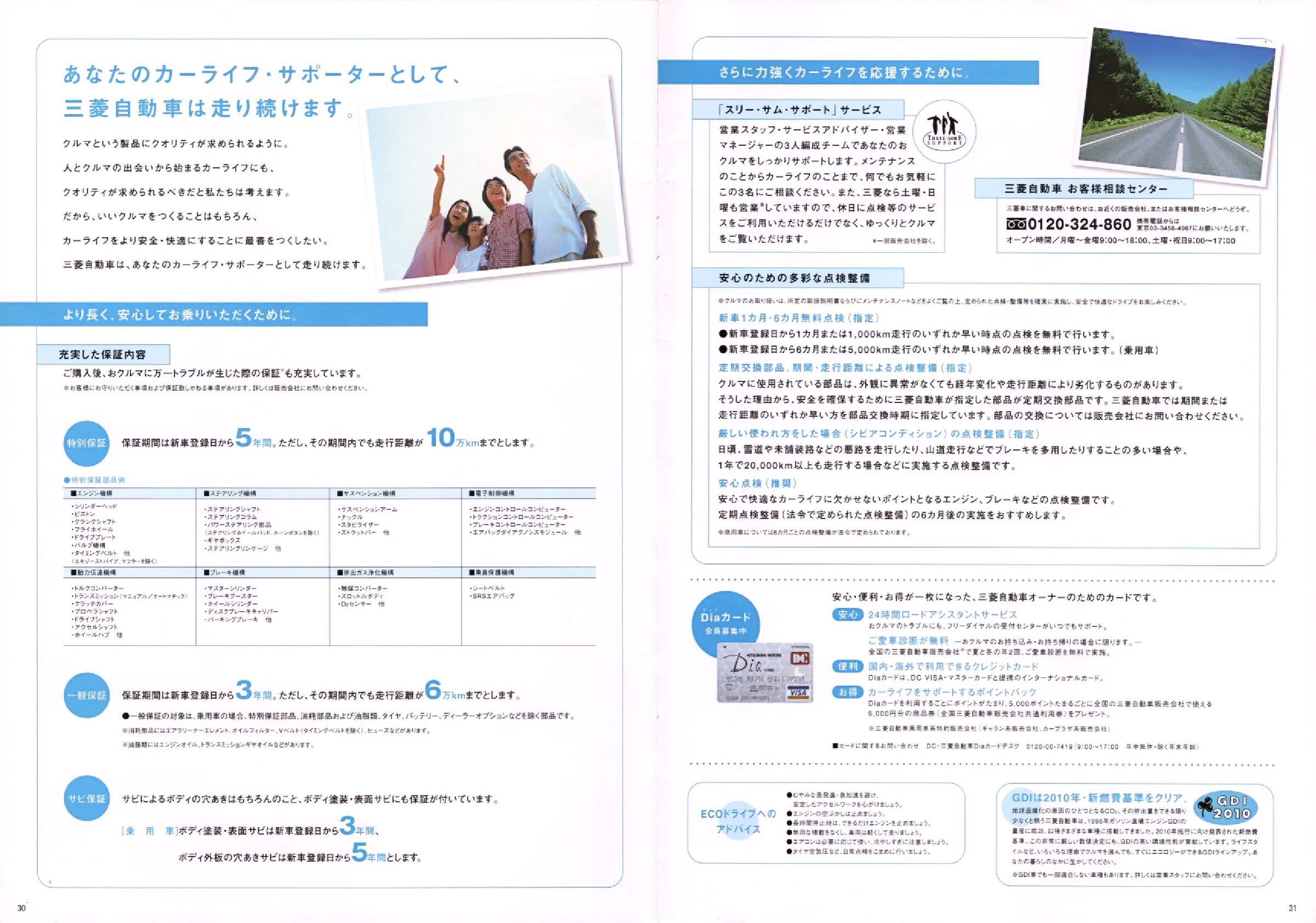
Just as quality is demanded of the product called a car, we believe quality should be demanded of the car life that begins when people meet cars too. So as well as building good cars, we want to do our very best to make car life safer and more comfortable. Mitsubishi Motors keeps on driving as your car life supporter.
After purchase, the warranty* should any trouble occur with your car is comprehensive too.
※ There are conditions the customer must follow and cases the warranty cannot cover. For details, please ask the dealer.
The warranty period is 5 years from the date of first registration, up to 100,000 km driven within that period.
| Engine | Steering | Suspension | Electronic control |
|---|---|---|---|
| Cylinder head; pistons; crankshaft; flywheel; drive plate; valve train; timing belt, etc. (excluding exhaust pipe and muffler) | Steering shaft; steering column; power steering parts (excluding steering wheel pad and horn button); gearbox; steering linkage, etc. | Suspension arms; knuckles; stabilizers; strut bars, etc. | Engine control computer; traction control computer; brake control computer; airbag diagnosis module, etc. |
| Drivetrain | Brakes | Exhaust purification | Occupant protection |
| Torque converter; transmission (manual/automatic); clutch cover; propeller shaft; drive shafts; axle shafts; wheel hubs, etc. | Master cylinder; brake booster; wheel cylinders; disc brake calipers; parking brake, etc. | Catalytic converter; throttle body; O2 sensor, etc. | Seat belts; SRS airbags |
The warranty period is 3 years from the date of first registration, up to 60,000 km driven within that period.
※ Consumables include the air cleaner element, oil filter, V-belts (excluding the timing belt), fuses, etc.
※ Lubricants include engine oil, transmission gear oil, etc.
As well as holes in the body caused by rust, body paint and surface rust are covered by warranty too.
[Passenger cars] Body paint and surface rust: 3 years from the date of first registration; perforation rust in the outer body panels: 5 years from the date of first registration.
A three-person team of sales staff, service advisor and sales manager supports your car fully. From maintenance to anything about car life, please feel free to talk to these three. And as Mitsubishi is also open on Saturdays and Sundays*, you can not only use services such as inspections on your days off, but also take your time looking at cars.
*Excluding some dealers.
THREE-SOME SUPPORT
For enquiries about Mitsubishi cars, please contact your nearest dealer or the Customer Consultation Center.
Free dial 0120-324-860. From mobile phones, please call Tokyo 03-3456-4967.
Opening hours: Monday to Friday 9:00 to 18:00, Saturdays and public holidays 9:00 to 17:00
※ Before using the car, read the owner's manual, maintenance notes, etc. carefully, carry out the required inspections and maintenance properly, and enjoy safe, comfortable driving.
New car 1-month and 6-month free inspections (specified)
Inspection and maintenance of periodic replacement parts by time and distance (specified)
Some of the parts used in a car deteriorate with age and distance driven, even when nothing looks wrong. For that reason, to ensure safety, the parts Mitsubishi Motors specifies are periodic replacement parts. Mitsubishi Motors specifies the time or distance, whichever comes first, as when the part is replaced. For replacing parts, please ask the dealer.
Inspection and maintenance for harsh use (severe conditions) (specified)
Inspection and maintenance carried out when the car is often driven on rough roads such as snowy or unpaved roads, often uses the brakes a lot, for example on mountain roads, or is driven more than 20,000 km in a year.
Peace-of-mind inspection (recommended)
Inspection and maintenance of the engine, brakes and other key points for a safe, comfortable car life. We recommend it 6 months after the periodic inspection and maintenance (the inspection and maintenance required by law).
※ For commercial vehicles, inspection and maintenance every 6 months is required by law.
The card for Mitsubishi Motors owners, with peace of mind, convenience and value in one.
Peace of mind: 24-hour road assistance service
If your car has trouble, the free-dial reception center supports you at any time.
Free car checkup (only when you bring the car in and take it home yourself)
At Mitsubishi Motors dealers* nationwide, a free car checkup twice a year, in summer and winter.
Convenience: a credit card for use in Japan and abroad
The Dia Card is an international card in partnership with DC, VISA and MasterCard.
Value: points back to support your car life
Every time you use the Dia Card you collect points, and for every 5,000 points you receive ¥5,000 of vouchers (common to Mitsubishi Motors dealers nationwide) for use at Mitsubishi Motors dealers nationwide.
※ Mitsubishi Motors passenger car franchised dealers (Galant dealers and Car Plaza dealers)
Mitsubishi Motors, wishing to keep CO2, one of the causes of global warming, as low as possible, succeeded in mass-producing the GDI gasoline direct injection engine in 1996, and has since fitted it to a wide range of models. The new fuel economy standards were announced for introduction in 2010. GDI's high environmental performance also contributed to setting these very strict figures. Whatever your reason for choosing a car, such as your lifestyle, the GDI line-up lets you be ecological straight away. Make it part of your life.
※ Some GDI models do not meet them. For details, please ask our sales staff.
GDI 2010
Dimensions on the drawings:
a: 1185 Interior height b: 885 (860: Center seat) c: 470 (455: Center seat)
GSR (unit = mm)
3SXGA8A011(01-01)
Seat belts and child seats, properly. Speed kept down. Safety is Mitsubishi's wish.
※ Before using the car, read the owner's manual, maintenance notes, etc. carefully, carry out the required inspections and maintenance properly, and enjoy safe, comfortable driving.
Heart-Beat Motors
MITSUBISHI MOTORS
www.mitsubishi-motors.co.jp
Mitsubishi Motors Corporation / 5-33-8 Shiba, Minato-ku, Tokyo 108-8410
Mitsubishi's Japanese brochure for the CT9A Lancer Evolution VII, printed in January 2001 when the car was launched, covering the GSR and the RS competition base car with engine, 4WD systems, chassis, equipment, colors, specifications and list prices, and the Lancer Evolution's WRC results from 1993 to 2000.
Reproduced for archival and reference purposes. Mitsubishi, its model names, logos and the images in this brochure are the trademarks and copyright of their owners; NENGUN is not affiliated with or endorsed by Mitsubishi. If you hold rights in this material and object to it appearing here, contact us and we will remove it promptly.