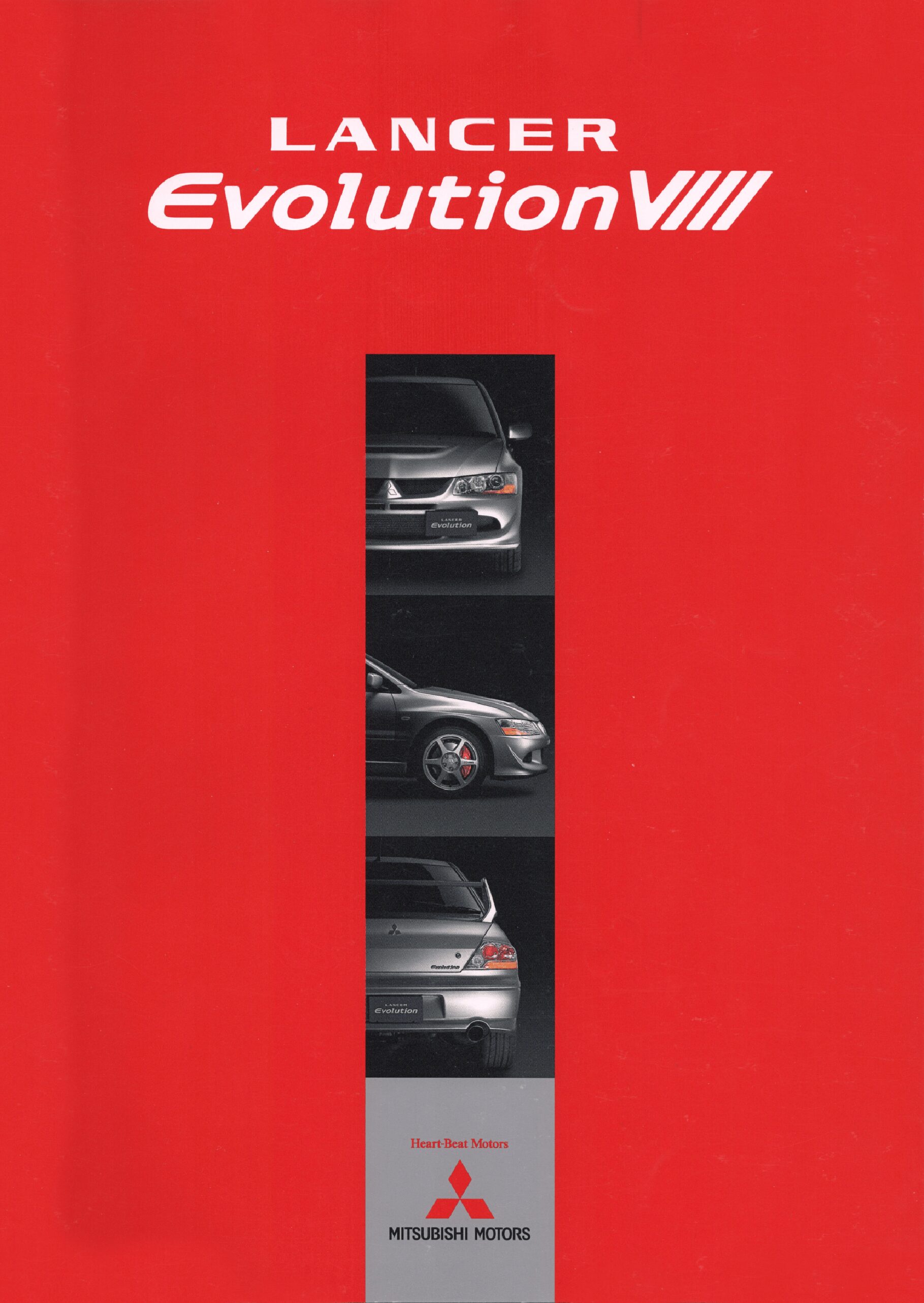
LANCER
Evolution VIII
Heart-Beat Motors
MITSUBISHI MOTORS
Your trusted source of JDM parts shipped direct from Japan

Japan · January 2003
Turn for full screen
Nothing to translate on this page.
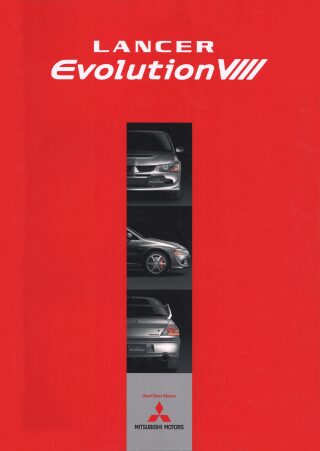
LANCER
Evolution VIII
Heart-Beat Motors
MITSUBISHI MOTORS
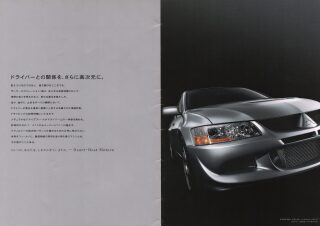
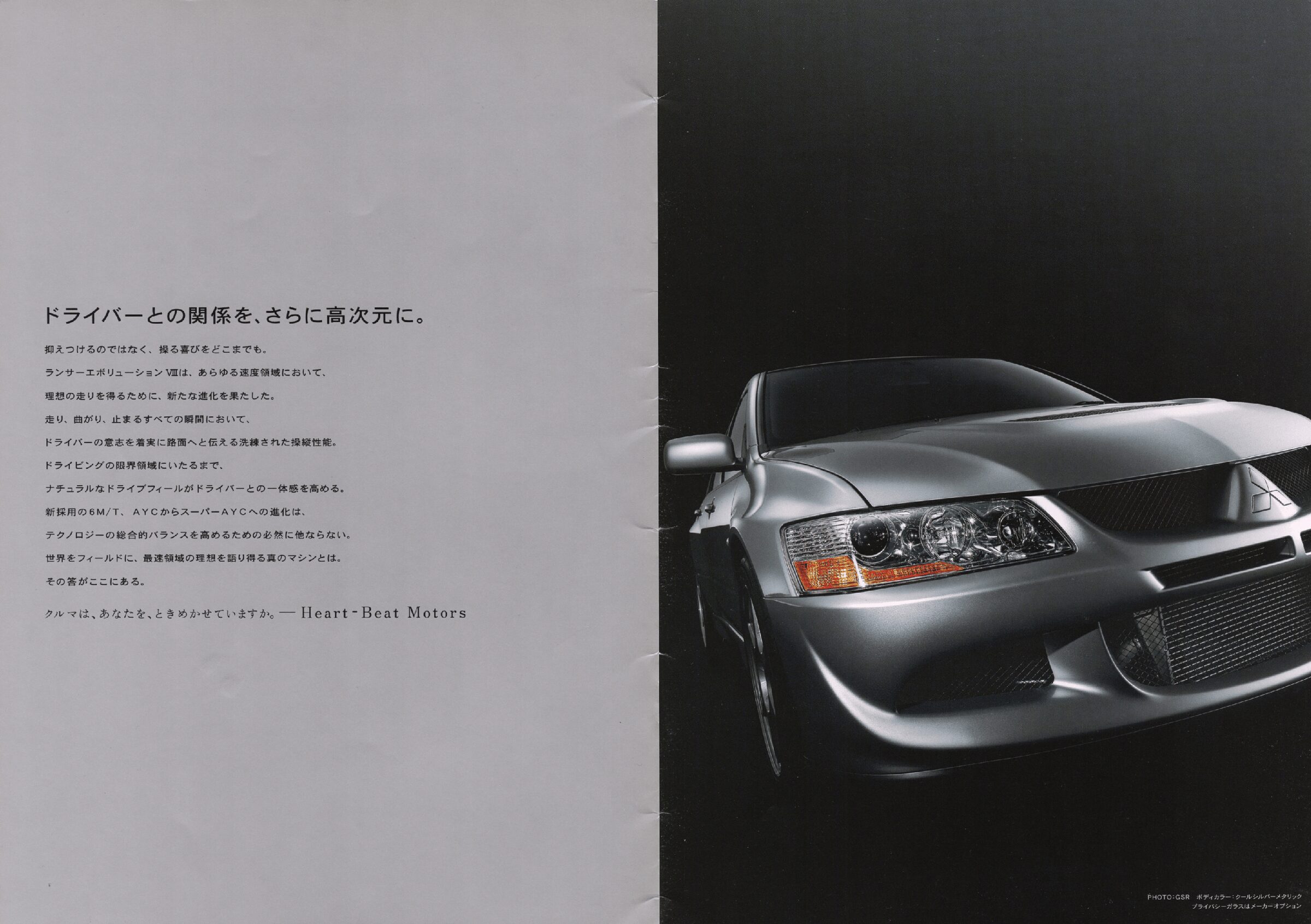
Not held down, but the joy of control, as far as it goes. Lancer Evolution VIII has evolved again, for ideal driving at every speed. At every moment of going, turning and stopping, refined handling delivers the driver's intentions surely to the road. Right up to the limits of driving, a natural drive feel strengthens the sense of being one with the driver. The newly adopted 6M/T and the evolution from AYC to Super AYC were essential to raise the overall balance of the technology. What is the true machine, with the world as the field, that can speak for the ideal at the very fastest? The answer is here.
Does your car make your heart beat faster? — Heart-Beat Motors
PHOTO: GSR
Body color: Cool Silver Metallic
Privacy glass is a maker option
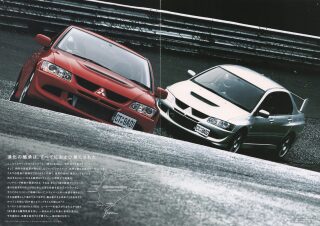
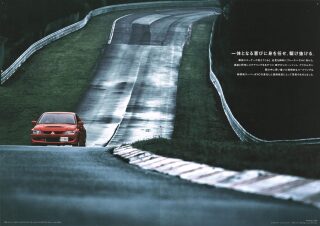
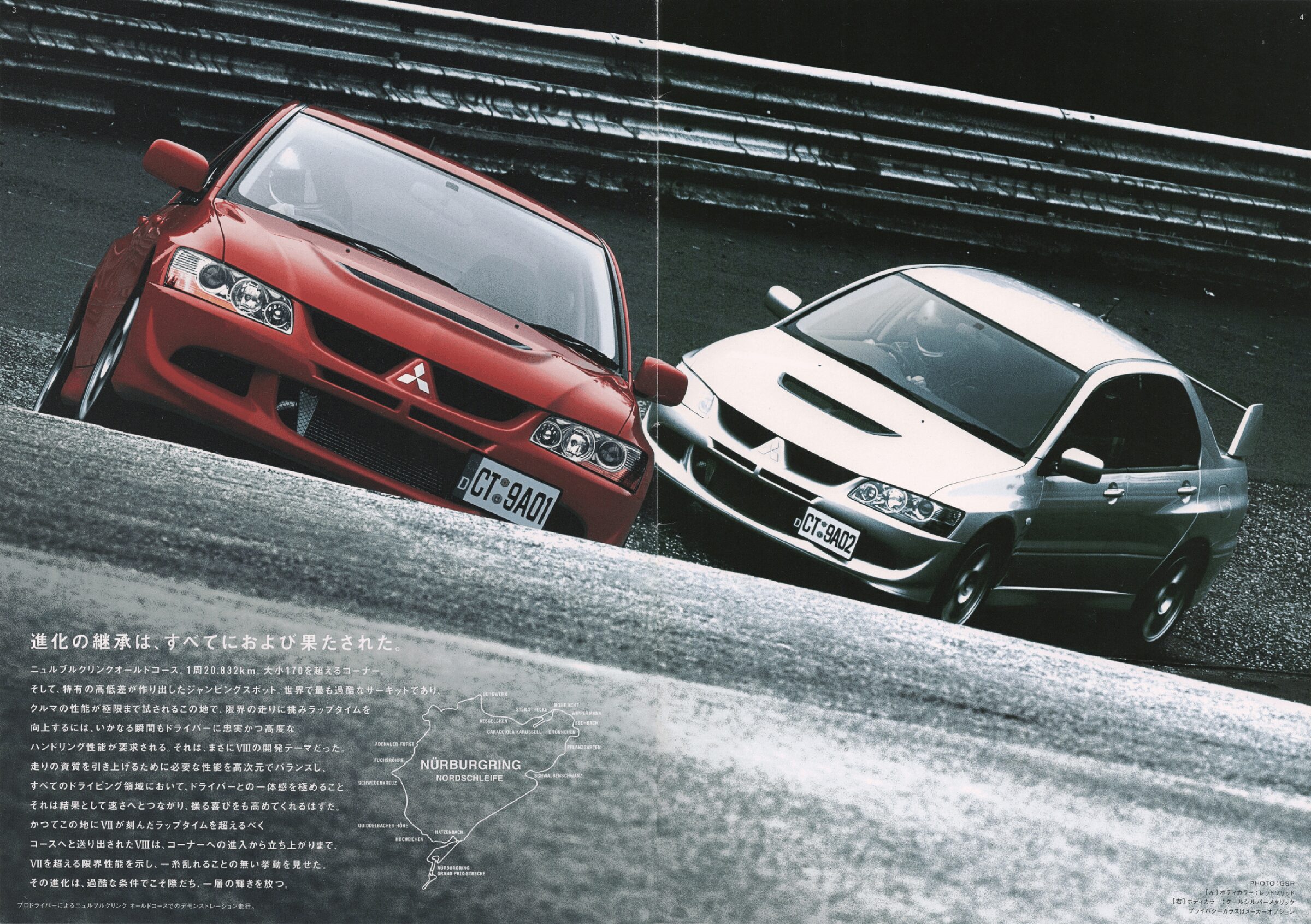
The Nürburgring old course. 20.832 km a lap. More than 170 corners, large and small. And the jumping spots made by the particular changes in height. The harshest circuit in the world, where a car's performance is tested to the limit: to take on driving at the limit here and improve the lap time, handling that is faithful to the driver and of a high order is needed at every moment. That was exactly VIII's development theme. To balance at a high level the performance needed to raise the quality of driving, and to perfect the sense of being one with the driver in every driving range. As a result, that should lead to speed and heighten the joy of control too. Sent onto the course to beat the lap time VII set here, VIII showed limit performance beyond VII's, from corner entry to exit, with behavior that never lost composure. That evolution stands out all the more in harsh conditions, shining all the brighter.
Demonstration driving by a professional driver on the Nürburgring old course.
The circuit map is labeled:
PHOTO: GSR
[Left] Body color: Red Solid
[Right] Body color: Cool Silver Metallic
Privacy glass is a maker option
Demonstration driving by a professional driver on the Nürburgring old course.
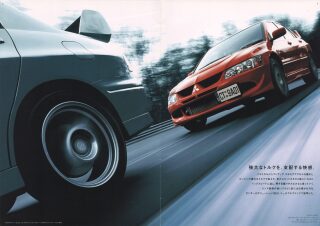
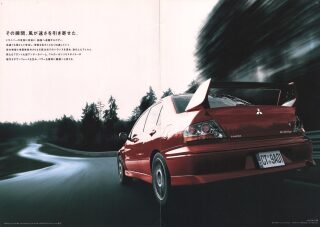
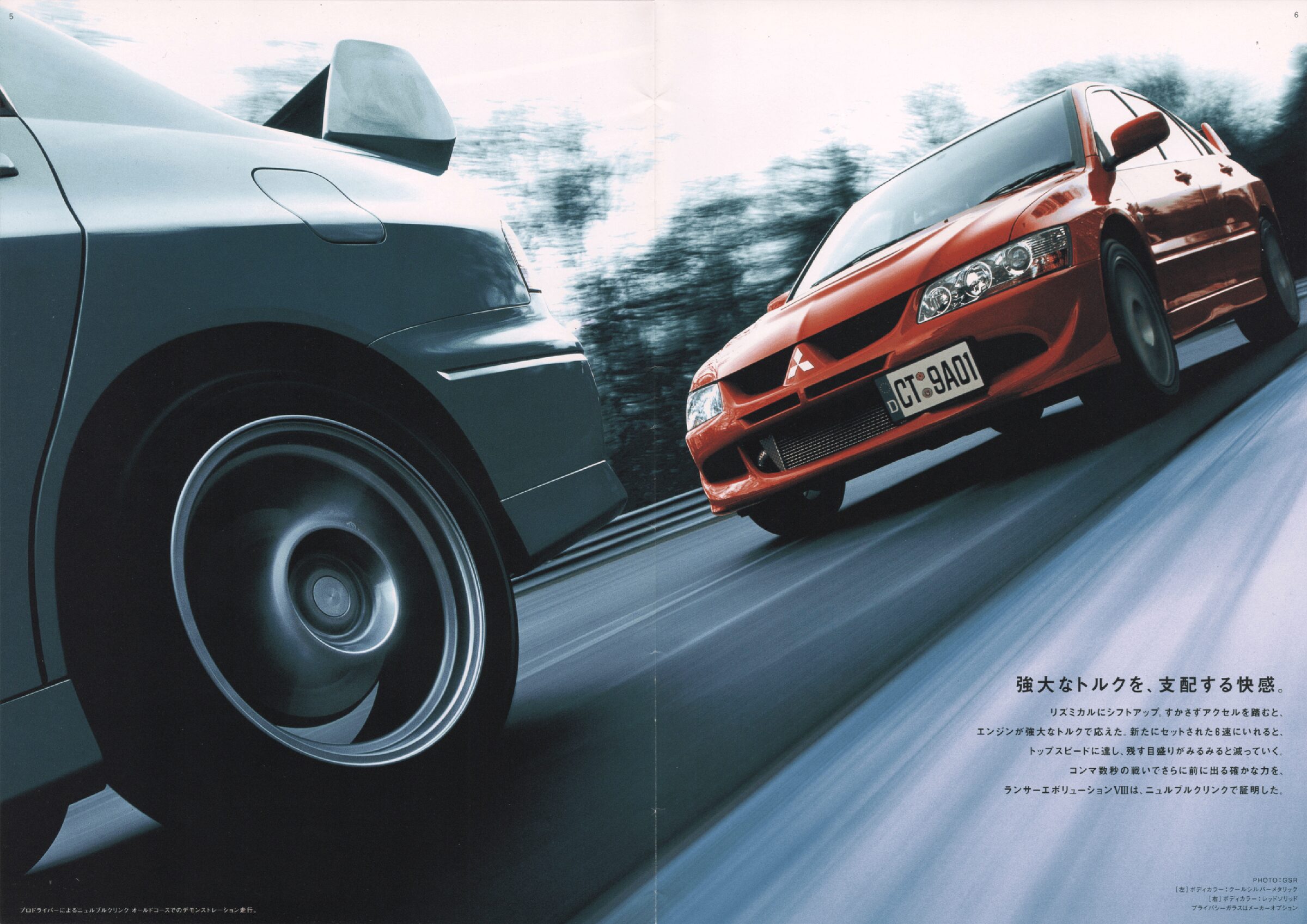
A rhythmic upshift. Press the accelerator straight away, and the engine answers with immense torque. Into the newly added sixth gear, it reaches top speed as the scale left to climb rapidly shrinks. Lancer Evolution VIII proved at the Nürburgring the sure power to pull further ahead in a fight measured in tenths of a second.
PHOTO: GSR
[Left] Body color: Cool Silver Metallic
[Right] Body color: Red Solid
Privacy glass is a maker option
Demonstration driving by a professional driver on the Nürburgring old course.
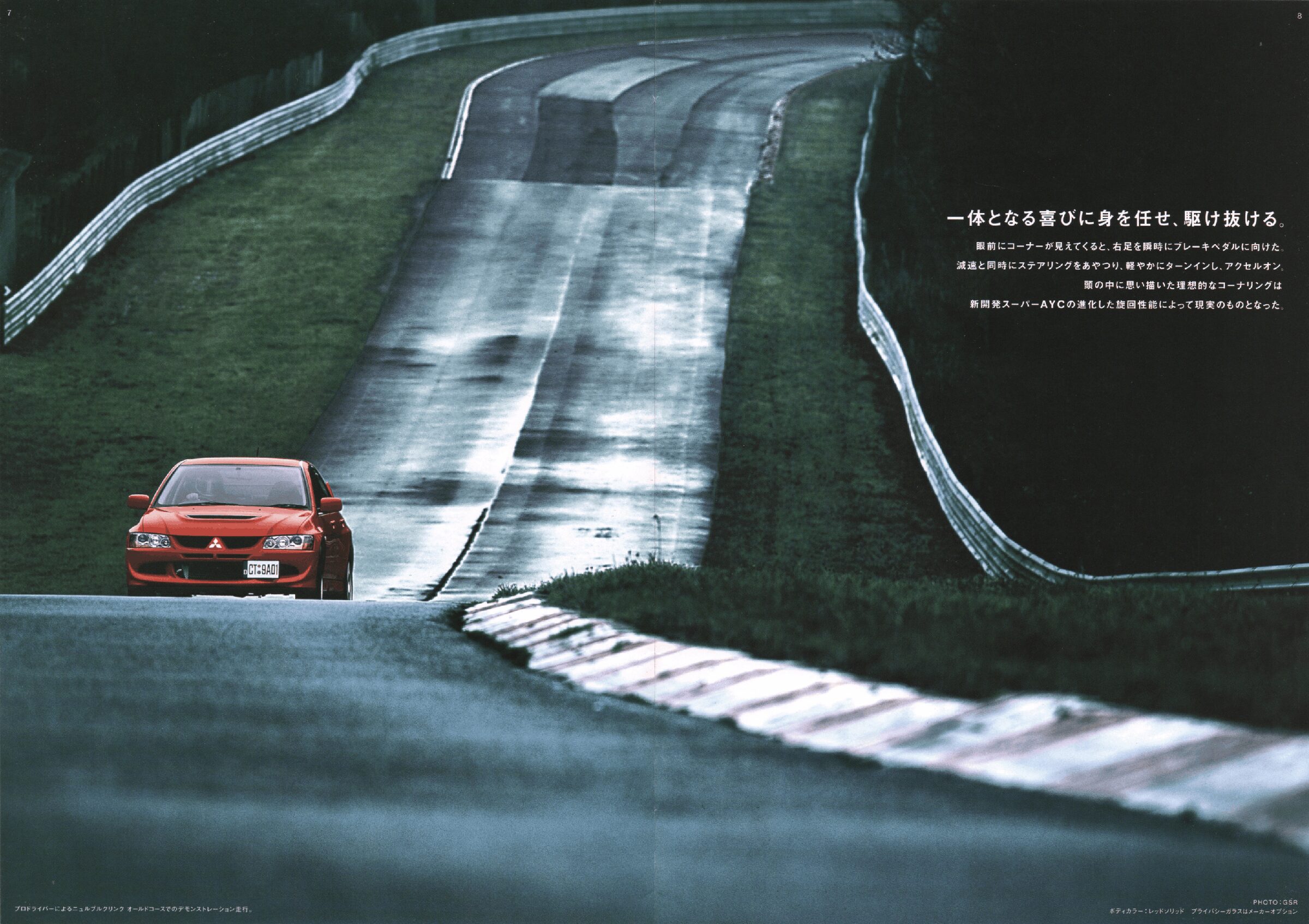
As a corner comes into view, the right foot moves instantly to the brake pedal. Steering while slowing, a light turn-in, then on the accelerator. The ideal cornering pictured in the mind became real through the evolved turning performance of the newly developed Super AYC.
PHOTO: GSR
Body color: Red Solid
Privacy glass is a maker option
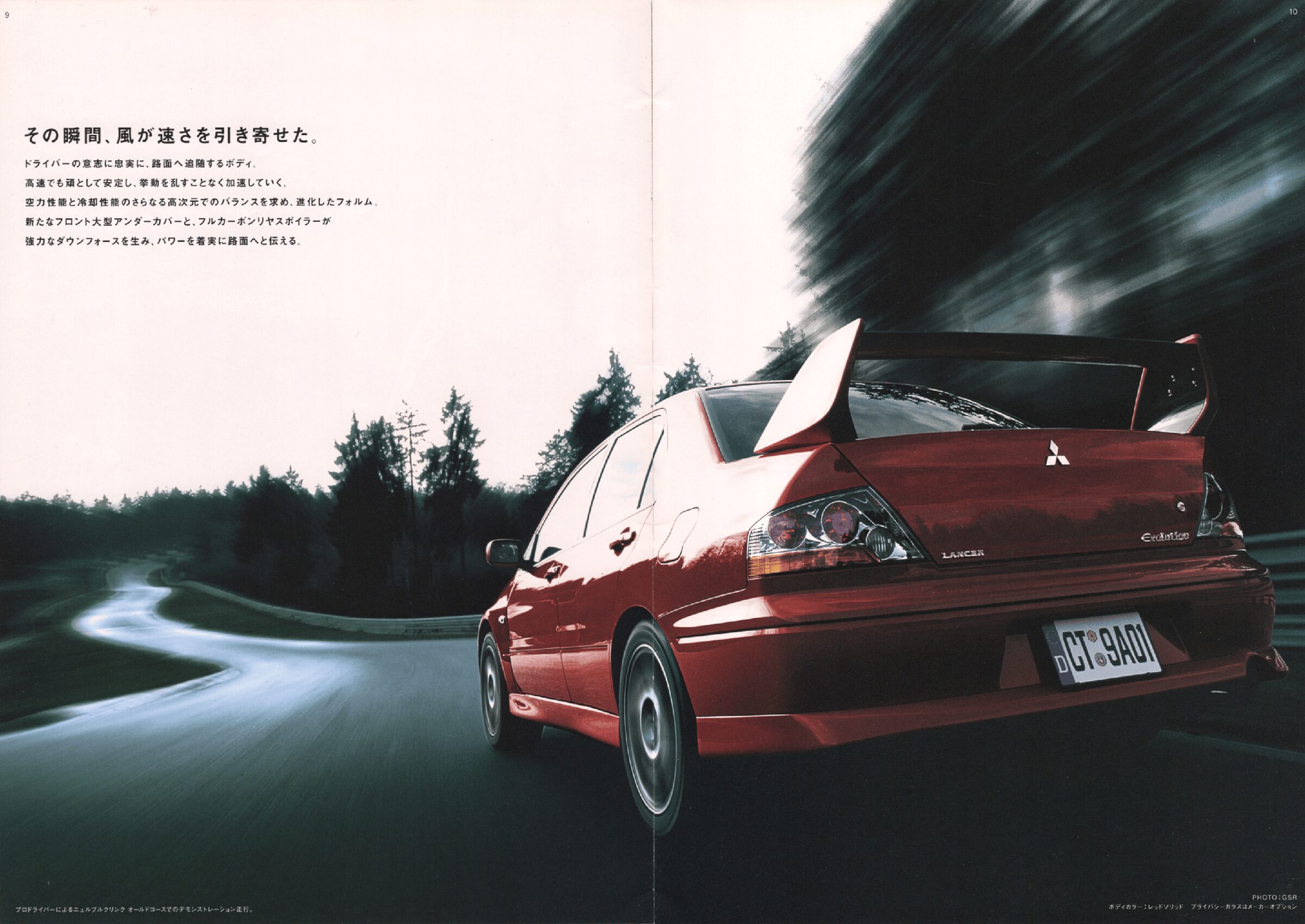
A body that follows the road faithfully to the driver's will. Firmly stable even at high speed, it accelerates without the behavior ever becoming unsettled. A form evolved in search of a still higher balance of aerodynamics and cooling. The new large front under cover and the full carbon rear spoiler create strong downforce and deliver the power surely to the road.
Demonstration driving by a professional driver on the Nürburgring old course.
PHOTO: GSR
Body color: Red Solid
Privacy glass is a maker option
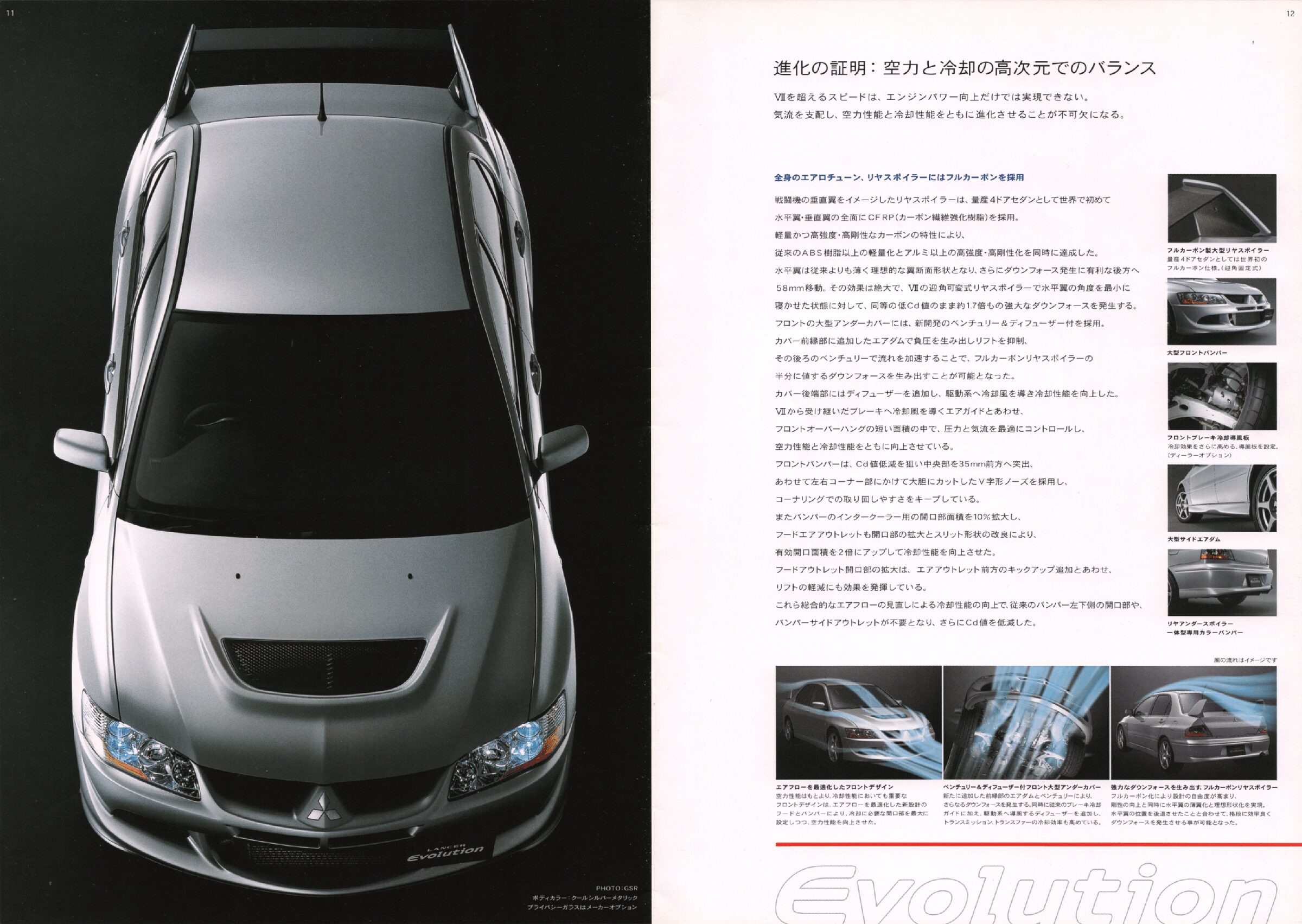
PHOTO: GSR
Body color: Cool Silver Metallic
Privacy glass is a maker option
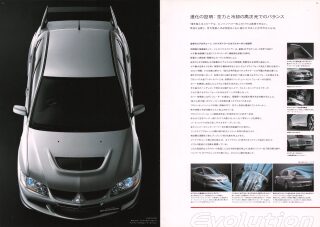
Speed beyond VII cannot come from more engine power alone. Commanding the airflow, and evolving aerodynamics and cooling together, is essential.
The rear spoiler, inspired by a fighter plane's vertical tail, is the world's first on a mass-production 4-door sedan to use CFRP (carbon fiber reinforced plastic) for the whole of both the horizontal and vertical wings. Thanks to the properties of carbon, light, strong and rigid, it is lighter than the previous ABS resin and at the same time stronger and more rigid than aluminum. The horizontal wing is thinner than before, with an ideal wing section, and has moved 58 mm rearward, where it makes downforce more easily. The effect is huge: compared with VII's adjustable-angle rear spoiler with the horizontal wing at the flattest angle, it makes about 1.7 times as much downforce at the same low Cd. The large front under cover uses a newly developed venturi & diffuser. An air dam added to the front edge of the cover creates negative pressure and suppresses lift, and the venturi behind it speeds up the flow, so it can make downforce worth half that of the full carbon rear spoiler. A diffuser added to the rear end of the cover guides cooling air to the drivetrain, improving cooling. Together with the air guides that lead cooling air to the brakes, carried over from VII, pressure and airflow are controlled as well as possible within the small area of the short front overhang, improving both aerodynamics and cooling. The center of the front bumper projects 35 mm further forward to lower the Cd, and with the V-shaped nose boldly cut away toward the left and right corners, the car stays easy to place in corners. The bumper's intercooler opening is 10% larger, and the hood air outlet, with a larger opening and improved slit shape, has twice the effective opening area, improving cooling. The larger hood outlet opening, with a kick-up added ahead of the air outlet, also helps reduce lift. With cooling improved by this overall review of the airflow, the openings at the lower left of the previous bumper and the bumper side outlets are no longer needed, lowering the Cd further.
Full carbon large rear spoiler
The world's first full carbon spoiler on a mass-production 4-door sedan. (Fixed angle of attack)
Large front bumper
Front brake cooling guide
A guide plate that raises the cooling effect further. (Dealer option)
Large side air dams
Dedicated color-keyed bumper with integrated rear under spoiler
The airflow shown is an illustration.
Front design with optimized airflow
The newly designed hood and bumper of the front design, important for cooling as well as aerodynamics, optimize the airflow, making the openings needed for cooling as large as possible while improving aerodynamics.
Large front under cover with venturi & diffuser
The newly added air dam at the front edge and the venturi make further downforce. As well as the previous brake cooling guides, an added diffuser leading air to the drivetrain also improves cooling of the transmission and transfer.
Full carbon rear spoiler that makes strong downforce
Full carbon gives more design freedom, allowing a thinner horizontal wing with an ideal shape while making it more rigid. Together with moving the horizontal wing rearward, it can make downforce far more efficiently.
Evolution
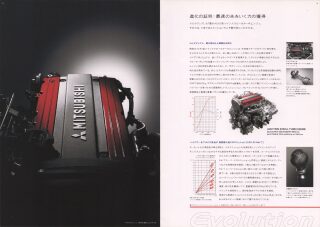
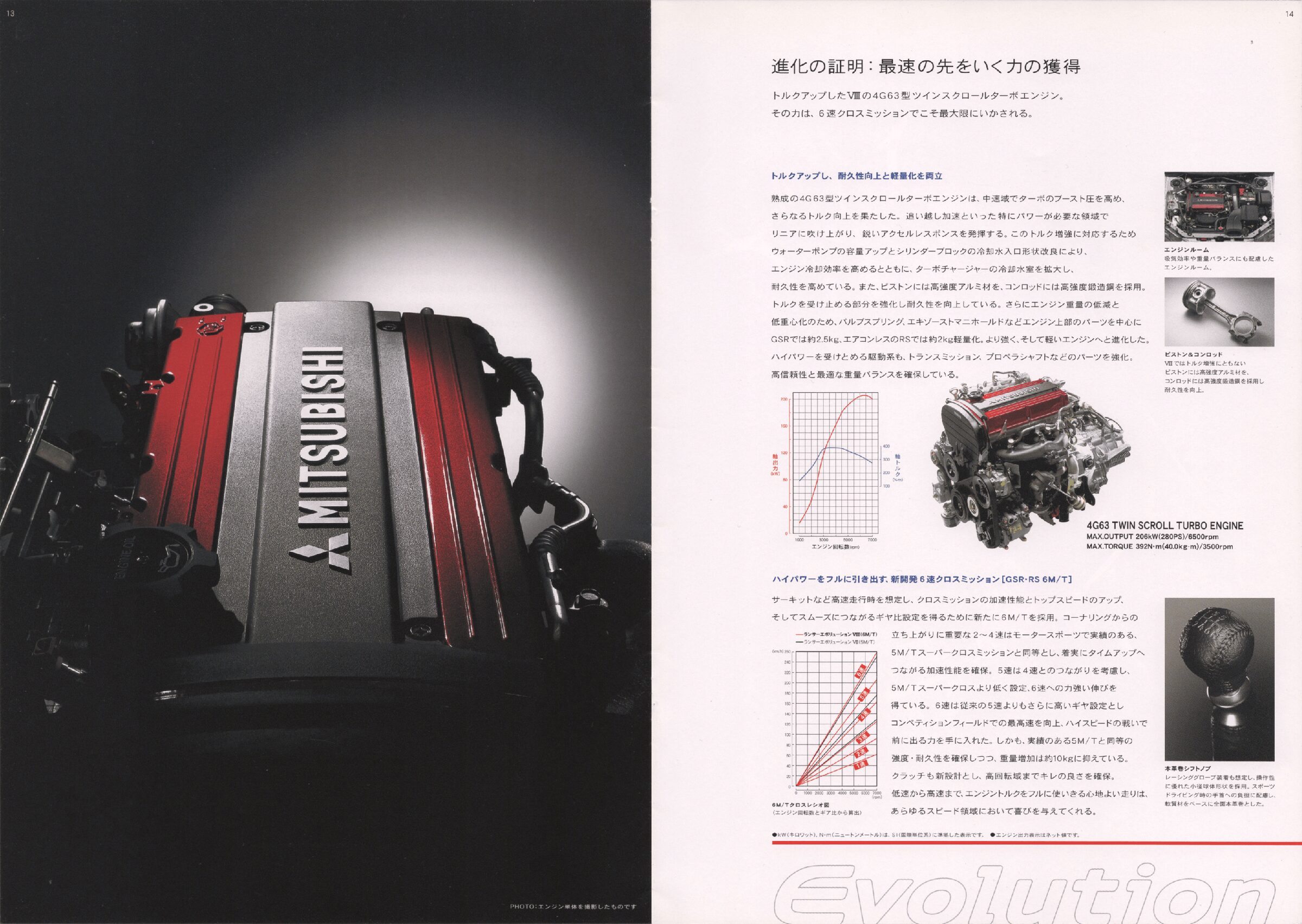
PHOTO: the engine photographed alone
VIII's 4G63 twin scroll turbo engine, with more torque. The 6-speed close-ratio transmission makes the most of that power.
The mature 4G63 twin scroll turbo engine raises the turbo boost pressure in the mid range for still more torque. Where power is needed most, as when accelerating to overtake, it revs up linearly with sharp accelerator response. To handle this extra torque, a higher-capacity water pump and an improved shape of the cylinder block's coolant inlet raise engine cooling efficiency, and a larger turbocharger water jacket improves durability. High-strength aluminum is used for the pistons and high-strength forged steel for the connecting rods, strengthening the parts that take the torque and improving durability. To reduce engine weight and lower the center of gravity, parts mainly at the top of the engine, such as the valve springs and exhaust manifold, are about 2.5 kg lighter on the GSR and about 2 kg lighter on the RS without air conditioning. It has evolved into a stronger, lighter engine. In the drivetrain that takes the high power, parts such as the transmission and propeller shaft are strengthened too, ensuring high reliability and the best weight balance.
Engine room
An engine room designed with intake efficiency and weight balance in mind.
Piston & connecting rod
In VIII, with the extra torque, high-strength aluminum is used for the pistons and high-strength forged steel for the connecting rods, improving durability.
The chart is labeled:
4G63 TWIN SCROLL TURBO ENGINE
MAX.OUTPUT 206kW(280PS)/6500rpm
MAX.TORQUE 392N·m(40.0kg-m)/3500rpm
With high-speed driving such as on a circuit in mind, a 6M/T is newly adopted for better acceleration and top speed from close ratios, and for gear ratios that connect smoothly. 2nd to 4th gears, important for exiting corners, are the same as in the 5M/T super close-ratio transmission with a proven record in motorsport, ensuring acceleration that leads surely to better lap times. 5th gear is set lower than in the 5M/T super close, considering the step from 4th, giving strong pull into 6th. 6th is geared higher still than the previous 5th, raising top speed in competition and giving the power to pull ahead in high-speed battles. While keeping the strength and durability of the proven 5M/T, the extra weight is held to about 10 kg. The clutch is newly designed too, staying crisp right up to high revs. Driving that uses the engine's torque to the full, from low speed to high, brings pleasure at every speed.
The chart is labeled:
6M/T close-ratio chart
(Calculated from engine speed and gear ratios)
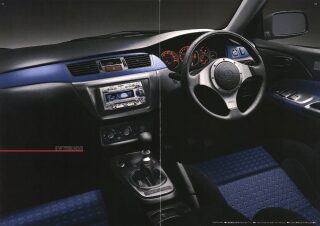
Leather-wrapped shift knob
A small spherical shape that is easy to use, designed with racing gloves in mind too. To ease the strain on the wrist in sports driving, it is fully wrapped in leather over a soft base.
Evolution
PHOTO: GSR
Body color: Cool Silver Metallic
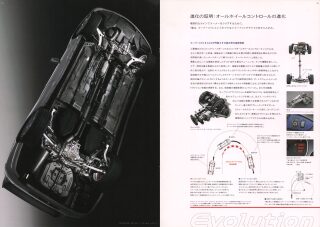
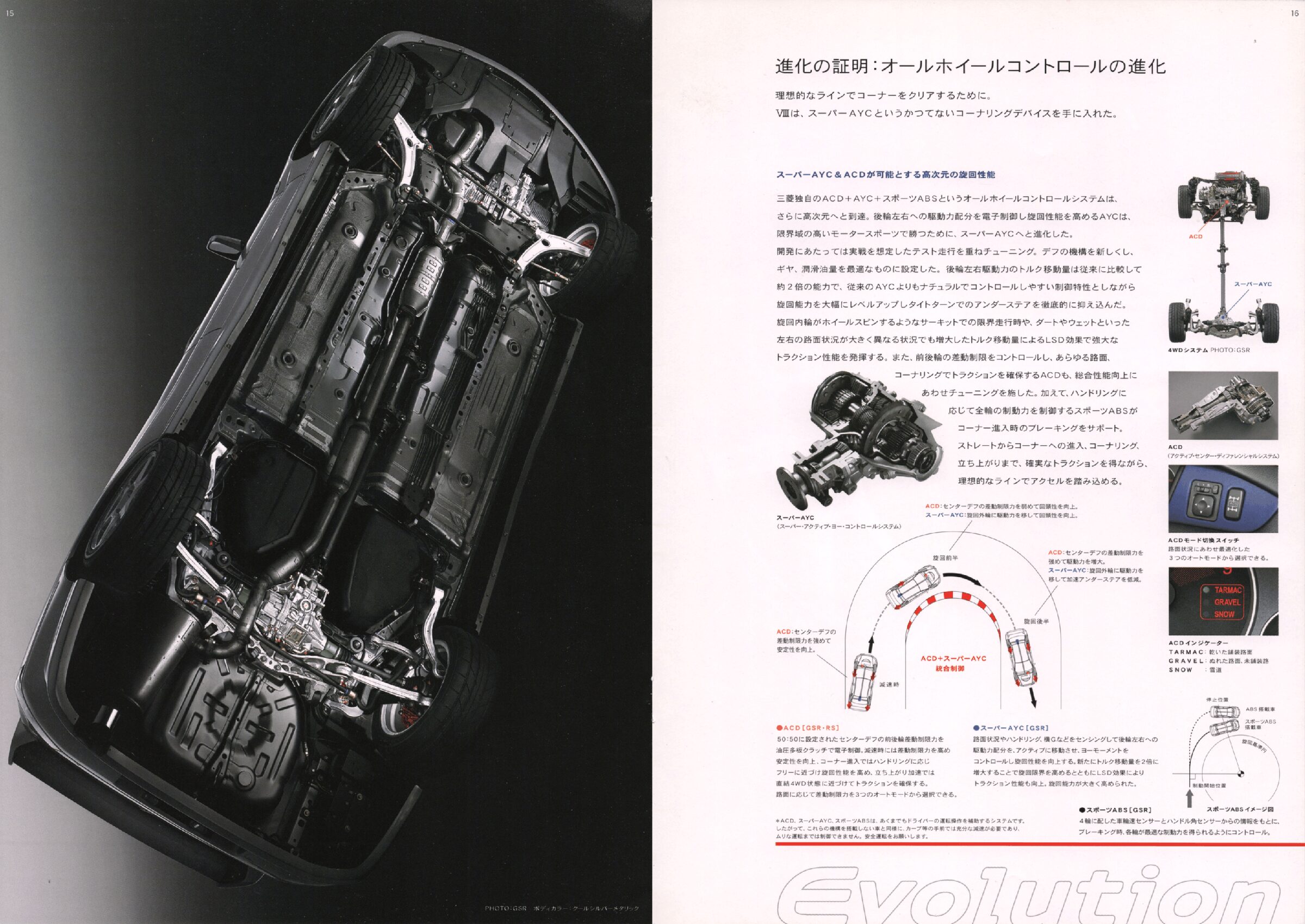
To take corners on the ideal line, VIII has gained an unprecedented cornering device: Super AYC.
Mitsubishi's all-wheel control system of ACD + AYC + Sports ABS has reached a still higher level. AYC, which electronically controls the distribution of drive between the left and right rear wheels to improve turning, has evolved into Super AYC, to win in motorsport where the limits are high. In development it was tuned through repeated test driving with real competition in mind. The differential mechanism is new, and the gears and lubricating oil volume are optimized. With about twice the capacity of the previous unit to transfer torque between the left and right rear wheels, the control is more natural and easier to manage than the previous AYC, while turning ability is greatly raised and understeer in tight turns is thoroughly suppressed. At the limit on a circuit, where the inside wheel spins as the car turns, or where the surface differs greatly from left to right, as on dirt or in the wet, the LSD effect of the greater torque transfer gives powerful traction. The ACD, which controls the limiting of differential action between the front and rear wheels and secures traction in cornering on any surface, has also been tuned to match the overall gain in performance. In addition, Sports ABS, which controls the braking force of every wheel according to steering, supports braking on corner entry. From the straight into the corner, through the corner and out, the driver gains sure traction and can press the accelerator on the ideal line.
Super AYC
(Super Active Yaw Control system)
4WD system PHOTO: GSR
The photo is labeled:
ACD
(Active Center Differential system)
ACD mode switch
Choose from 3 auto modes, each optimized for the road surface.
ACD indicator
The cornering diagram is labeled:
ACD [GSR, RS]
The limiting of differential action between the front and rear wheels by the center differential, set at 50:50, is controlled electronically by a hydraulic multi-plate clutch. When slowing, the limiting force is raised for stability; on corner entry, it is brought close to free according to steering, sharpening turning; and when accelerating out, it is brought close to a locked 4WD state to secure traction. The limiting force can be chosen to suit the road from 3 auto modes.
Super AYC [GSR]
Sensing the road surface, steering, lateral G and so on, it actively moves the distribution of drive between the left and right rear wheels, controlling the yaw moment to improve turning. With the torque transfer newly doubled, the turning limit is raised, and the LSD effect also improves traction. Turning ability is greatly raised.
Sports ABS [GSR]
Using information from wheel speed sensors at all 4 wheels and a steering angle sensor, it controls each wheel to get the best braking force when braking.
Sports ABS illustration
*ACD, Super AYC and Sports ABS are systems that only assist the driver's operation. So, as with cars without these systems, enough slowing is needed before a curve and so on, and they cannot control unreasonable driving. Please drive safely.
Evolution
PHOTO: GSR
Body color: Cool Silver Metallic
Privacy glass is a maker option
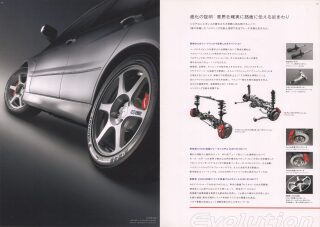
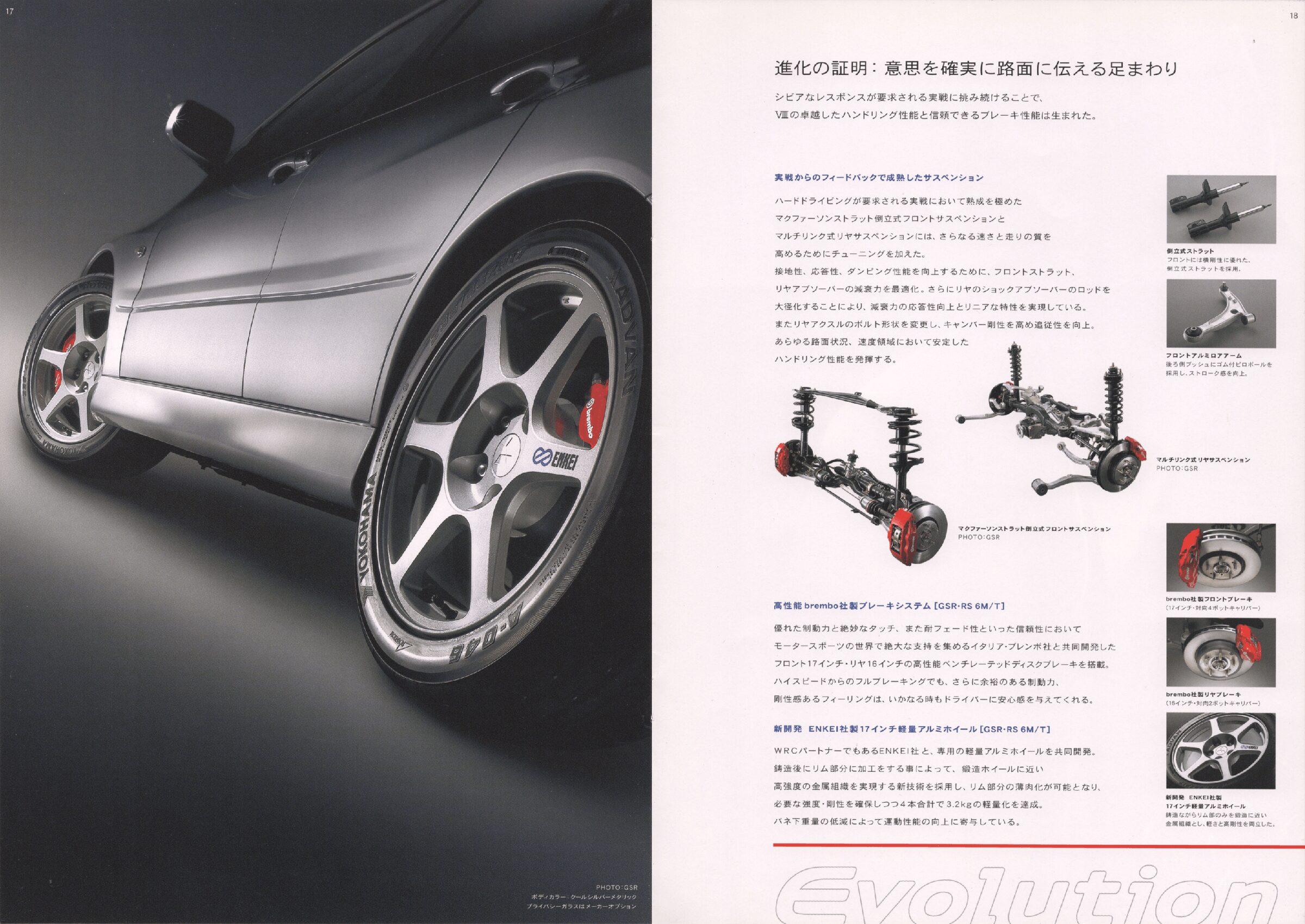
By continuing to take on real competition that demands sharp response, VIII's outstanding handling and dependable braking were born.
The MacPherson strut front suspension with inverted struts and the multi-link rear suspension, which reached full maturity in real competition demanding hard driving, have been tuned further for even more speed and a better quality of driving. To improve grip, response and damping, the damping force of the front struts and rear shock absorbers has been optimized. A larger-diameter rear shock absorber rod also gives quicker damping response and linear characteristics. The shape of the rear axle bolts has been changed too, raising camber rigidity and improving road-following. The result is stable handling on every road surface and at every speed.
Inverted struts
The front uses inverted struts, with excellent lateral rigidity.
Front aluminum lower arm
Rubber-bushed pillow balls at the rear bushings improve the feel of the suspension stroke.
Multi-link rear suspension
PHOTO: GSR
MacPherson strut front suspension with inverted struts
PHOTO: GSR
High-performance ventilated disc brakes, 17-inch at the front and 16-inch at the rear, developed jointly with Italy's Brembo, which has enormous support in the motorsport world for superb stopping power, fine touch and reliability such as fade resistance. Even under full braking from high speed, the stopping power in reserve and the rigid feel give the driver confidence at all times.
brembo front brakes
(17-inch, opposed 4-pot calipers)
brembo rear brakes
(16-inch, opposed 2-pot calipers)
Dedicated lightweight aluminum wheels developed jointly with ENKEI, also a WRC partner. A new technology that machines the rim after casting gives a high-strength metal structure close to that of a forged wheel. This allows a thinner rim, saving 3.2 kg across the four wheels while keeping the strength and rigidity needed. The lower unsprung weight contributes to better dynamic performance.
Newly developed ENKEI 17-inch lightweight aluminum wheels
Though cast, the rim alone has a metal structure close to a forged one, combining lightness with high rigidity.
Evolution
PHOTO: GSR
Body color: Cool Silver Metallic
Privacy glass is a maker option
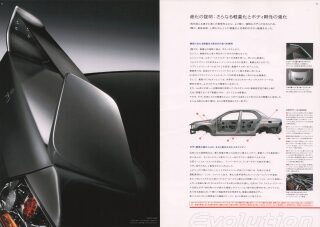
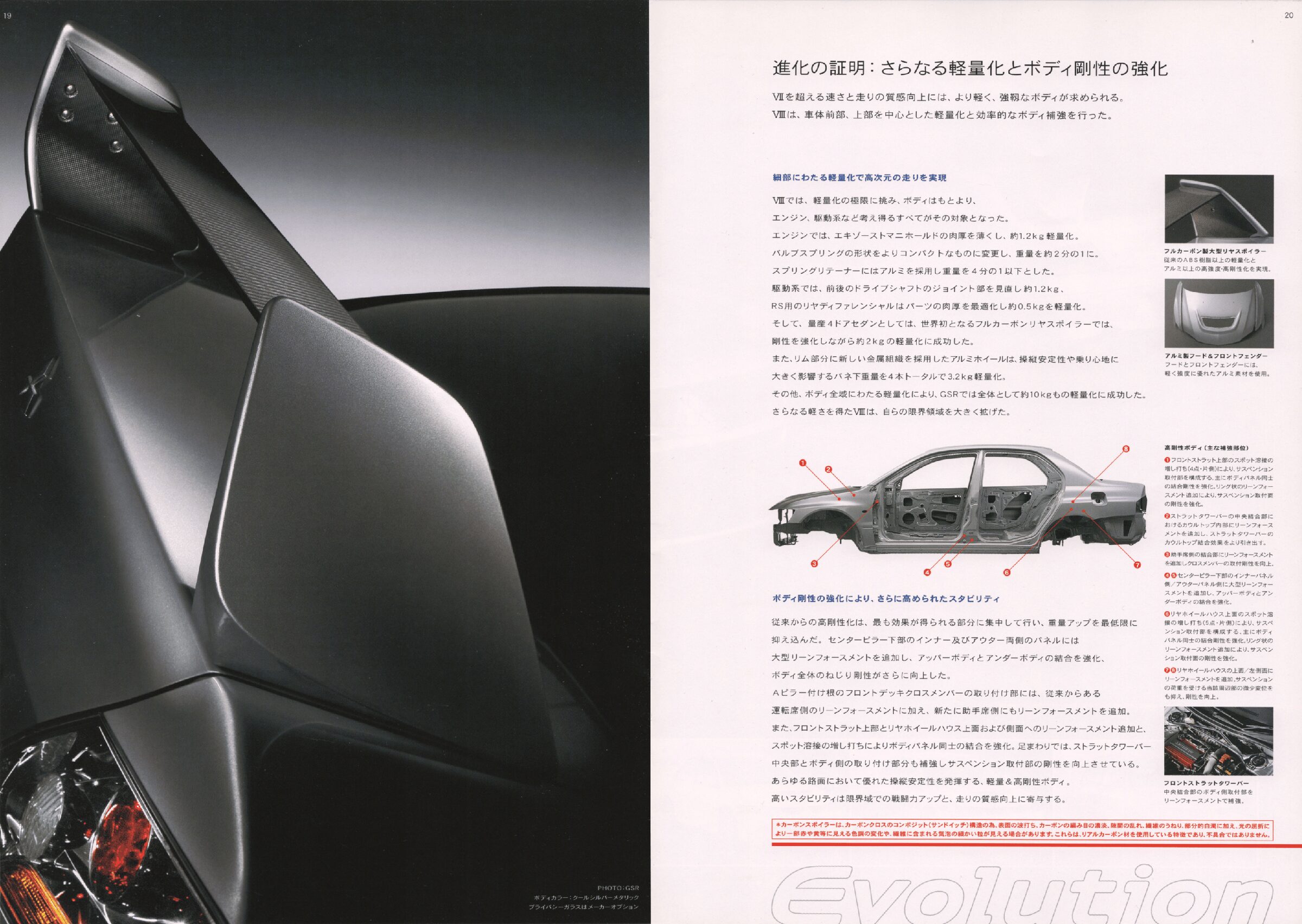
To go beyond VII in speed and in the quality of driving, a lighter, tougher body is needed. VIII is lightened mainly at the front and top of the body, and the body is reinforced efficiently.
For VIII, weight reduction was pushed to the limit, and everything conceivable became a target: not only the body, but the engine and drivetrain too. In the engine, thinner exhaust manifold walls save about 1.2 kg. Valve springs reshaped to be more compact weigh about half as much, and aluminum spring retainers weigh a quarter or less. In the drivetrain, revised joints in the front and rear driveshafts save about 1.2 kg, and optimized wall thickness of parts in the RS's rear differential saves about 0.5 kg. And the full carbon rear spoiler, a world first for a mass-production 4-door sedan, is about 2 kg lighter while being more rigid. The aluminum wheels, with a new metal structure in the rim, save 3.2 kg of unsprung weight across the four wheels, which strongly affects handling stability and ride comfort. With weight also saved throughout the body, the GSR is about 10 kg lighter overall. Lighter still, VIII has greatly widened the limits.
Full carbon large rear spoiler
Lighter than the previous ABS resin, with strength and rigidity higher than aluminum.
Aluminum hood & front fenders
The hood and front fenders are made of light, strong aluminum.
High-rigidity body (main reinforcement points)
The rigidity added so far was concentrated where it is most effective, keeping the added weight to a minimum. Large reinforcements on both the inner and outer panels at the bottom of the center pillar strengthen the joint between the upper body and the underbody, raising the torsional rigidity of the whole body further. At the mounting of the front deck crossmember at the base of the A-pillar, reinforcement is now added on the front passenger side as well as the existing one on the driver's side. Reinforcements added to the top of the front struts and to the top and sides of the rear wheelhouses, with extra spot welds, strengthen the joints between body panels. In the suspension, the center of the strut tower bar and the mountings on the body are reinforced too, raising the rigidity of the suspension mounts. A light, highly rigid body with excellent handling stability on any road. This high stability adds fighting power at the limit and a better quality of driving.
Front strut tower bar
The body-side mountings of the central joint are reinforced.
*Because the carbon spoiler is a composite (sandwich) construction of carbon cloth, the surface may show waviness, variations in the shade of the carbon weave, irregular gaps, wavy fibers and partial clouding, as well as changes in color that make parts look red or yellow as light is refracted, and fine bubbles in the fibers. These are characteristics of real carbon material and are not defects.
Evolution
PHOTO: GSR
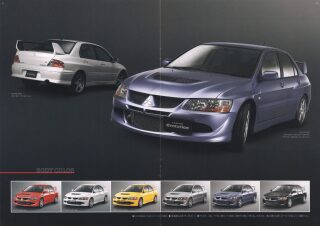
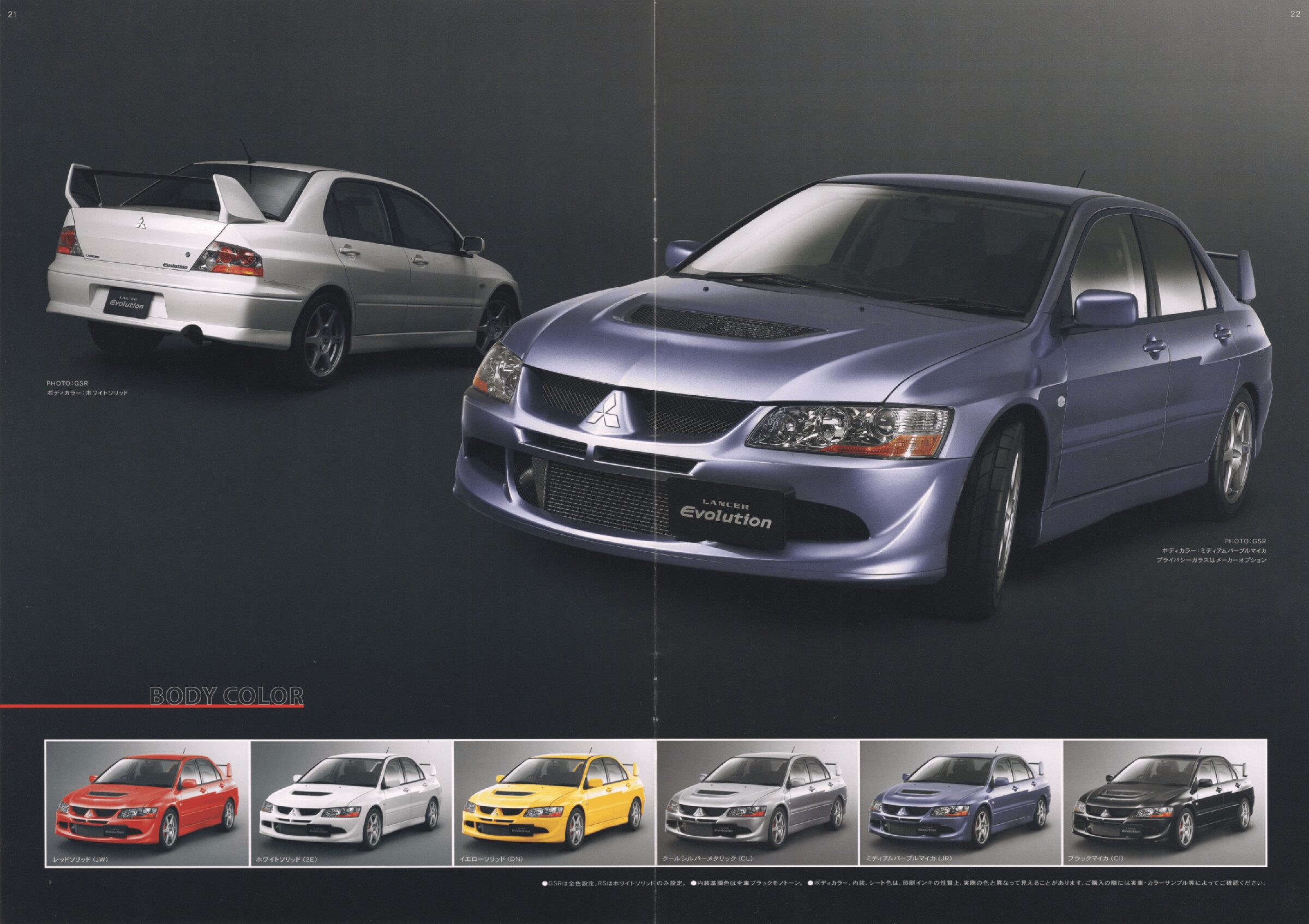
Body color: White Solid
PHOTO: GSR
Body color: Medium Purple Mica
Privacy glass is a maker option
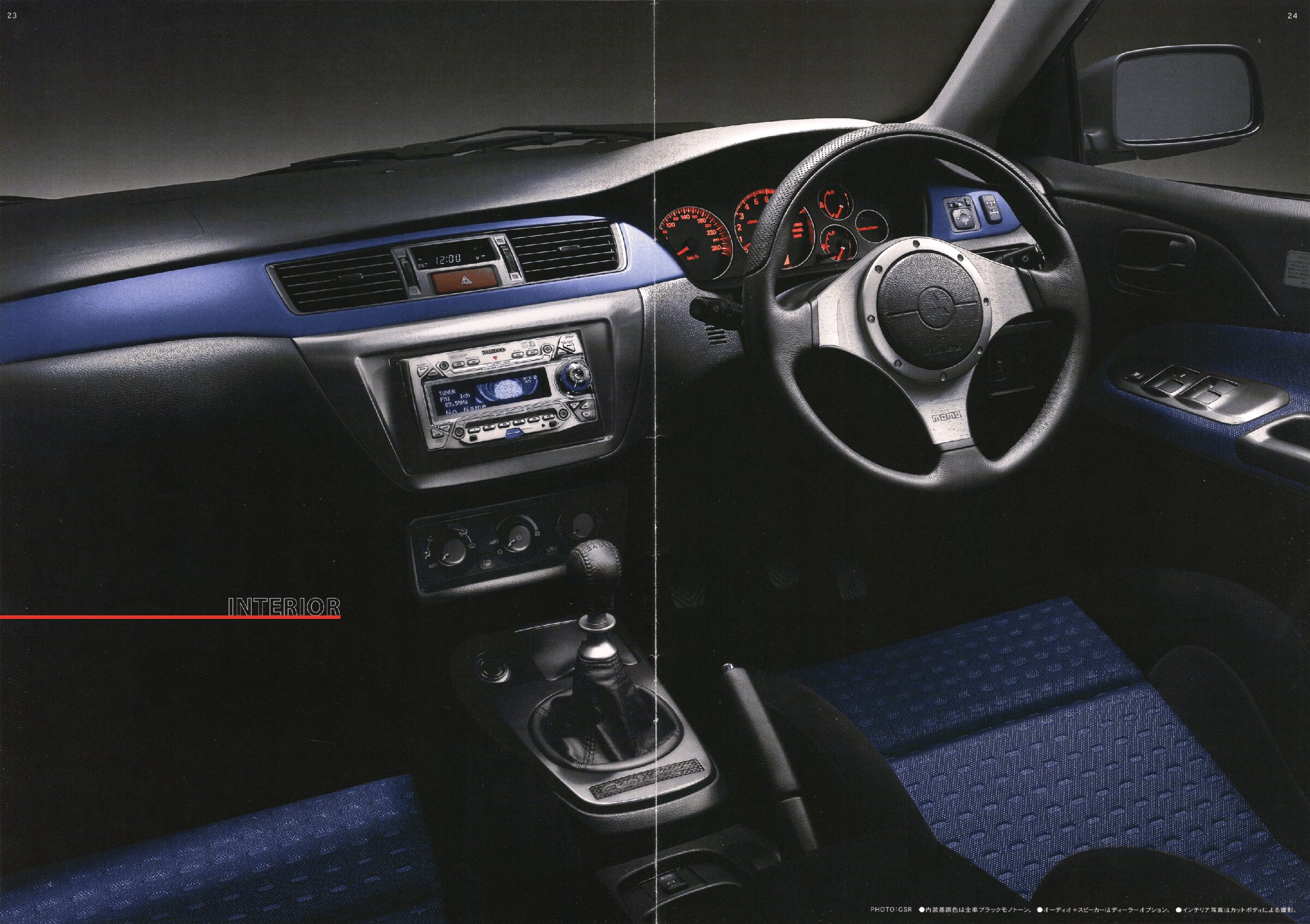
PHOTO: GSR
PHOTO: GSR
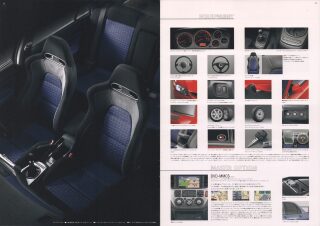
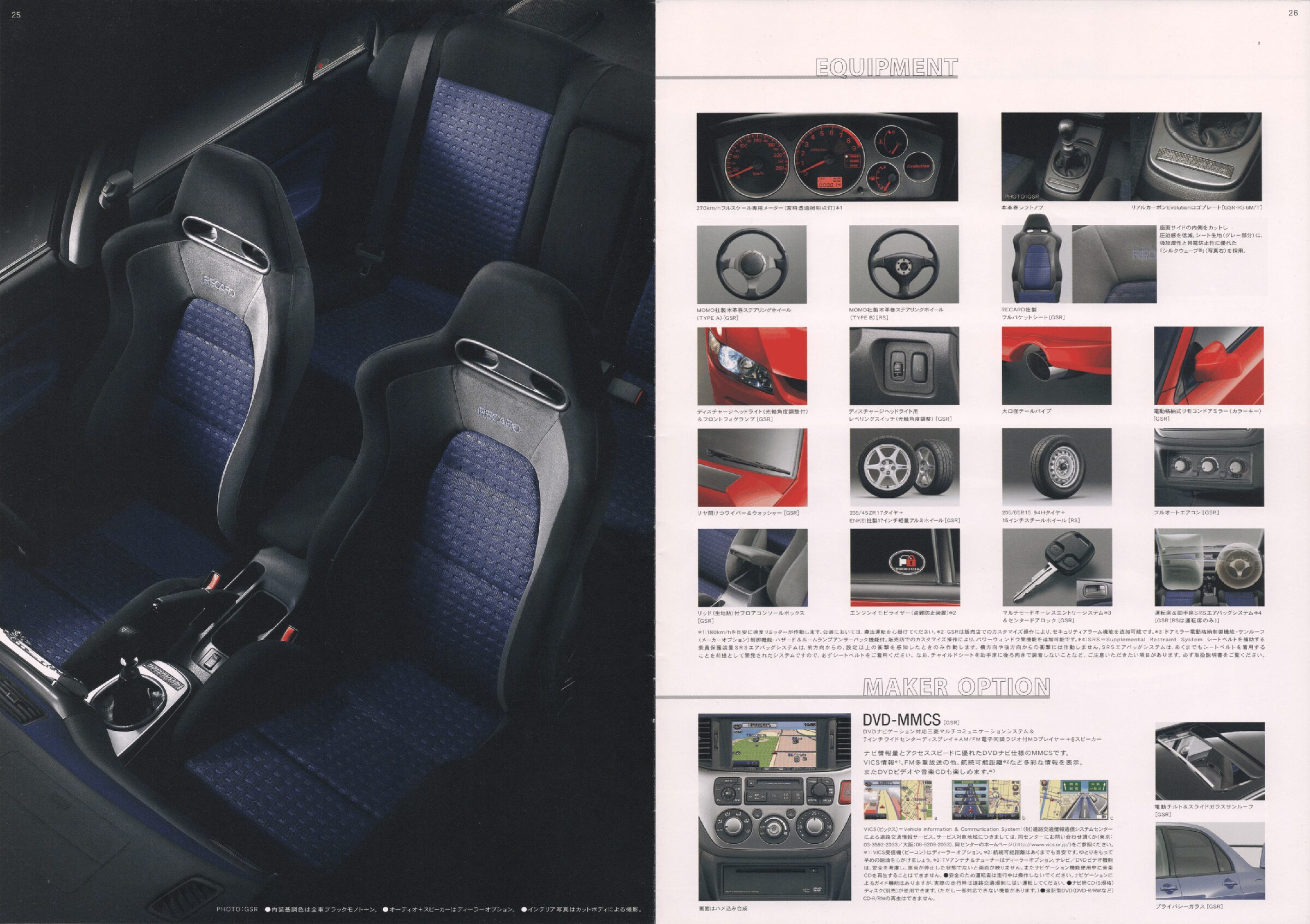
DVD navigation-compatible Mitsubishi Multi-Communication System & 7-inch wide center display + AM/FM electronic tuning radio with MD player + 6 speakers
The MMCS with DVD navigation, excellent in the volume of navigation data and access speed. It displays a wide range of information, including VICS information1, FM multiplex broadcasts and the cruising range2. You can also enjoy DVD video and music CDs.*3
Screens are composited.
VICS = Vehicle Information & Communication System: a road traffic information service by the Vehicle Information and Communication System Center (a foundation). For the areas the service covers, please contact the center (Tokyo: 03-3592-2033 / Osaka: 06-6209-2033) or see the center's website (http://www.vics.or.jp/).
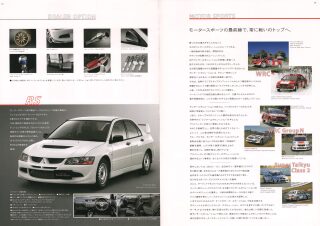
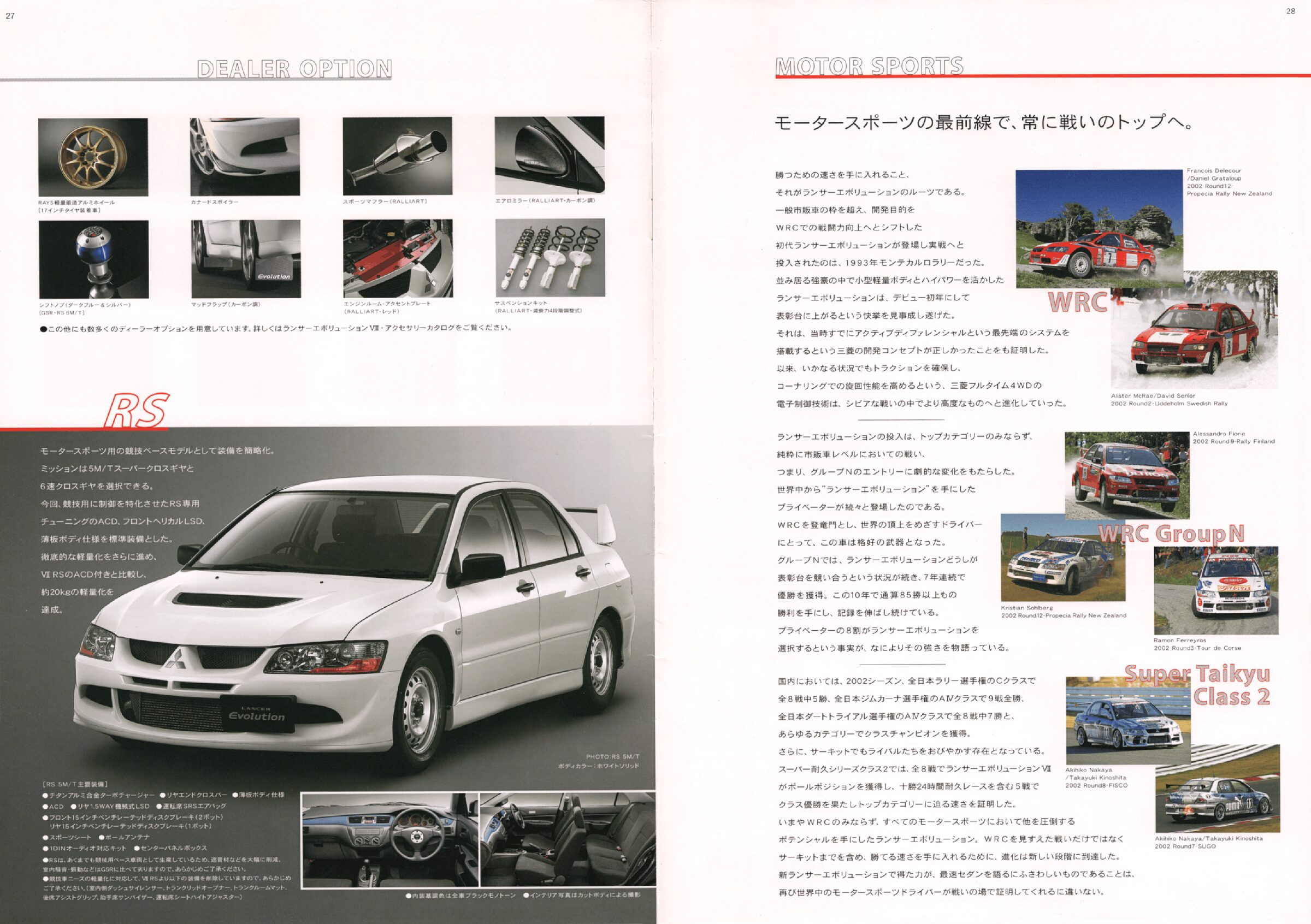
Equipment simplified as a competition base model for motorsport. The transmission can be either the 5M/T super close gear or the 6-speed close gear. This time the RS has, as standard, the RS-specific ACD and front helical LSD, with control tuned for competition, and the thin-panel body. Pushing weight reduction further, it is about 20 kg lighter than the VII RS with ACD.
PHOTO: RS 5M/T
Body color: White Solid
[RS 5M/T main equipment]
Gaining the speed to win: that is the root of the Lancer Evolution. Going beyond the bounds of a production car, with the development aim shifted to competitiveness in the WRC, the first Lancer Evolution appeared and was sent into real competition at the 1993 Monte Carlo Rally. Among a field of powerful rivals, the Lancer Evolution, making the most of a small, light body and high power, achieved the feat of reaching the podium in the very first year. This also proved right Mitsubishi's development concept of fitting a cutting-edge system, the active differential, even then. Since then, Mitsubishi's full-time 4WD electronic control technology, which secures traction in any conditions and sharpens turning in corners, has evolved to an ever higher level through tough competition.
WRC
The Lancer Evolution's arrival brought dramatic change not only to the top category but to competition at pure production-car level: Group N entries. Privateers from all over the world who had got hold of a "Lancer Evolution" appeared one after another. For drivers aiming for the top of the world with the WRC as their gateway, this car became the ideal weapon. In Group N, Lancer Evolutions have battled each other for the podium, winning the championship 7 years in a row. Over these 10 years they have taken more than 85 wins in all, and the record keeps growing. The fact that 80% of privateers choose the Lancer Evolution speaks louder than anything of the car's strength.
WRC Group N
In Japan, in the 2002 season, it won class championships in every category: 5 wins in 8 rounds in the C class of the All Japan Rally Championship, all 9 rounds in the A-IV class of the All Japan Gymkhana Championship, and 7 wins in 8 rounds in the A-IV class of the All Japan Dirt Trial Championship. On circuits too it has become a threat to rivals. In Class 2 of the Super Taikyu series, the Lancer Evolution VII took pole position at all 8 rounds and won the class in 5 races, including the Tokachi 24 Hours, proving speed close to the top category. The Lancer Evolution now has the potential to overwhelm the rest in all motorsport, not only the WRC. To gain the speed to win not only in the WRC but on circuits too, the evolution has reached a new stage. Drivers around the world will surely prove once again, on the field of battle, that the power gained by the new Lancer Evolution is worthy of the title of fastest sedan.
Super Taikyu Class 2
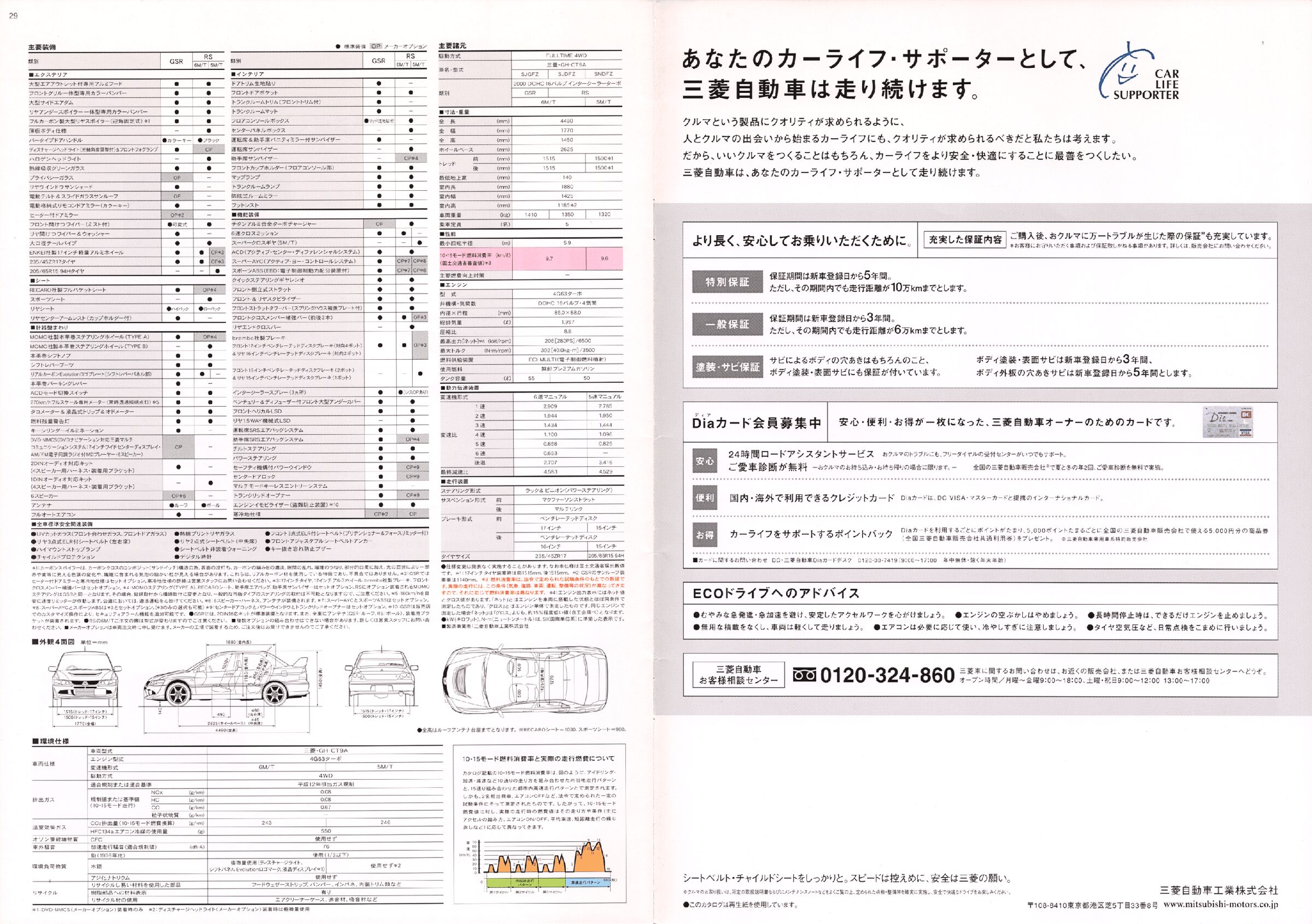
Key: Standard, Maker option (OP), — not available.
| Item | GSR | RS 6M/T | RS 5M/T |
|---|---|---|---|
| Exterior | |||
| Dedicated aluminum hood with large air outlet | Standard | Standard | Standard |
| Dedicated color-keyed bumper with integrated front grille | Standard | Standard | Standard |
| Large side air dams | Standard | Standard | Standard |
| Dedicated color-keyed bumper with integrated rear under spoiler | Standard | Standard | Standard |
| Full carbon large rear spoiler (fixed angle of attack) *1 | Standard | Standard | Standard |
| Thin-panel body | — | Standard | Standard |
| Bar-type door handles | Standard (color-keyed) | Standard (black) | Standard (black) |
| Discharge headlamps (with beam angle adjustment) & front fog lamps | Standard | Maker option | Maker option |
| Halogen headlamps | — | Standard | Standard |
| Heat-absorbing green glass | Standard | Standard | Standard |
| Privacy glass | Maker option | — | — |
| Rear window sunshade | Standard | — | — |
| Electric tilt & slide glass sunroof | Maker option | — | — |
| Electric folding remote-control door mirrors (color-keyed) | Standard | — | — |
| Heated door mirrors | Maker option *2 | — | — |
| Front intermittent wipers (with mist) | Standard (variable) | Standard | Standard |
| Rear intermittent wiper & washer | Standard | — | — |
| Large-diameter tailpipe | Standard | Standard | Standard |
| ENKEI 17-inch lightweight aluminum wheels | Standard | Standard | Maker option *3 |
| 235/45ZR17 tires | Standard | Standard | Maker option *3 |
| 205/65R15 94H tires | — | — | Standard |
| Seats | |||
| RECARO full bucket seats | Standard | Maker option *4 | Maker option *4 |
| Sports seats | — | Standard | Standard |
| Rear seat | Standard (high back) | Standard (low back) | Standard (low back) |
| Rear center armrest (with cup holders) | Standard | — | — |
| Instrument panel | |||
| MOMO leather-wrapped steering wheel (TYPE A) | Standard | Maker option *4 | Maker option *4 |
| MOMO leather-wrapped steering wheel (TYPE B) | — | Standard | Standard |
| Leather-wrapped shift knob | Standard | Standard | Standard |
| Shift lever boot | Standard | Standard | Standard |
| Real carbon Evolution logo plate (shift lever panel) | Standard | Standard | — |
| Leather-wrapped parking brake lever | Standard | — | — |
| ACD mode switch | Standard | Standard | Standard |
| 270 km/h full-scale meters (transmitted illumination always on) *5 | Standard | Standard | Standard |
| Tachometer & LCD trip & odometer | Standard | Standard | Standard |
| Low fuel warning light | Standard | Standard | Standard |
| Key cylinder illumination | Standard | — | — |
| DVD-MMCS (DVD navigation-compatible Mitsubishi Multi-Communication System: 7-inch wide center display, AM/FM electronic tuning radio with MD player, 6 speakers) | Maker option | — | — |
| 2DIN audio kit (4-speaker harness, mounting brackets) | Standard | — | — |
| 1DIN audio kit (4-speaker harness, mounting brackets) | — | Standard | Standard |
| 6 speakers | Maker option *6 | — | — |
| Antenna | Standard (roof) | Standard (pole) | Standard (pole) |
| Fully automatic air conditioner | Standard | — | — |
The table continues:
| Item | GSR | RS 6M/T | RS 5M/T |
|---|---|---|---|
| Interior | |||
| Fabric-covered door trim | Standard | — | — |
| Front door pockets | Standard | Standard | Standard |
| Trunk room trim (with front trim) | Standard | — | — |
| Trunk room mat | Standard | — | — |
| Floor console box | Standard (with lid, fabric-covered) | Standard | Standard |
| Center panel box | — | Standard | Standard |
| Driver & front passenger sun visors with vanity mirrors | Standard | — | — |
| Driver's sun visor | — | Standard | Standard |
| Front passenger sun visor | — | Maker option *4 | Maker option *4 |
| Front cup holders (floor console) | Standard | Standard | Standard |
| Map lamps | Standard | Standard | Standard |
| Trunk room lamp | Standard | Standard | Standard |
| Anti-glare rear-view mirror | Standard | Standard | Standard |
| Footrest | Standard | Standard | Standard |
| Mechanical equipment | |||
| Titanium aluminide turbocharger | Maker option | Standard | Standard |
| 6-speed close-ratio transmission | Standard | Standard | — |
| Super close gear (5M/T) | — | — | Standard |
| ACD (Active Center Differential system) | Standard | Standard | Standard |
| Super AYC (Active Yaw Control system) | Standard | Maker option *7 | Maker option *8 |
| Sports ABS (with EBD electronic brake-force distribution) | Standard | Maker option *7 | Maker option *8 |
| Quick steering gear ratio | Standard | Standard | Standard |
| Front inverted struts | Standard | Standard | Standard |
| Front & rear stabilizers | Standard | Standard | Standard |
| Front strut tower bar (with spring house reinforcement plates) | Standard | Standard | Standard |
| Front crossmember reinforcement bars (2, front and rear) | Standard | Standard | Maker option *3 |
| Rear end crossbar | — | Standard | Standard |
| brembo brakes: front 17-inch ventilated disc brakes (opposed 4-pot) & rear 16-inch ventilated disc brakes (opposed 2-pot) | Standard | Standard | Maker option *3 |
| Front 15-inch ventilated disc brakes (2-pot) & rear 15-inch ventilated disc brakes (1-pot) | — | — | Standard |
| Intercooler spray (3 nozzles) | Standard | Standard (delete option available) | Standard (delete option available) |
| Large front under cover with venturi & diffuser | Standard | Standard | Standard |
| Front helical LSD | Standard | Standard | Standard |
| Rear 1.5-way mechanical LSD | — | Standard | Standard |
| Driver's SRS airbag system | Standard | Standard | Standard |
| Front passenger SRS airbag system | Standard | Maker option *4 | Maker option *4 |
| Tilt steering | Standard | Standard | Standard |
| Power steering | Standard | Standard | Standard |
| Power windows with safety mechanism | Standard | Maker option *9 | Maker option *9 |
| Central door locking | Standard | Maker option *9 | Maker option *9 |
| Multi-mode keyless entry system | Standard | — | — |
| Trunk lid opener | Standard | Maker option *9 | Maker option *9 |
| Engine immobilizer (anti-theft device) *10 | Standard | Standard | Standard |
| Cold climate specification | Maker option *2 | Maker option | Maker option |
Safety equipment standard on every car
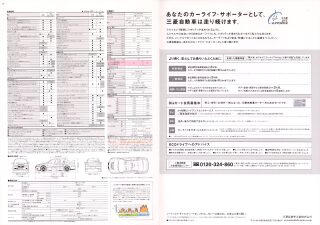
| GSR | RS | RS | |
|---|---|---|---|
| Drive | FULLTIME 4WD | FULLTIME 4WD | FULLTIME 4WD |
| Name and model | Mitsubishi GH-CT9A | Mitsubishi GH-CT9A | Mitsubishi GH-CT9A |
| Model code | SJGFZ | SJDFZ | SNDFZ |
| Class | 2000 DOHC 16-valve intercooler turbo | 2000 DOHC 16-valve intercooler turbo | 2000 DOHC 16-valve intercooler turbo |
| Transmission | 6M/T | 6M/T | 5M/T |
| Dimensions and weight | |||
| Overall length (mm) | 4,490 | 4,490 | 4,490 |
| Overall width (mm) | 1,770 | 1,770 | 1,770 |
| Overall height (mm) | 1,450 | 1,450 | 1,450 |
| Wheelbase (mm) | 2,625 | 2,625 | 2,625 |
| Tread, front (mm) | 1,515 | 1,515 | 1,500*1 |
| Tread, rear (mm) | 1,515 | 1,515 | 1,500*1 |
| Minimum ground clearance (mm) | 140 | 140 | 140 |
| Interior length (mm) | 1,880 | 1,880 | 1,880 |
| Interior width (mm) | 1,425 | 1,425 | 1,425 |
| Interior height (mm) | 1,185*2 | 1,185*2 | 1,185*2 |
| Vehicle weight (kg) | 1,410 | 1,350 | 1,320 |
| Seating capacity (persons) | 5 | 5 | 5 |
| Performance | |||
| Minimum turning radius (m) | 5.9 | 5.9 | 5.9 |
| 10-15 mode fuel consumption (km/L) (Ministry of Land, Infrastructure and Transport figure) *3 | 9.7 | 9.7 | 9.6 |
| Main fuel economy measures | — | — | — |
| Engine | |||
| Type | 4G63 turbo | 4G63 turbo | 4G63 turbo |
| Valve mechanism and cylinders | DOHC 16-valve, 4 cylinders | DOHC 16-valve, 4 cylinders | DOHC 16-valve, 4 cylinders |
| Bore × stroke (mm) | 85.0 × 88.0 | 85.0 × 88.0 | 85.0 × 88.0 |
| Displacement (L) | 1.997 | 1.997 | 1.997 |
| Compression ratio | 8.8 | 8.8 | 8.8 |
| Maximum output [net] *4 (kW/rpm) | 206 [280PS]/6500 | 206 [280PS]/6500 | 206 [280PS]/6500 |
| Maximum torque (N·m/rpm) | 392 [40.0kg-m]/3500 | 392 [40.0kg-m]/3500 | 392 [40.0kg-m]/3500 |
| Fuel system | ECI-MULTI (electronically controlled fuel injection) | ECI-MULTI (electronically controlled fuel injection) | ECI-MULTI (electronically controlled fuel injection) |
| Fuel | Unleaded premium gasoline | Unleaded premium gasoline | Unleaded premium gasoline |
| Tank capacity (L) | 55 | 50 | 50 |
| Drivetrain | |||
| Transmission | 6-speed manual | 6-speed manual | 5-speed manual |
| Gear ratio, 1st | 2.909 | 2.909 | 2.785 |
| Gear ratio, 2nd | 1.944 | 1.944 | 1.950 |
| Gear ratio, 3rd | 1.434 | 1.434 | 1.444 |
| Gear ratio, 4th | 1.100 | 1.100 | 1.096 |
| Gear ratio, 5th | 0.868 | 0.868 | 0.825 |
| Gear ratio, 6th | 0.693 | 0.693 | — |
| Gear ratio, reverse | 2.707 | 2.707 | 3.416 |
| Final drive ratio | 4.583 | 4.583 | 4.529 |
| Running gear | |||
| Steering | Rack & pinion (power steering) | Rack & pinion (power steering) | Rack & pinion (power steering) |
| Suspension, front | MacPherson strut | MacPherson strut | MacPherson strut |
| Suspension, rear | Multi-link | Multi-link | Multi-link |
| Brakes, front | Ventilated disc, 17-inch | Ventilated disc, 17-inch | Ventilated disc, 15-inch |
| Brakes, rear | Ventilated disc, 16-inch | Ventilated disc, 16-inch | Ventilated disc, 15-inch |
| Tire size | 235/45ZR17 | 235/45ZR17 | 205/65R15 94H |
Unit = mm. The drawings are labeled:
| Item | 6M/T | 5M/T | |
|---|---|---|---|
| Vehicle | Model | Mitsubishi GH-CT9A | Mitsubishi GH-CT9A |
| Vehicle | Engine type | 4G63 turbo | 4G63 turbo |
| Vehicle | Transmission | 6M/T | 5M/T |
| Vehicle | Drive | 4WD | 4WD |
| Exhaust gas | Regulation or standard met | 2000 (Heisei 12) exhaust gas regulations | 2000 (Heisei 12) exhaust gas regulations |
| Exhaust gas | Limit or standard (10-15 mode driving): NOx (g/km) | 0.08 | 0.08 |
| Exhaust gas | HC (g/km) | 0.08 | 0.08 |
| Exhaust gas | CO (g/km) | 0.67 | 0.67 |
| Exhaust gas | Particulate matter (g/km) | — | — |
| Greenhouse gases | CO₂ emissions (10-15 mode fuel consumption converted) (g/km) | 243 | 246 |
| Greenhouse gases | HFC134a air conditioning refrigerant used (g) | 550 | 550 |
| Ozone-depleting substances | CFC | Not used | Not used |
| Exterior noise | Acceleration noise (regulation met) (dB-A) | 76 | 76 |
| Substances of environmental concern | Lead (compared with 1996) | Used (1/3 or less) | Used (1/3 or less) |
| Substances of environmental concern | Mercury | Very small amounts used (discharge lamps, Evolution logo on the shift panel, LCD display*1) | Not used*2 |
| Substances of environmental concern | Sodium azide | Not used | Not used |
| Recycling | Parts made of easily recycled materials | Hood weatherstrip, bumpers, instrument panel, interior trim and so on | Hood weatherstrip, bumpers, instrument panel, interior trim and so on |
| Recycling | Material marking on resin parts | Yes | Yes |
| Recycling | Use of recycled materials | Air cleaner case, sound insulation, sound absorbing material and so on | Air cleaner case, sound insulation, sound absorbing material and so on |
*1: Only with the DVD-MMCS (maker option) fitted. *2: Very small amounts used with the discharge headlamps (maker option) fitted.
The 10-15 mode fuel consumption given in the catalog is measured, as the figure shows, with an urban driving pattern combining 10 ways of driving, such as idling, accelerating and decelerating, and an urban high-speed driving pattern combining 15 ways. It is also measured under fixed test conditions set by law, such as a load equal to two occupants and the air conditioning OFF. Actual fuel consumption therefore differs from the 10-15 mode figure depending on how and in what conditions the car is driven (mainly how the accelerator is pressed, air conditioning ON/OFF, average speed, repeated short trips and so on).
The chart is labeled:
CAR LIFE SUPPORTER
Just as quality is demanded of the product we call a car, we believe quality should also be demanded of the car life that begins when a person meets a car. So, as well as building good cars, we want to do our very best to make your car life safer and more comfortable. Mitsubishi Motors keeps on running as your car life supporter.
Full warranty cover: after purchase, the warranty* is full too, should any trouble arise with the car. *There are points the customer must observe and matters the warranty cannot cover. For details, please ask the dealer.
A single card for peace of mind, convenience and savings, for Mitsubishi owners.
Mitsubishi Motors Customer Center: 0120-324-860. For enquiries about Mitsubishi cars, please contact your nearest dealer or the Mitsubishi Motors Customer Center. Open Monday to Friday 9:00 to 18:00, Saturdays and holidays 9:00 to 12:00 and 13:00 to 17:00.
Wear your seatbelt and use a child seat. Keep your speed down: safety is Mitsubishi's wish.
※Before handling the car, read the owner's manual and maintenance notes carefully, carry out the specified inspections and maintenance, and enjoy safe, comfortable driving.
Mitsubishi Motors Corporation
5-33-8 Shiba, Minato-ku, Tokyo 108-8410
www.mitsubishi-motors.co.jp
Heart-Beat Motors
MITSUBISHI MOTORS
3SXGA8A031(03-01)
Mitsubishi's Japanese brochure for the CT9A Lancer Evolution VIII, printed in January 2003, covering the GSR and the RS with the Nürburgring testing, aerodynamics, engine, Super AYC, equipment, colors, dealer options, motorsport record and full specifications.
Reproduced for archival and reference purposes. Mitsubishi, its model names, logos and the images in this brochure are the trademarks and copyright of their owners; NENGUN is not affiliated with or endorsed by Mitsubishi. If you hold rights in this material and object to it appearing here, contact us and we will remove it promptly.