Skyline GT-R and GT-R V-spec II BNR32 original sales brochure
Japan · February 1994
Turn for full screen
Nissan's Japanese brochure for the R32 Skyline GT-R, printed in February 1994 when the V-spec II joined the range, covering the GT-R and the V-spec II with the engine, chassis, ATTESA E-TS four-wheel drive, safety, equipment, specifications and colors. More
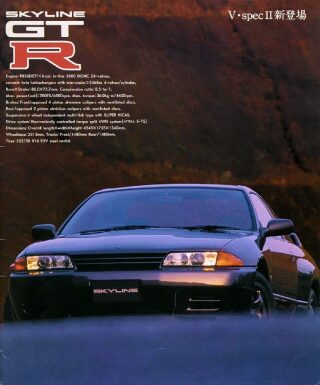
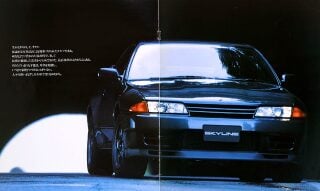
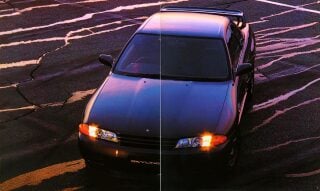
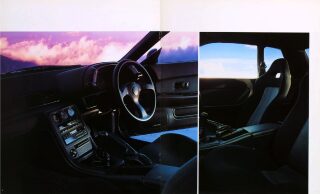
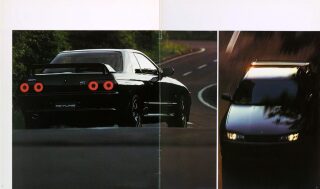
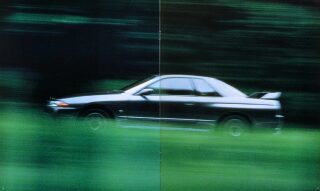
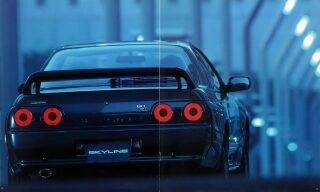
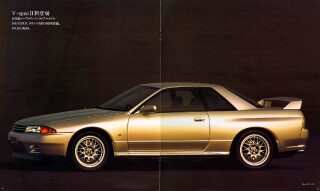
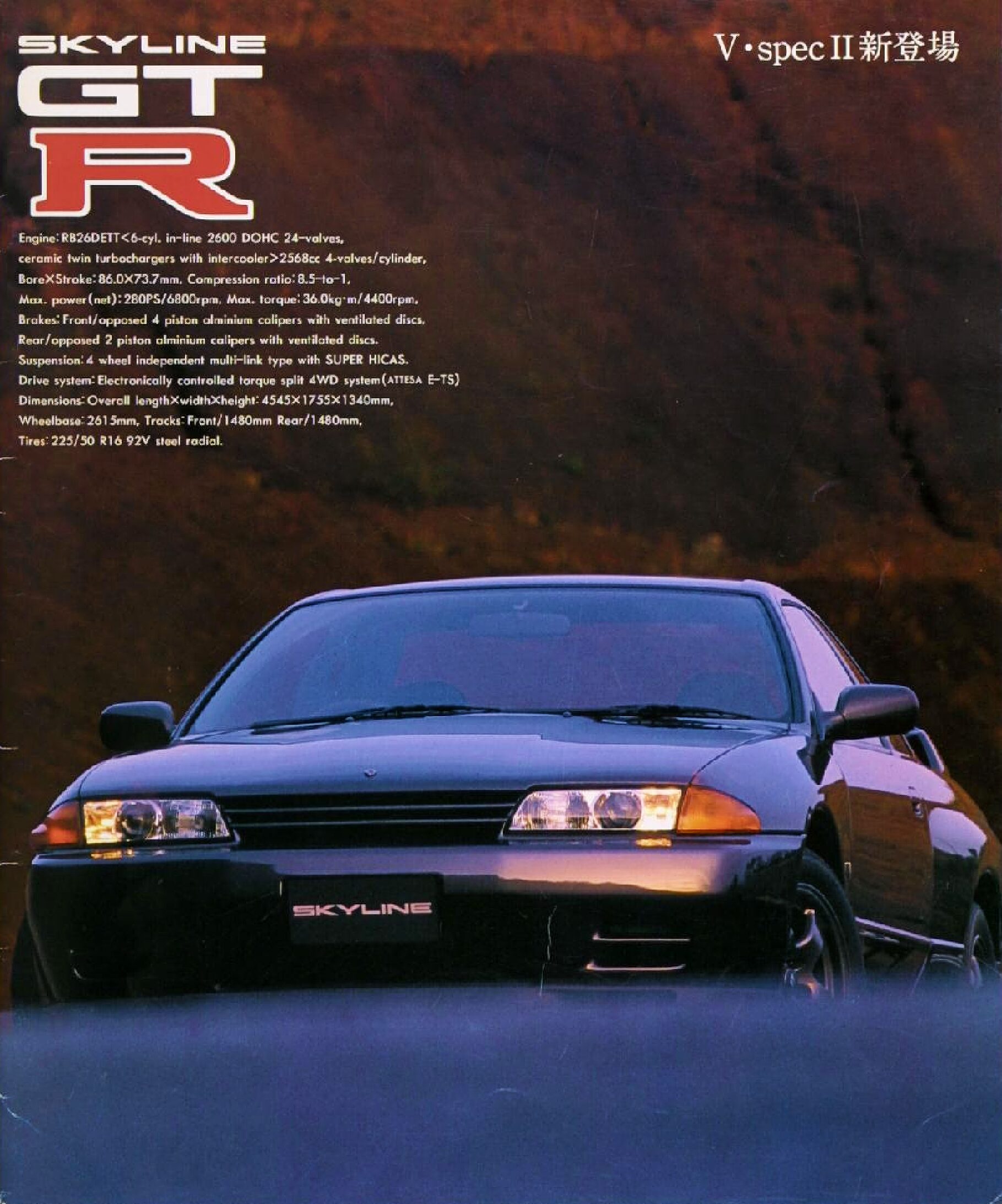
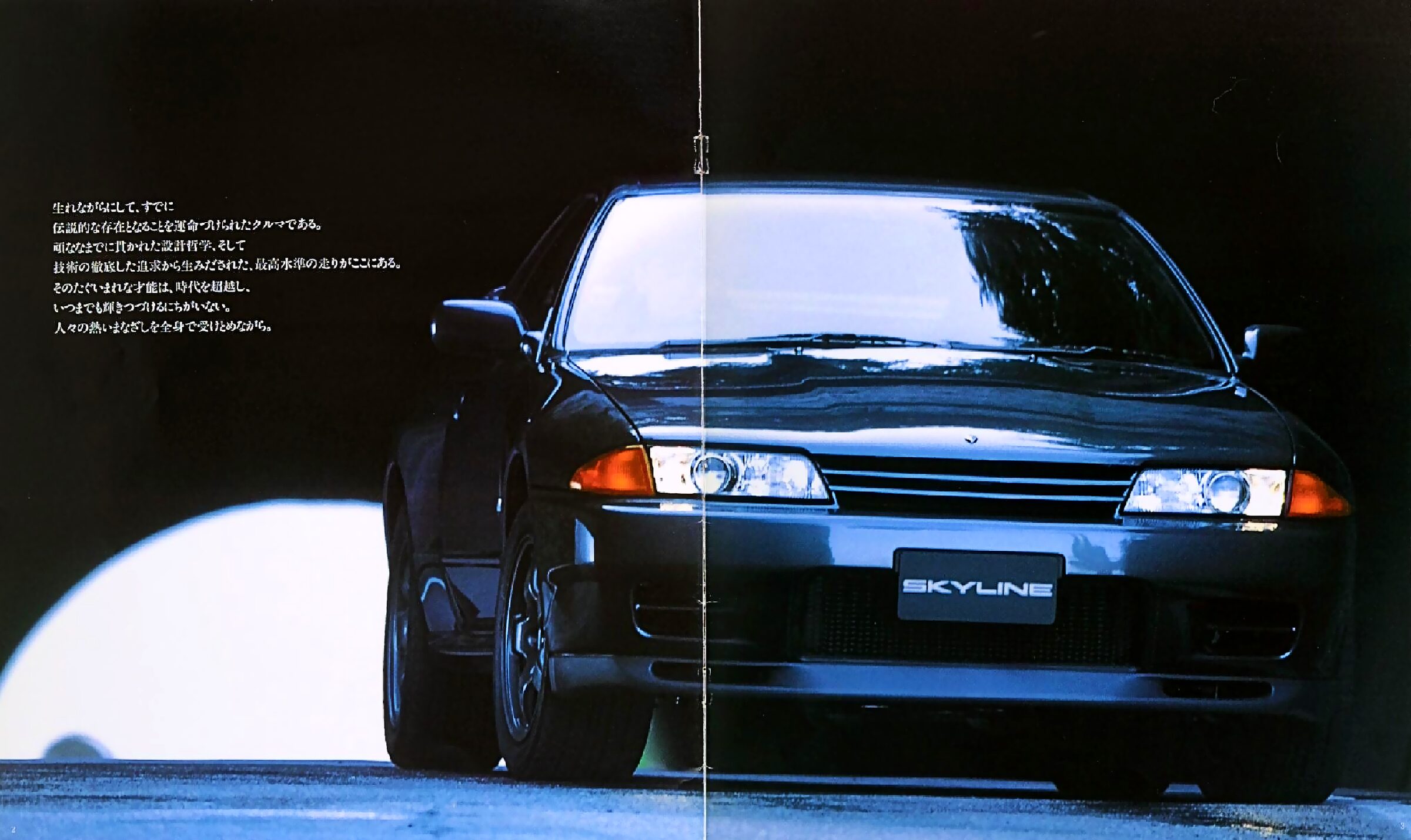
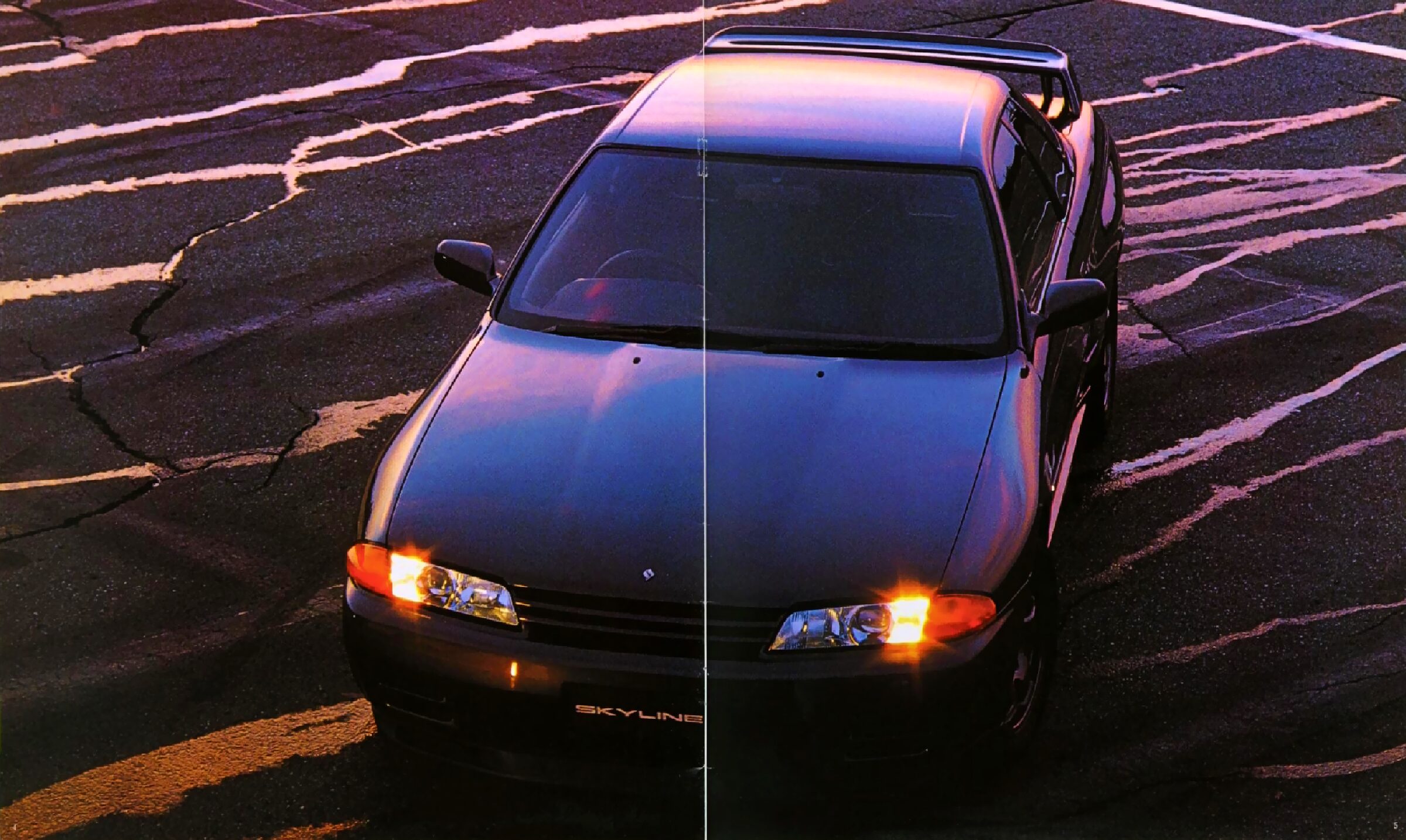
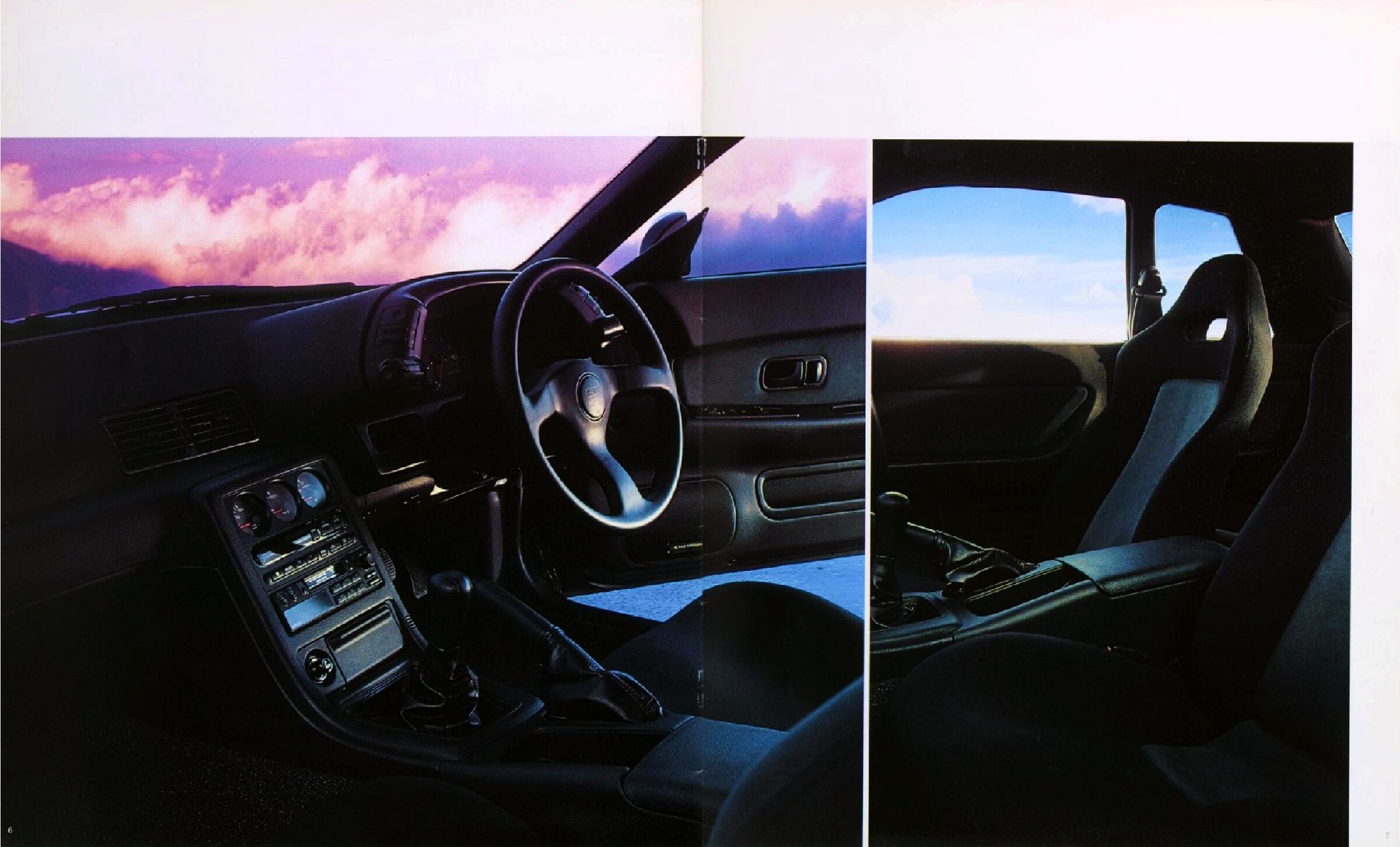
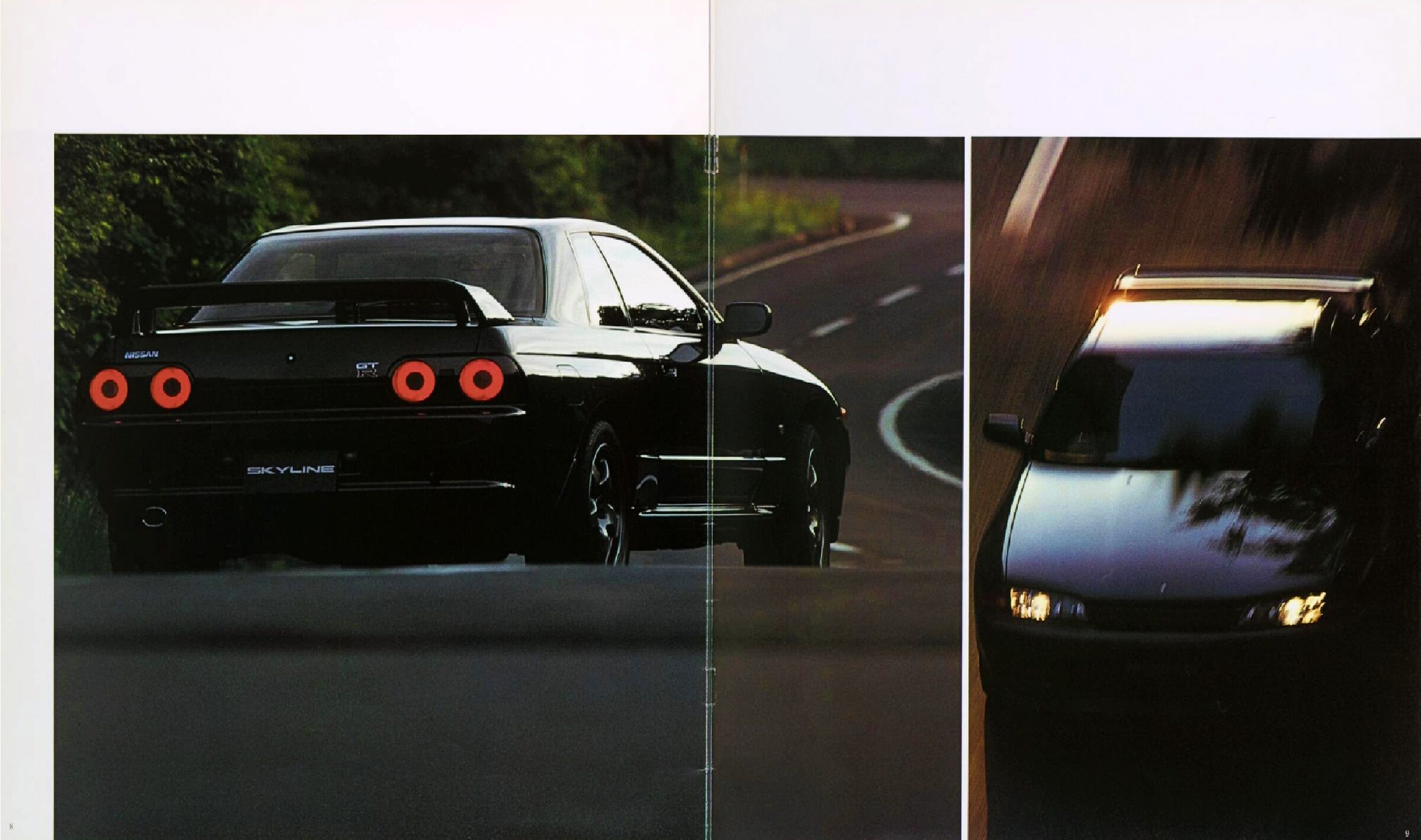
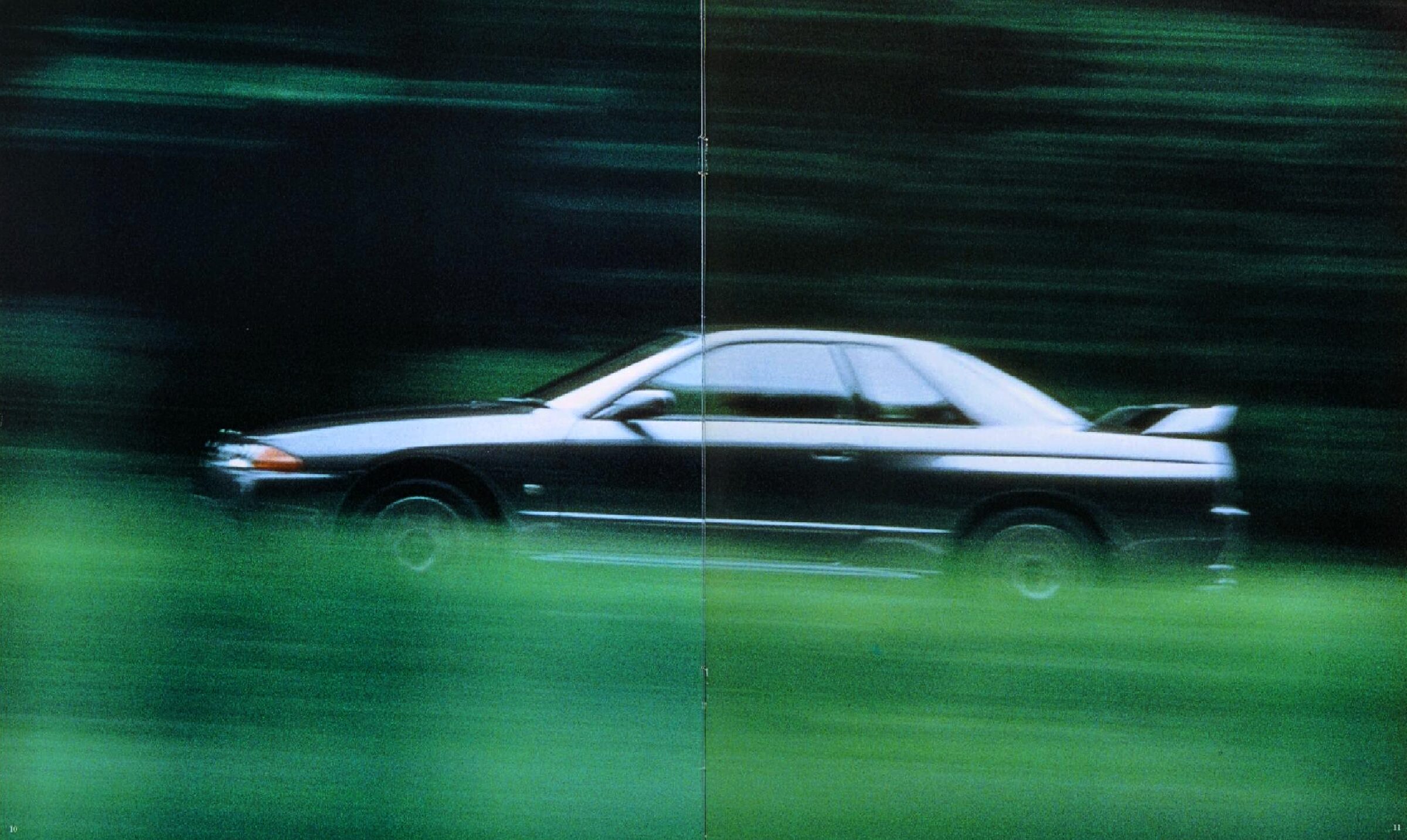
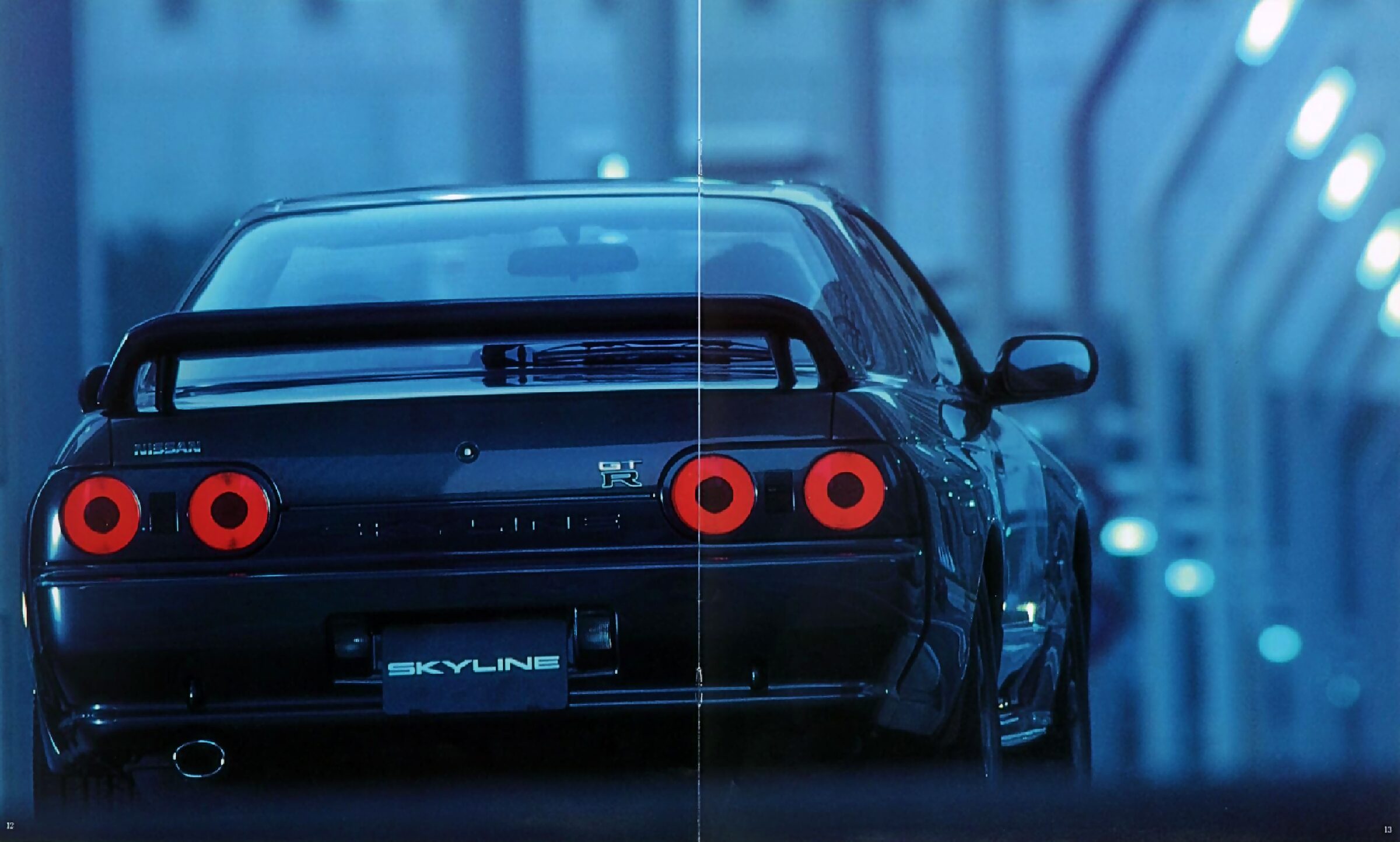
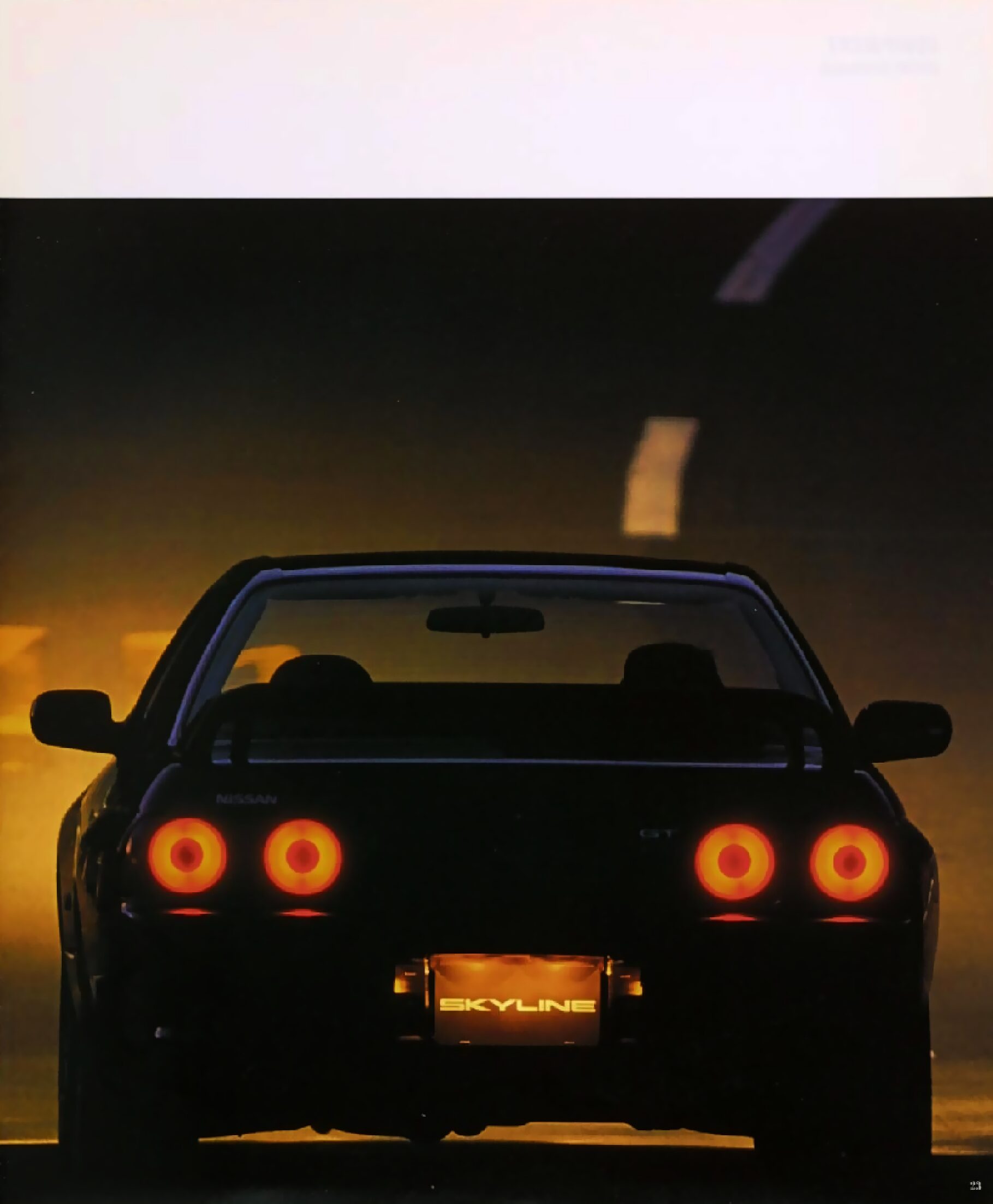
Page 1 of 21 · Front cover A dark Skyline GT-R head-on at dusk below a hillside, with the SKYLINE GT-R logo and a summary of the specifications in English. Page 2 of 21 · Born a legend A dark Skyline GT-R head-on in a darkened setting, across a two-page spread. Page 3 of 21 · Exterior A Skyline GT-R seen from above with the headlamps lit, on cracked asphalt in low evening sun. Page 4 of 21 · Interior The GT-R cockpit with the dashboard, steering wheel and gear lever, and the bucket seats on the right. Page 5 of 21 · On the road A black Skyline GT-R from behind with the taillights lit on a winding country road, and a second car under the trees. Page 6 of 21 · At speed A Skyline GT-R in profile, panned at speed past a blur of green. Page 7 of 21 · Rear view The rear of a Skyline GT-R with the round taillights and rear spoiler, in a blue-lit tunnel. Page 8 of 21 · V·spec II, newly introduced A silver V-spec II in profile on BBS wheels against a dark backdrop. Page 9 of 21 · Safety Preventive and collision safety, with photos of the meters, the front and rear brakes, a drawing of the aluminum panels and the SRS airbag inflated. Page 10 of 21 · Front fender The front fender and five-spoke wheel of a gray Skyline GT-R with the GT badge, on a wet surface. Page 11 of 21 · Power unit: RB26DETT The RB26DETT engine, with a cutaway drawing, the system diagram, the twin ceramic turbochargers, the intercooler and the engine performance curves. Page 12 of 21 · Engine bay The RB26DETT in the engine bay of a gray GT-R, with the headlamp lit. Page 13 of 21 · Chassis and suspension The multi-link front and rear suspension, the SUPER HICAS system diagram, and how a car with SUPER HICAS takes a corner compared with 2WS. Page 14 of 21 · Dusk drive A Skyline GT-R at speed in blue dusk light, with the driver visible through the window. Page 15 of 21 · 4 wheel drive: ATTESA E-TS ATTESA E-TS explained, with a road diagram of the front-to-rear torque split, the system layout and a cutaway of the transfer. Page 16 of 21 · Taillights A Skyline GT-R from behind, the taillights and lit SKYLINE number plate glowing in amber haze. Page 17 of 21 · Equipment The climate and audio controls, projector headlamps and 16-inch forged wheels, and the brembo brakes and BBS wheels of the V-spec II, beside a GT-R on a track. Page 18 of 21 · 2-door Sports Coupe GT-R and V-spec II A GT-R in Gun Grey Metallic (KH2) with photos of the cockpit and seats, and a V-spec II in Crystal White (326). Page 19 of 21 · Specifications and equipment The equipment list, the specification table for the GT-R and V-spec II, the engine and drivetrain tables, and Nissan's service and warranty. Page 20 of 21 · Body colors and options The five body colors, Super Fine Coating, dealer options fitted to a GT-R, and the dimension drawings. Page 21 of 21 · Back cover The back cover, with Nissan's customer service details, the LIFE TOGETHER NISSAN logo and the catalogue number.
A car destined, from the moment of birth, to become a legend.
Here is driving of the highest standard, born of a design philosophy held to almost stubbornly and the thorough pursuit of technology.
That rare talent will surely transcend the times and go on shining forever,
while taking in the ardent gaze of people with the whole body.
Page 8
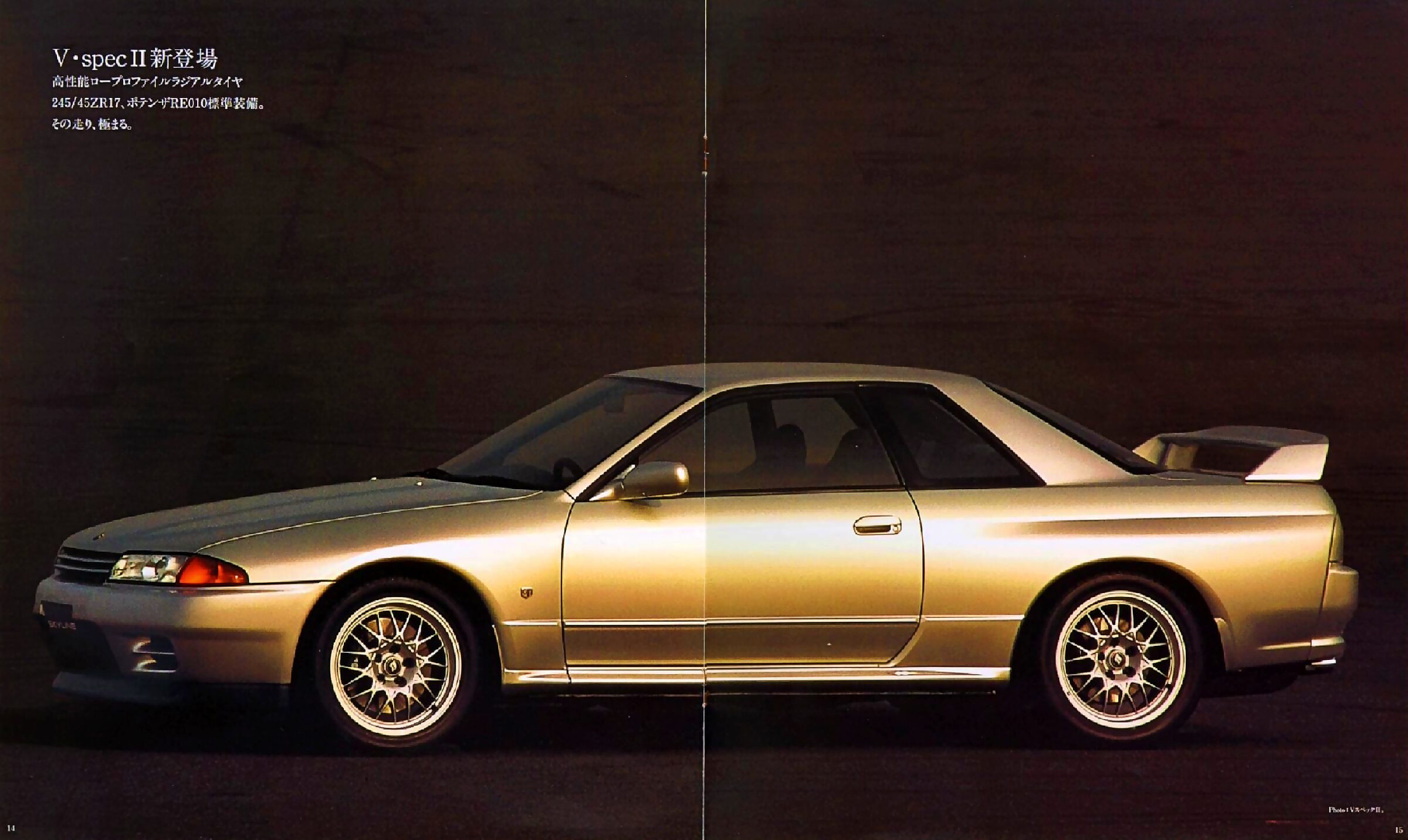
V·spec II, newly introduced
High-performance low-profile radial tires, 245/45ZR17 POTENZA RE010, fitted as standard.
The drive, perfected.
Photo: V-spec II.
Page 9
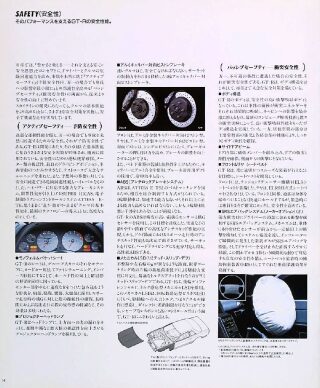
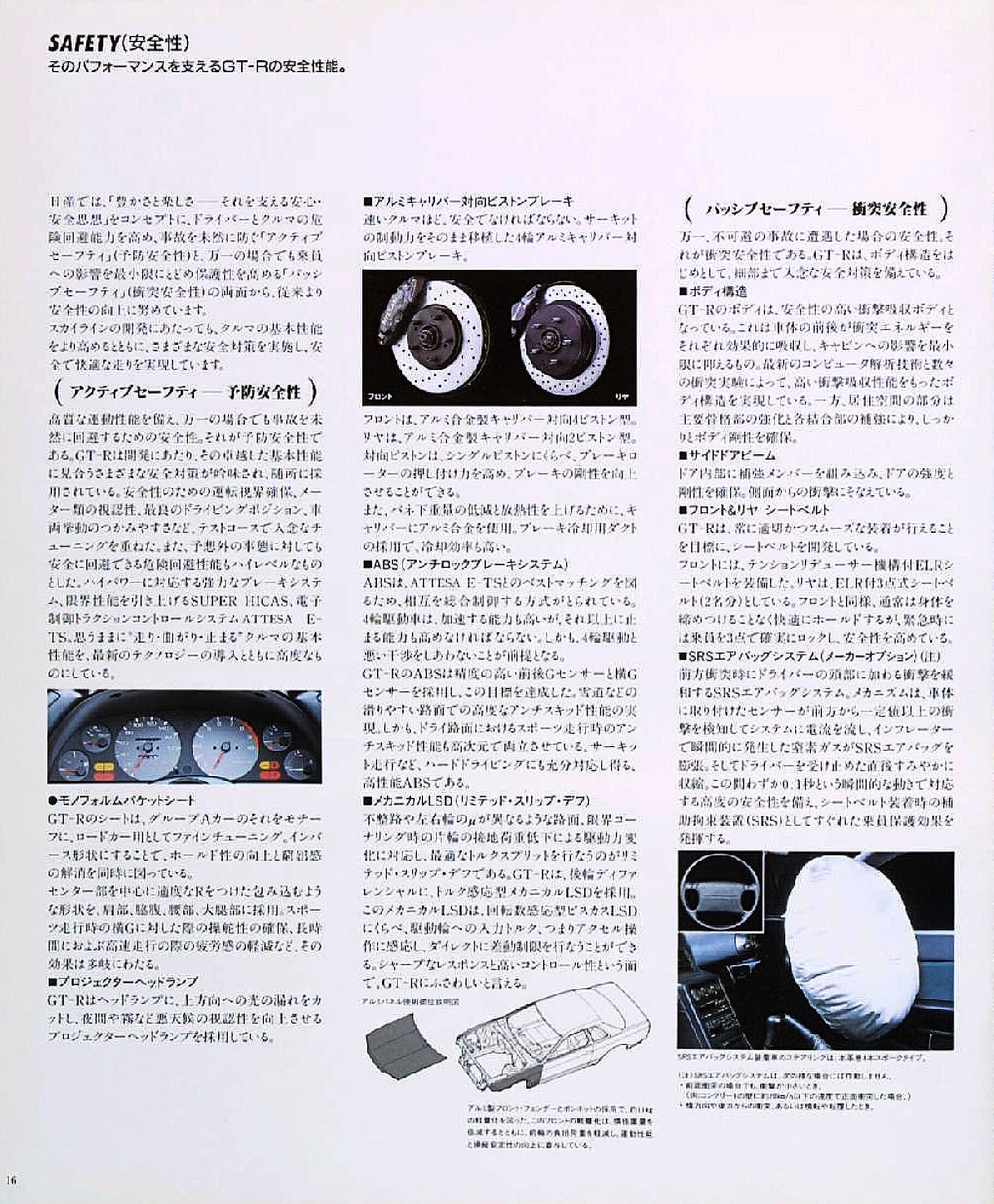
SAFETY
The GT-R's safety, supporting the performance.
At Nissan, under the concept of “richness and enjoyment, and the thinking on peace of mind and safety that supports them”, we work to improve safety beyond what went before from two sides: “active safety” (preventive safety), which raises the ability of driver and car to avoid danger and prevents accidents before they happen, and “passive safety” (collision safety), which keeps the effect on the occupants to a minimum should an accident happen and raises their protection.
In developing the Skyline too, we have further raised the car's basic performance and carried out a range of safety measures, achieving safe and comfortable driving.
(Active safety — preventive safety)
Safety that, with high-grade dynamic performance, avoids an accident before it happens should the worst occur: that is preventive safety. In developing the GT-R, a range of safety measures worthy of the car's outstanding basic performance were examined and adopted throughout. Thorough tuning was carried out on the test course for good visibility for safe driving, legible meters, the best driving position, car behavior that is easy to read and more. The ability to avoid danger safely in the unexpected was also made high-level. With a powerful brake system to match the high power, SUPER HICAS, which raises the limits, and ATTESA E-TS, an electronically controlled traction control system, the car's basic abilities to “go, turn and stop” as the driver wishes have been raised to a high level with the latest technology.
Monoform bucket seats
The GT-R's seats take those of the Group A car as their motif, fine-tuned for road use. An inverse shape both improves hold and does away with a cramped feeling.
A wrapping shape, with a moderate curve centered on the middle section, is used at the shoulders, flanks, lower back and thighs. The benefits are many: steering control against lateral G in sporty driving, less fatigue on long high-speed drives and more.
Projector headlamps
The GT-R's headlamps are projector headlamps, which cut light spilling upward and improve visibility at night and in bad weather such as fog.
Aluminum-caliper opposed-piston brakes
The faster the car, the safer it must be. Four-wheel aluminum-caliper opposed-piston brakes, carrying over circuit braking power as it is.
Photo labels:
Front
Rear
At the front, aluminum alloy calipers with 4 opposed pistons. At the rear, aluminum alloy calipers with 2 opposed pistons. Compared with a single piston, opposed pistons press harder on the brake rotor and make the brakes more rigid.
Aluminum alloy is also used for the calipers to reduce unsprung weight and shed heat better. With brake cooling ducts, cooling efficiency is high too.
ABS (anti-lock brake system)
For the best match with ATTESA E-TS, the two are controlled together. A 4-wheel-drive car has a great ability to accelerate, but the ability to stop must be raised even more. And it is a prerequisite that the ABS and the 4-wheel drive do not interfere badly with each other.
The GT-R's ABS achieves this with high-precision front-rear G sensors and a lateral G sensor. It delivers advanced anti-skid performance on slippery surfaces such as snowy roads, while also achieving high anti-skid performance in sporty driving on dry roads. A high-performance ABS, fully able to handle hard driving such as circuit driving.
Mechanical LSD (limited-slip differential)
The limited-slip differential deals with changes in driving force on rough roads, on surfaces where the μ of the left and right wheels differs, and from the drop in load on one wheel when cornering at the limit, splitting the torque in the best way. The GT-R uses a torque-sensing mechanical LSD in the rear differential. Compared with a speed-sensing viscous LSD, this mechanical LSD responds to the input torque to the driven wheels, that is, to the accelerator, and limits differential action directly. With sharp response and high controllability, it is fitting for the GT-R.
Diagram: where the aluminum panels are used
Aluminum front fenders and hood save about 11 kg. This lighter front lowers inertial weight and reduces the load on the front wheels, helping agility and stability.
(Passive safety — collision safety)
Safety should an unavoidable accident happen: that is collision safety. The GT-R has thorough safety measures, from the body structure down to the details.
Body structure
The GT-R's body is a highly safe impact-absorbing body. The front and rear of the body each absorb collision energy effectively, keeping the effect on the cabin to a minimum. The latest computer analysis and many crash tests have achieved a body structure with high impact absorption. The cabin, meanwhile, has firm body rigidity from strengthened main frame members and reinforced joints.
Side door beams
Reinforcing members built into the doors give them strength and rigidity, ready for impacts from the side.
Front & rear seatbelts
The GT-R's seatbelts were developed so that they can always be worn properly and smoothly.
The front has ELR seatbelts with a tension reducer. The rear has 3-point seatbelts with ELR (for 2). As at the front, they hold the body comfortably without tightening in normal use, and in an emergency lock the occupant firmly at three points, raising safety.
SRS airbag system (maker option) (Note)
The SRS airbag system cushions the impact to the driver's head in a frontal collision. Sensors fitted to the body detect a frontal impact above a set level and send current to the system, and nitrogen gas generated instantly by the inflator inflates the SRS airbag. Having caught the driver, the airbag deflates quickly. Responding in as little as 0.1 second, a split-second movement, it gives a high level of safety and, as a supplemental restraint system (SRS) when seatbelts are worn, protects the occupant well.
On cars with the SRS airbag system, the steering wheel is a leather-wrapped 4-spoke type.
(Note) The SRS airbag system does not deploy in cases such as:
A frontal collision where the impact is small (e.g. a head-on collision with a concrete wall at about 20 km/h or less).
A collision from the side or rear, or a rollover or overturn.
Page 11
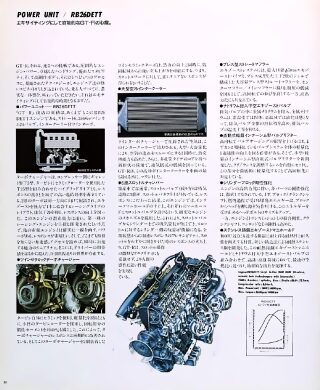
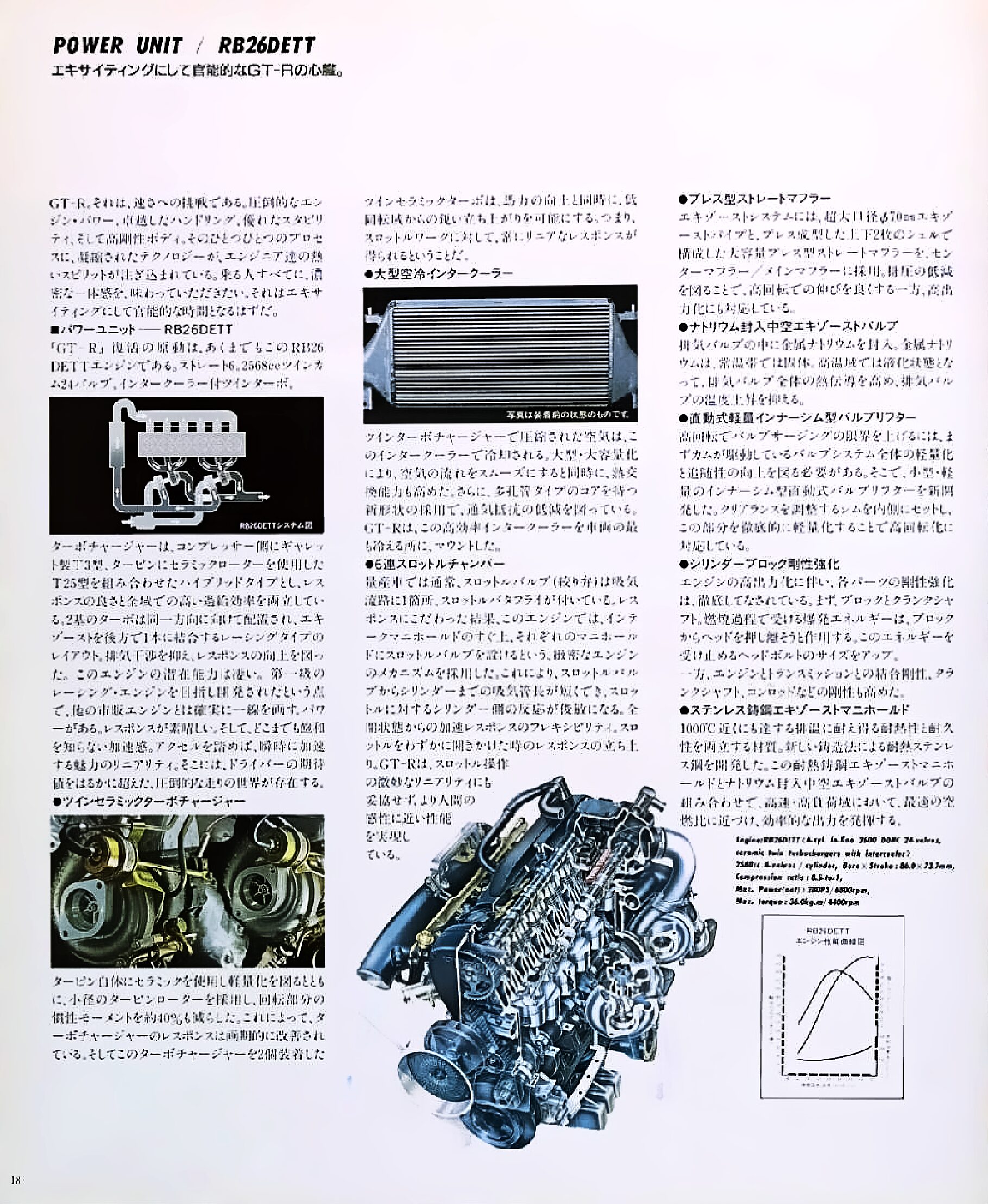
POWER UNIT / RB26DETT
The GT-R's heart, exciting and sensual.
GT-R: a challenge to speed. Overwhelming engine power, outstanding handling, excellent stability and a highly rigid body. Into every one of these processes went concentrated technology and the engineers' passionate spirit. We want everyone who drives it to savor a close sense of unity with the car. It should be an exciting and sensual time.
Power unit — RB26DETT
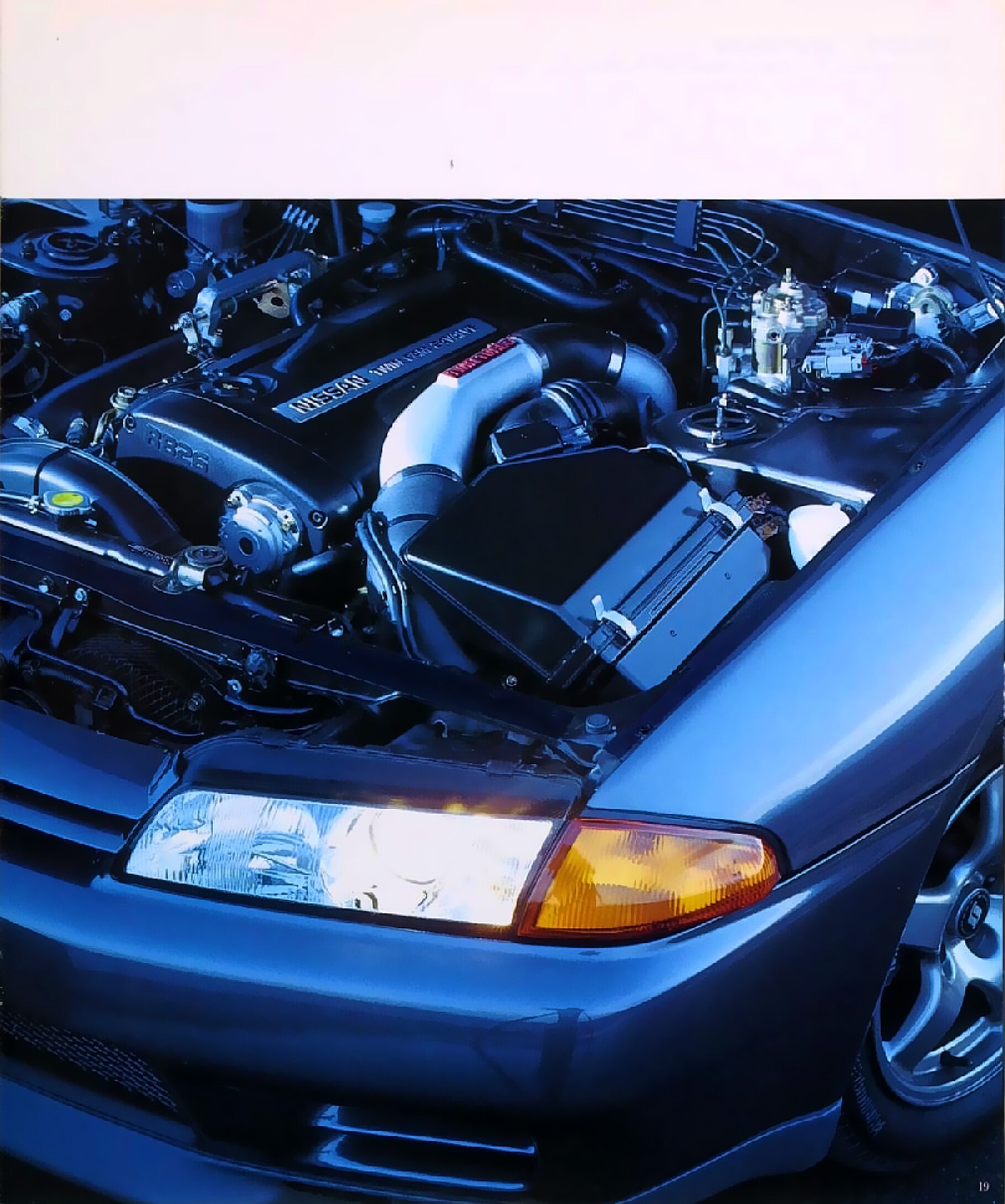
The driving force behind the revival of the “GT-R” is, above all, this RB26DETT engine. A straight six, 2568cc, twin-cam 24-valve, twin turbo with intercooler.
Diagram: RB26DETT system diagram
The turbochargers are a hybrid type, combining a Garrett T3 on the compressor side with a T25 using a ceramic rotor on the turbine side, balancing good response with high boost efficiency across the range. The two turbos face the same way, in a racing-type layout joining the exhaust into one pipe at the rear, which keeps down exhaust interference and improves response. This engine's potential is formidable. Developed with a first-class racing engine as the goal, it has power clearly a cut above other production engines. The response is superb. And acceleration that knows no limit. Press the accelerator, and there is the appeal of instant, linear acceleration. There lies a world of overwhelming driving far beyond what the driver expects.
Twin ceramic turbochargers
The turbine itself uses ceramic to save weight, and a small-diameter turbine rotor cuts the moment of inertia of the rotating parts by about 40%. Turbocharger response is improved dramatically as a result. And the twin ceramic turbo, with two of these turbochargers fitted, raises power while allowing a strong rise from low revs. That is, there is always a linear response to the throttle.
Large air-cooled intercooler
The photo shows the intercooler before fitting.
Air compressed by the twin turbochargers is cooled by this intercooler. Making it larger and of greater capacity smooths the air flow and raises heat exchange. A new shape with a multi-hole tube core also reduces air flow resistance. The GT-R mounts this high-efficiency intercooler where the car is coolest.
Six throttle chambers
Production cars normally have one throttle valve (butterfly) in the intake path. Out of a commitment to response, this engine uses a precise mechanism with a throttle valve on each manifold, right above the intake manifold. This shortens the intake path from throttle valve to cylinder, and the cylinders respond sharply to the throttle. Flexible acceleration response from fully open, and a quick rise in response when the throttle is just starting to open. The GT-R achieves performance closer to human feel, without compromise even in the subtle linearity of throttle operation.
Pressed straight muffler
The exhaust system uses extra-large φ70mm exhaust pipes and, for the center muffler / main muffler, high-capacity pressed straight mufflers built from two pressed shells, upper and lower. Lower back pressure improves pull at high revs while handling higher output.
Sodium-filled hollow exhaust valves
Metallic sodium is sealed inside the exhaust valves. Solid at normal temperatures, the metallic sodium turns liquid at high temperatures, raising heat conduction through the whole exhaust valve and keeping down the valve temperature.
Raising the valve-surging limit at high revs needs the whole valve system driven by the cams to be lighter and follow better. So small, light inner-shim direct-acting valve lifters were newly developed. The shim that sets the clearance sits inside, and this part is made as light as possible for high revs.
Stronger cylinder block rigidity
With higher output, every part has been made thoroughly more rigid. First, the block and crankshaft. The explosive energy of combustion acts to push the head away from the block, so the head bolts that hold this energy were made larger.
The rigidity of the engine-to-transmission joint, the crankshaft, the connecting rods and more was also raised.
Stainless cast-steel exhaust manifold
A material combining heat resistance and durability to withstand exhaust temperatures approaching 1000°C. A heat-resistant stainless steel was developed using a new casting method. Combining this heat-resistant cast-steel exhaust manifold with sodium-filled hollow exhaust valves brings the air-fuel ratio close to optimal at high speed and high load, delivering power efficiently.
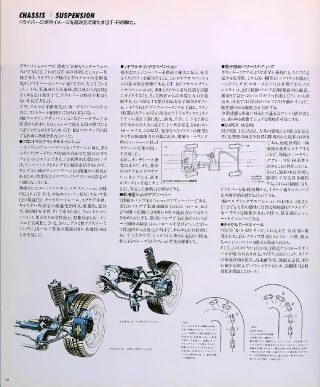
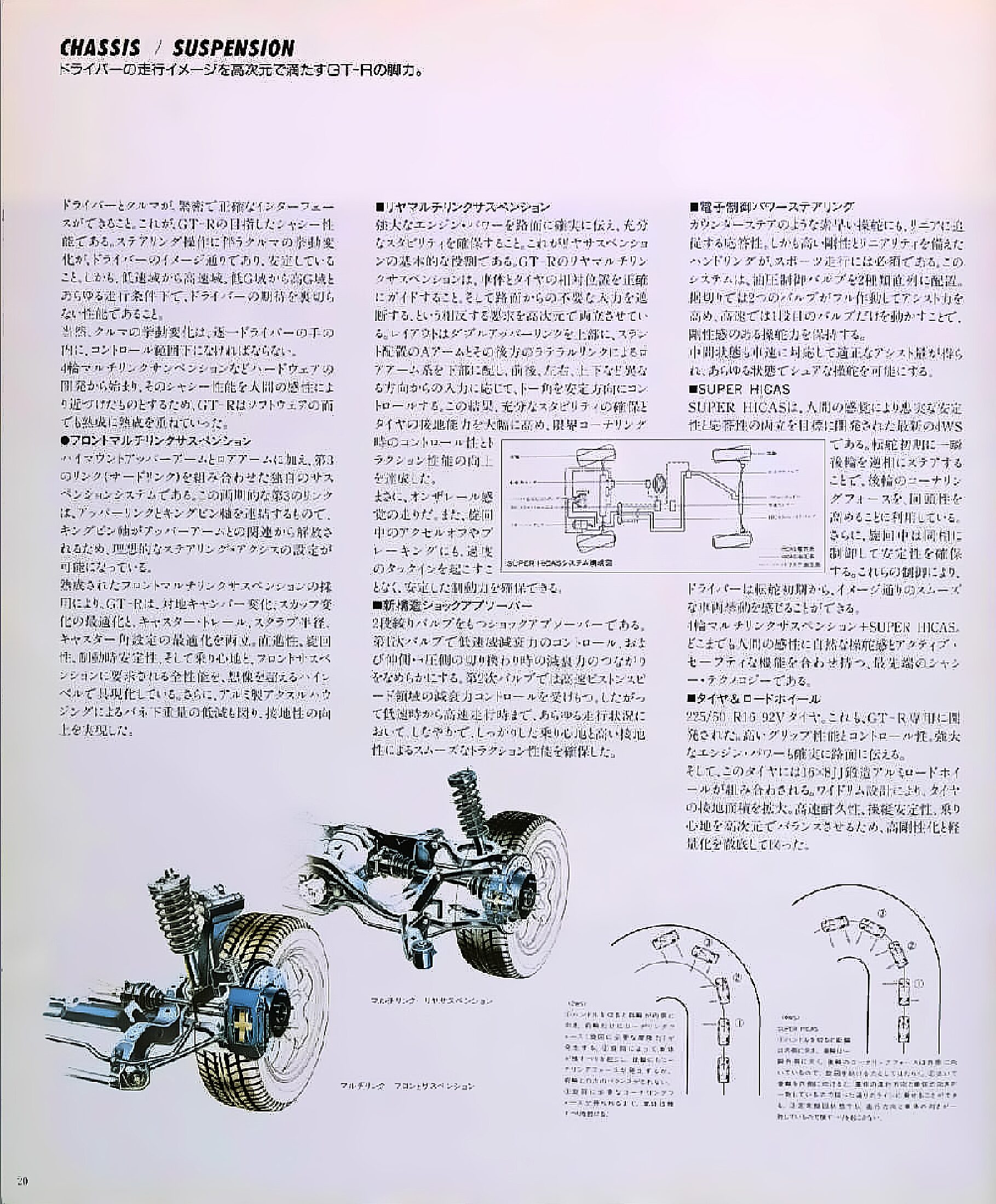
The GT-R's legs, meeting the driver's image of driving at a higher level.
A close, precise interface between driver and car: that is the chassis performance the GT-R aimed for. Changes in the car's behavior as the driver steers follow the driver's image and are stable; and from low speed to high, from low G to high G, in every driving condition, the performance never betrays the driver's expectations.
Naturally, the car's behavior must always stay in the driver's hands, within control.
Starting from the development of hardware such as the 4-wheel multi-link suspension, the GT-R was matured with care in software too, to bring that chassis performance closer to human feel.
Front multi-link suspension
A unique suspension system combining a high-mounted upper arm and a lower arm with a third link (third link). This groundbreaking third link connects the upper link and the kingpin axis; freeing the kingpin axis from the upper arm makes ideal steering-axis settings possible.
With the matured front multi-link suspension, the GT-R balances optimal camber change to the road and scuff change with optimal caster trail, scrub radius and caster angle. It achieves, at a level beyond imagination, everything a front suspension needs: straight-line stability, turning, stability under braking, and ride. Aluminum axle housings also reduce unsprung weight, improving grip.
Rear multi-link suspension
Putting the powerful engine's power onto the road surely, and ensuring full stability: these are the basic roles of the rear suspension. The GT-R's rear multi-link suspension achieves, at a high level, the conflicting demands of guiding the relative position of body and tires precisely and cutting unwanted input from the road. The layout places a double upper link at the top and, at the bottom, a lower arm system of a slanted A-arm and a lateral link behind it, controlling toe in a stable direction in response to input from front and back, left and right, up and down and other directions. As a result, full stability is ensured and tire grip greatly raised, improving control and traction when cornering at the limit.
This is truly driving with an on-rail feel. And when lifting off the accelerator or braking mid-corner, stable braking force is kept without excessive tuck-in.
Diagram: SUPER HICAS system diagram (labels [illegible])
New-structure shock absorbers
Shock absorbers with two-stage orifice valves. The first-stage valve controls the low-speed damping force and smooths the joining of damping force when switching between rebound and compression. The second-stage valve handles damping force control in the high piston-speed range. So from low speeds to high, in every driving condition, smooth traction is ensured through a supple, firm ride and high grip.
Electronically controlled power steering
Linear, responsive following of quick steering such as countersteering, together with handling that is highly rigid and linear, is essential to sporty driving. This system arranges two hydraulic control valves in series. When parking, the two valves work fully to raise assist; at high speed only the first-stage valve works, keeping a steering effort with a rigid feel.
In between, an assist suited to the speed is given too, allowing sure steering in every condition.
SUPER HICAS
SUPER HICAS is the latest 4WS, developed to balance stability and response faithful to human senses. At the start of a turn, the rear wheels are steered in the opposite phase for an instant, using the rear wheels' cornering force to raise turn-in. During the turn they are steered in the same phase to ensure stability. With this control, the driver feels smooth vehicle behavior, just as imagined, from the start of the turn.
4-wheel multi-link suspension + SUPER HICAS: leading-edge chassis technology, combining a feel of steering natural to human senses with active-safety abilities.
Tires & road wheels
225/50 R16 92V tires. These too were developed for the GT-R alone. With high grip and controllability, they put the powerful engine's power onto the road surely.
And these tires are combined with 16×8JJ forged aluminum road wheels. A wide-rim design enlarges the tire contact patch, and to balance high-speed durability, stability and ride at a higher level, the wheels are made thoroughly rigid and light.
Drawing labels:
Multi-link rear suspension
Multi-link front suspension
Cornering diagrams:
(2WS) ① Turning the steering wheel points the front wheels inward, and cornering force arises at the front wheels only. ② The turn makes the body slide sideways, and cornering force [illegible]. Until the cornering force the turn needs is reached, the body keeps sliding sideways.
(4WS) SUPER HICAS ① Turning the steering wheel points the front wheels inward, and [illegible] the rear wheels [illegible]. [illegible] the direction of travel and the direction of the body match, [illegible].
Page 15
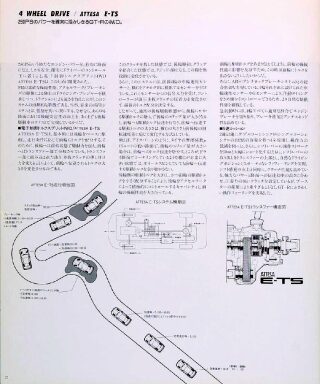
4 WHEEL DRIVE / ATTESA E-TS
The GT-R's 4WD, making full use of 280PS.
Putting a powerful 280PS of engine power onto the road effectively, and keeping it safely and surely under the driver's control: ATTESA E-TS, electronically controlled torque-split 4WD, was developed for this.
The groundbreaking feature of this system is that it keeps the honest handling of an FR and the unique driving pleasure of making full use of the accelerator and brakes, while adding the speed that traction brings. Naturally, it is very different in character from earlier 4WD systems, because it achieves better stability on every surface while keeping, above all, the feel of a rear-wheel-drive car.
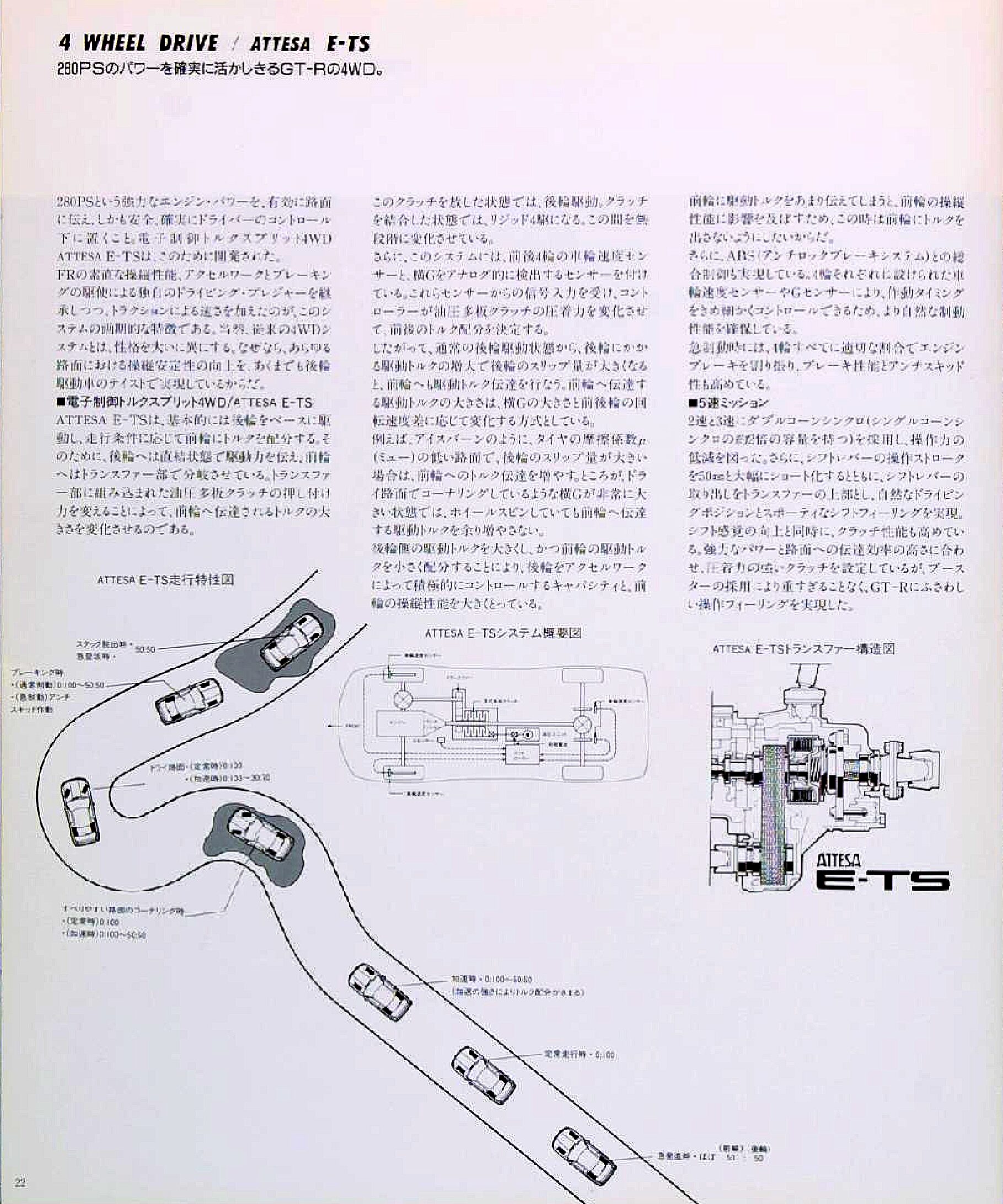
ATTESA E-TS basically drives the rear wheels, and sends torque to the front wheels as driving conditions require. For this, drive goes directly to the rear wheels, and is branched off to the front wheels at the transfer. Changing the pressing force of the hydraulic multi-plate clutch built into the transfer varies the amount of torque sent to the front wheels.
With this clutch released, the car is rear-wheel drive; with the clutch engaged, rigid 4WD. Between the two, it varies steplessly.
The system also has wheel speed sensors at all four wheels and a sensor that detects lateral G in analog form. Taking the signals from these sensors, the controller varies the clamping force of the hydraulic multi-plate clutch to decide the front-rear torque split.
So from normal rear-wheel drive, when increased drive torque on the rear wheels makes them slip more, drive torque is also sent to the front wheels. The amount of drive torque sent to the front wheels varies with the size of the lateral G and the difference in rotational speed between the front and rear wheels.
For example, on a surface where the tire friction coefficient μ (mu) is low, such as an icy road, when the rear wheels slip a lot, more torque is sent to the front wheels. But when lateral G is very high, as when cornering on a dry road, little more drive torque is sent to the front wheels even with wheelspin.
By giving more drive torque to the rear wheels and less to the front wheels, the system leaves plenty of room both for actively controlling the rear wheels with the accelerator and for steering with the front wheels. Sending much drive torque to the front wheels would affect their steering performance, so at such times no torque is sent to the front wheels.
Integrated control with the ABS (anti-lock brake system) is also achieved. Wheel speed sensors at each of the four wheels and the G sensor allow fine control of when it works, for more natural braking.
Under hard braking, engine braking is shared among all four wheels in suitable proportions, raising braking and anti-skid performance too.
5-speed transmission
Double-cone synchros (with about twice the capacity of single-cone synchros) on 2nd and 3rd reduce shift effort. The shift lever stroke is also shortened substantially to 50mm, and the lever comes out of the top of the transfer, for a natural driving position and a sporty shift feel. Along with the better shift feel, clutch performance is raised too. A clutch with high clamping force is set to match the strong power and the efficient transfer to the road, but a booster keeps it from being too heavy, for an operating feel fitting the GT-R.
Braking: (normal braking) 0:100 to 50:50; (hard braking) anti-skid works
Dry road: (steady) 0:100; (accelerating) 0:100 to 30:70
Cornering on a slippery road: (steady) 0:100; (accelerating) 0:100 to 50:50
Accelerating: 0:100 to 50:50 (the torque split is set by how hard the car accelerates)
Steady driving: 0:100
Sudden start: about (front) 50 : 50 (rear)
Diagram: ATTESA E-TS system overview (labels: wheel speed sensor, engine; the others [illegible])
Diagram: ATTESA E-TS transfer structure
ATTESA E-TS
Page 17
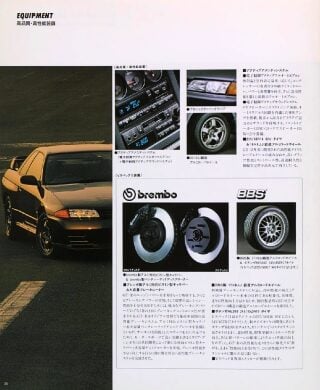
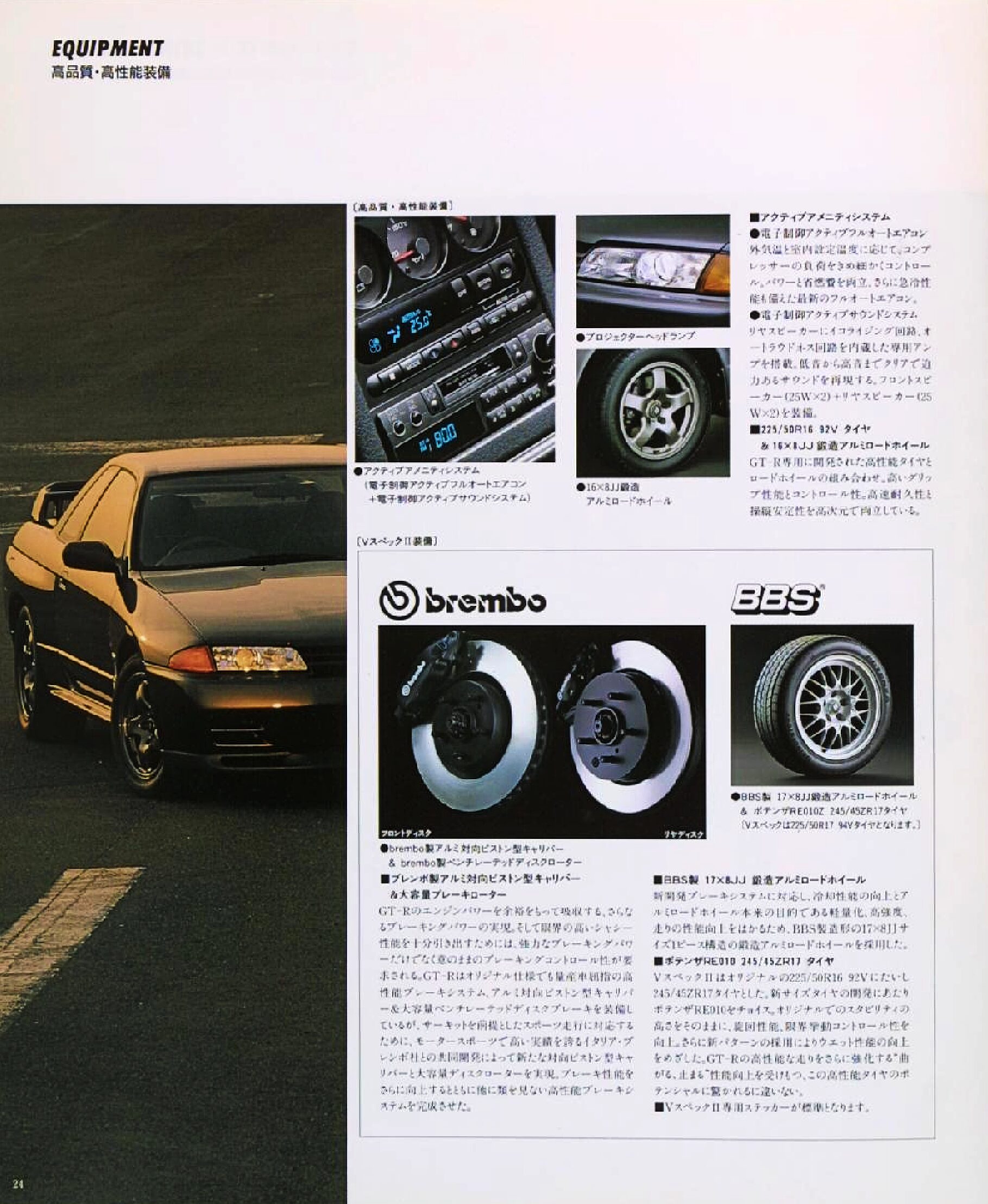
EQUIPMENT
High-quality, high-performance equipment
〔High-quality, high-performance equipment〕
Active amenity system (electronically controlled active full-auto air conditioner + electronically controlled active sound system)
Projector headlamps
16×8JJ forged aluminum road wheels
Active amenity system
Electronically controlled active full-auto air conditioner
Compressor load is finely controlled according to the outside temperature and the cabin temperature set, balancing power and fuel economy. The latest full-auto air conditioner, with quick cooling too.
Electronically controlled active sound system
A dedicated amplifier with an equalizing circuit and an auto loudness circuit for the rear speakers reproduces clear, powerful sound from bass to treble. Front speakers (25W×2) + rear speakers (25W×2).
A combination of high-performance tires and road wheels developed for the GT-R alone, balancing high grip and controllability with high-speed durability and stability at a higher level.
Still greater braking power, absorbing the GT-R's engine power with room to spare. And to bring out the full chassis performance with its high limits, not only strong braking power but braking control just as intended is needed. Even in the original specification the GT-R has one of the finest brake systems among production cars, with aluminum opposed-piston calipers & high-capacity ventilated disc brakes; but to handle sporty driving on the circuit, new opposed-piston calipers and high-capacity disc rotors were made in joint development with Brembo of Italy, proven in motor sport, raising braking performance further and completing a high-performance brake system without equal.
BBS 17×8JJ forged aluminum road wheels
To suit the newly developed brake system and improve cooling, and to achieve the real aims of a road wheel, lighter weight, high strength and better driving performance, BBS-made 17×8JJ one-piece forged aluminum road wheels are used.
POTENZA RE010 245/45ZR17 tires
The V-spec II has 245/45ZR17 tires instead of the original 225/50R16 92V. POTENZA RE010 was chosen in developing the new tire size. Keeping the high stability of the original, it improves cornering and control at the limit, and a new tread pattern aims at better wet performance. With better “turning and stopping” to strengthen the GT-R's high performance further, the potential of this high-performance tire will surely amaze.
A V-spec II sticker is standard.
Page 18
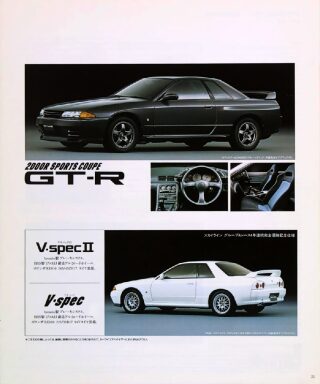
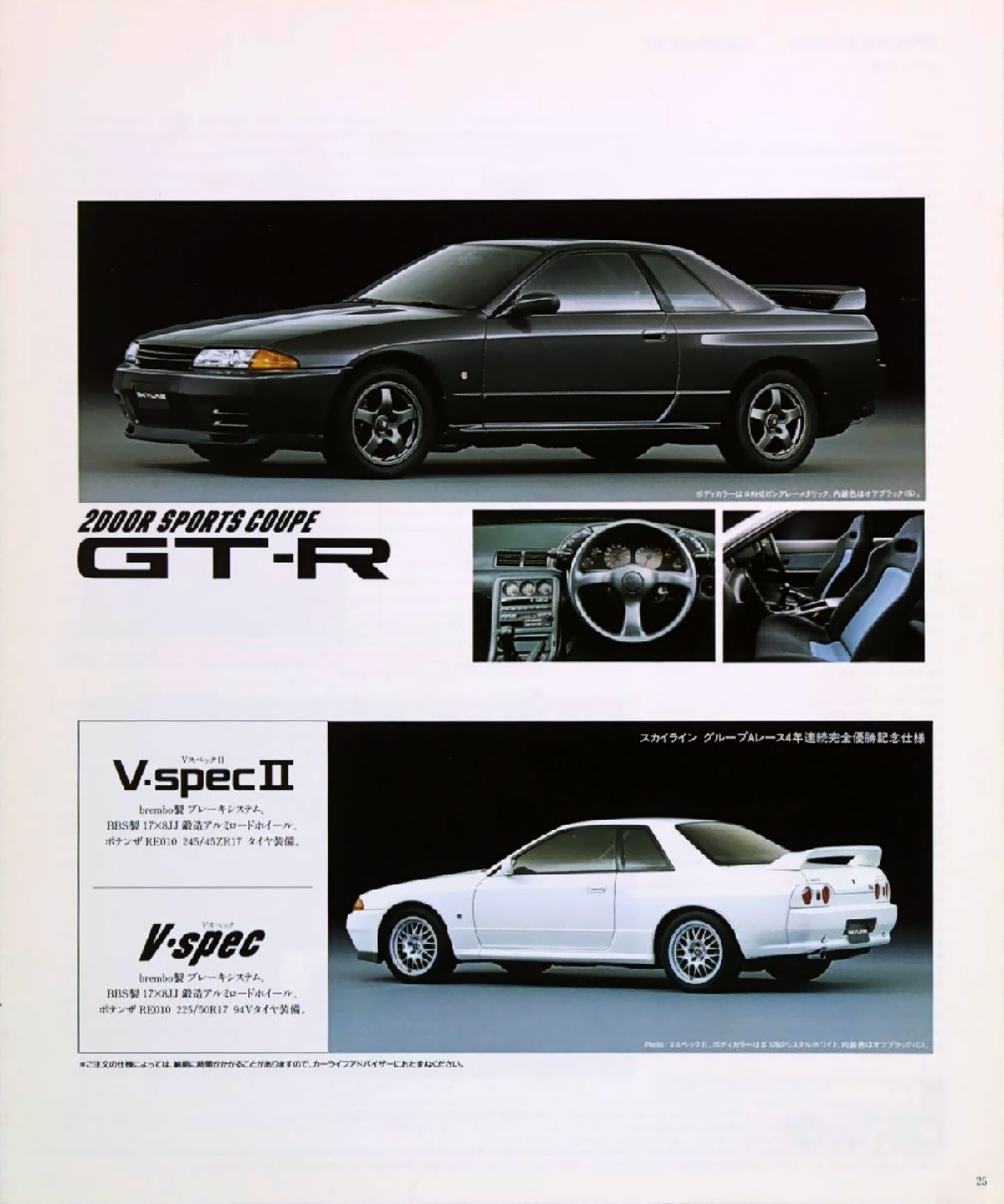
Body color #KH2 Gun Grey Metallic, interior color Off Black (G).
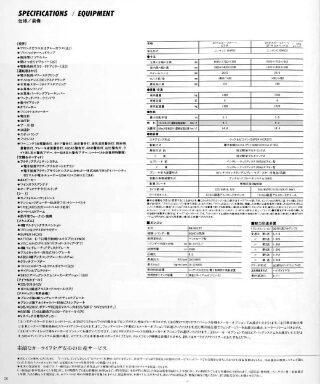
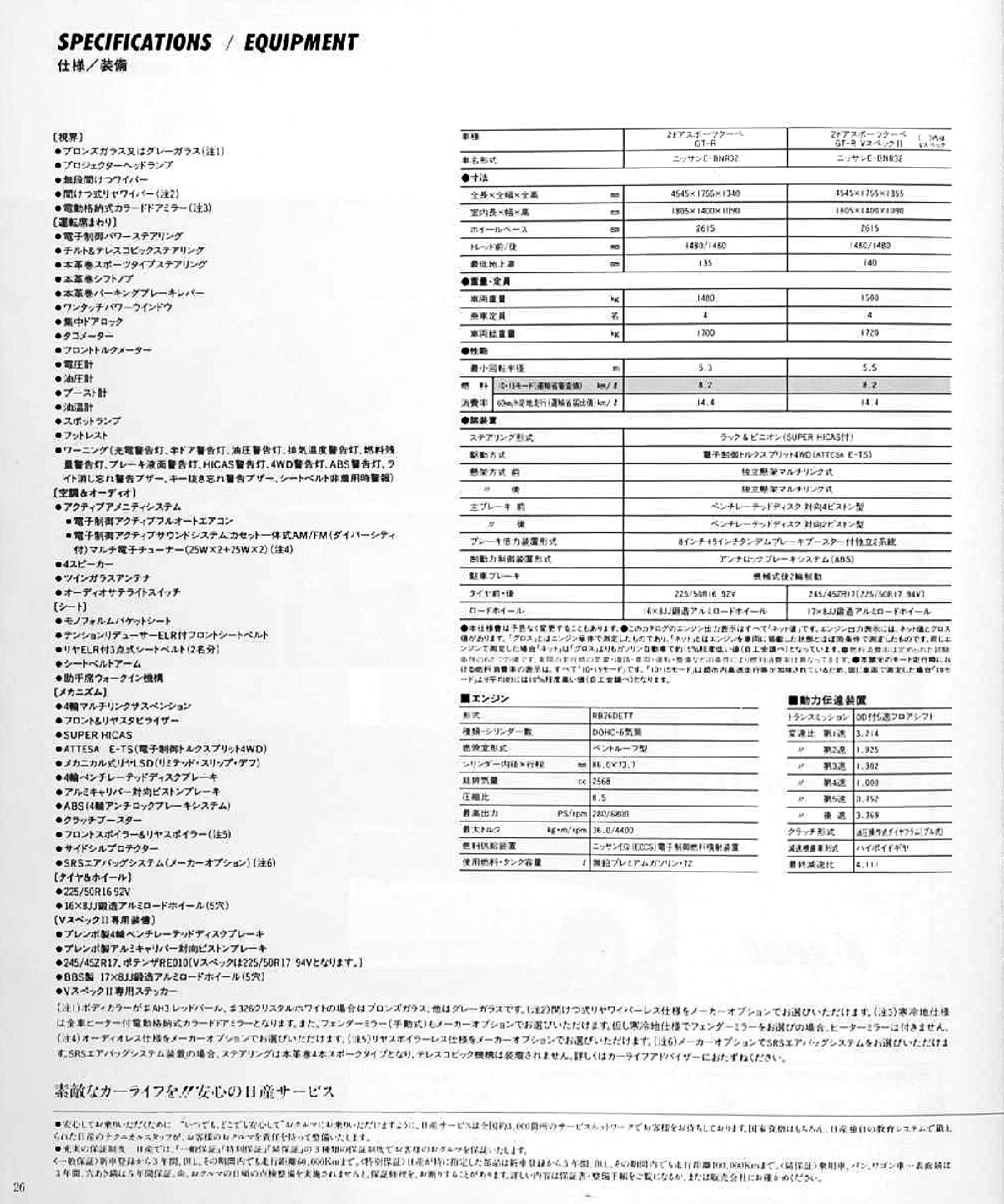
8-inch + 9-inch tandem brake booster, independent dual circuit
8-inch + 9-inch tandem brake booster, independent dual circuit
Braking force control
Anti-lock brake system (ABS)
Anti-lock brake system (ABS)
Parking brake
Mechanical, on the 2 rear wheels
Mechanical, on the 2 rear wheels
Tires, front/rear
225/50R16 92V
245/45ZR17 〔225/50R17 94V〕
Road wheels
16×8JJ forged aluminum road wheels
17×8JJ forged aluminum road wheels
These specifications may change without notice.
All engine outputs in this catalogue are “net” figures. Engine outputs are shown as “net” or “gross” figures: “gross” is measured on the engine alone, and “net” with the engine in nearly the same state as when fitted to the car. For the same engine, the “net” figure is about 15% lower than the “gross” for gasoline cars (JAMA survey).
Fuel consumption figures are values under set test conditions; in actual driving, fuel consumption varies with conditions such as weather, road, vehicle, driving and maintenance.
All mode fuel consumption figures in this catalogue are “10-15 mode”. As “10-15 mode” adds suburban high-speed driving, it is on average about 10% higher (JAMA survey) than “10 mode” measured on the same car.
(Note 1) With body colors #AH3 Red Pearl and #326 Crystal White, the glass is bronze; with the others, gray.
(Note 2) A specification without the intermittent rear wiper can be chosen as a maker option.
(Note 3) Cold-climate specification cars all have heated power-folding body-color door mirrors. Fender mirrors (manual) can also be chosen as a maker option; however, when fender mirrors are chosen with the cold-climate specification, heated mirrors are not fitted.
(Note 4) A specification without audio can be chosen as a maker option.
(Note 5) A specification without the rear spoiler can be chosen as a maker option.
(Note 6) The SRS airbag system can be chosen as a maker option. With the SRS airbag system, the steering wheel is a leather-wrapped 4-spoke type and the telescopic mechanism is not fitted. For details, please ask a Car Life Advisor.
For a wonderful car life!! Nissan service, for peace of mind
For peace of mind: so that you can drive your car “anytime, anywhere, with peace of mind”, Nissan service awaits you with a service network of about [illegible] locations nationwide. Nissan's technical staff, holding national qualifications and trained in Nissan's own education system, service your car with responsibility.
A full warranty: Nissan covers your car with three kinds of warranty, the “general warranty”, “special warranty” and “rust warranty”. 〈General warranty〉 3 years from new registration, but within that period only up to 60,000 km. 〈Special warranty〉 parts specially designated by Nissan, 5 years from new registration, but within that period only up to 100,000 km. 〈Rust warranty〉 passenger cars, vans and wagons: surface rust 3 years, perforation rust 5 years. Note that if daily inspection and maintenance of your car are not carried out, warranty repairs may be refused. For details, please see the warranty and maintenance booklet, or ask your dealer.
Page 20
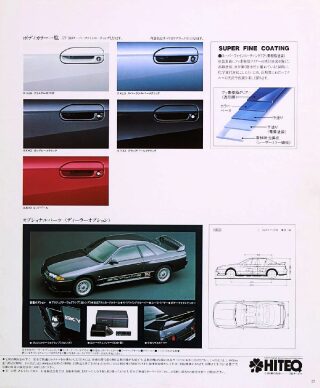
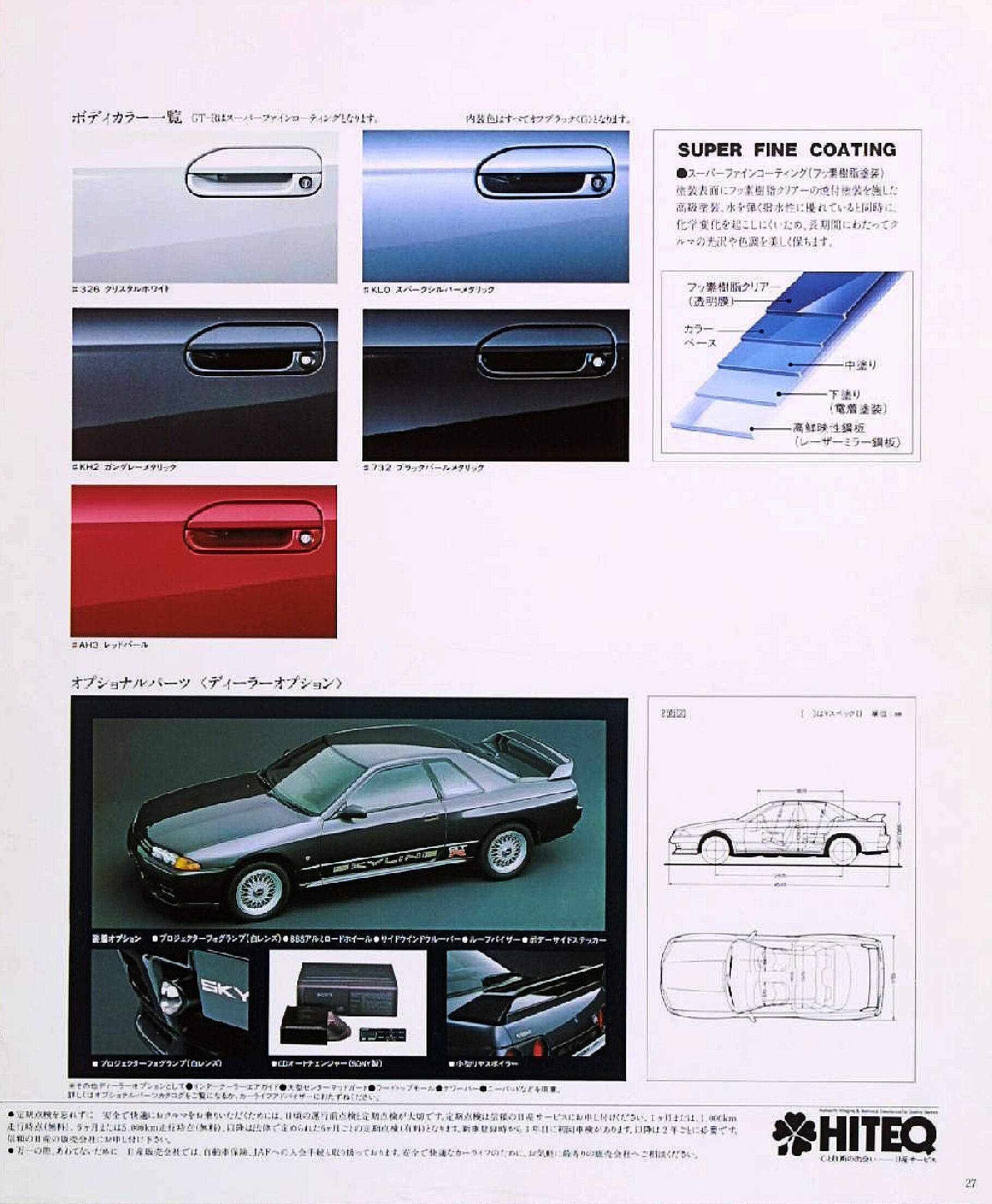
Body colors
All GT-Rs have Super Fine Coating. All interiors are Off Black (G).
#326 Crystal White
#KL0 Spark Silver Metallic
#KH2 Gun Grey Metallic
#732 Black Pearl Metallic
#AH3 Red Pearl
SUPER FINE COATING
Super Fine Coating (fluorine resin paint)
A high-grade paint with a baked fluorine-resin clear coat over the paint surface. It repels water well and resists chemical change, keeping the car's gloss and color beautiful for a long time.
Don't forget periodic inspections: to drive your car safely and comfortably, daily pre-drive checks and periodic inspections are important. Please ask your nearest Nissan service for periodic inspections. They are at 1 month or 1,000 km (free) and at 6 months or 5,000 km (free), and after that the periodic inspections required by law every 6 months (charged). The first vehicle inspection comes 3 years after new registration, and one is needed every 2 years after that. Please ask your nearest Nissan dealer.
So as not to be caught out in an emergency: Nissan dealers also handle car insurance and JAF membership, so for a safe and comfortable car life, please feel free to consult your nearest dealer.
HITEQ
[illegible] — Nissan Service
Page 21
If, having looked through this catalogue, you would like more detailed information or a test drive, please feel free to consult your nearest dealer.
Nissan Motor has also set up a “Customer Relations Office”, wishing to use your valuable opinions and requests for “making better cars” and “fuller service” in the future, so please feel free to consult or ask us by phone too.
We want to widen our circle of communication with customers, and strive to be of help in choosing your car.
We look forward to your continued support.
For inquiries and consultation, please contact the dealer below or the Nissan Motor Customer Relations Office.
Nissan Motor Co., Ltd. Customer Relations Office
Nationwide toll-free number 0120-315-232
The contents of this catalogue are as of February 1994; specifications and equipment may change without notice.
Body colors and interior colors may look different from the actual colors because of the printing inks, photographic conditions and so on.
LIFE TOGETHER NISSAN
Bringing human kindness to cars.
Nissan Motor Co., Ltd.
〒104 6-17-1 Ginza, Chuo-ku, Tokyo
C4253-4021AGG
About this sales brochure
Nissan's Japanese brochure for the R32 Skyline GT-R, printed in February 1994 when the V-spec II joined the range, covering the GT-R and the V-spec II with the engine, chassis, ATTESA E-TS four-wheel drive, safety, equipment, specifications and colors.
Grades: 2-door Sports Coupe GT-R and GT-R V-spec II (E-BNR32), with the V-spec's differences noted. No prices are listed.
Engine: RB26DETT 2,568 cc in-line six, DOHC 24-valve with ceramic twin turbochargers and intercooler, 280 PS at 6,800 rpm and 36.0 kg·m at 4,400 rpm, with a 5-speed manual and ATTESA E-TS electronically controlled torque-split 4WD.
V-spec II: brembo brakes, BBS 17×8JJ forged aluminum road wheels and POTENZA RE010 245/45ZR17 tires (the V-spec has 225/50R17 94V tires); the GT-R has 225/50R16 92V tires on 16×8JJ forged aluminum road wheels.
Colors: Crystal White (326), Spark Silver Metallic (KL0), Gun Grey Metallic (KH2), Black Pearl Metallic (732) and Red Pearl (AH3), all with an Off Black (G) interior and Super Fine Coating.
Size: 4,545 mm long, 1,755 mm wide and 1,340 mm high (V-spec II 1,355 mm) on a 2,615 mm wheelbase, 1,480 kg (V-spec II 1,500 kg).
Reproduced for archival and reference purposes. Nissan, its model names, logos and the images in this brochure are the trademarks and copyright of their owners; NENGUN is not affiliated with or endorsed by Nissan. If you hold rights in this material and object to it appearing here, contact us and we will remove it promptly.