GT-R

Skyline GT-R BNR32 original sales brochure
Japan · August 1989
Turn for full screen
Nissan's Japanese brochure for the R32 Skyline GT-R (BNR32), printed in August 1989 as the GT-R returned, covering the RB26DETT twin-turbo engine, the multi-link suspension with SUPER HICAS, ATTESA E-TS four-wheel drive, the brakes and body, with full specifications, equipment and colors. More
In English
Nothing to translate on this page.
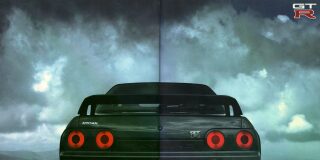
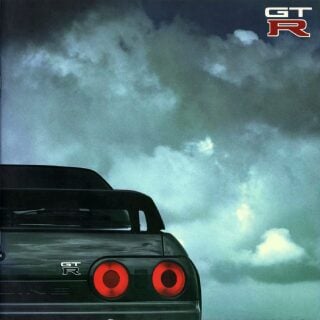
GT-R
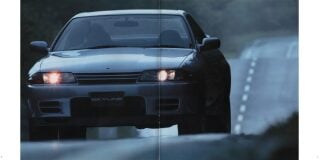
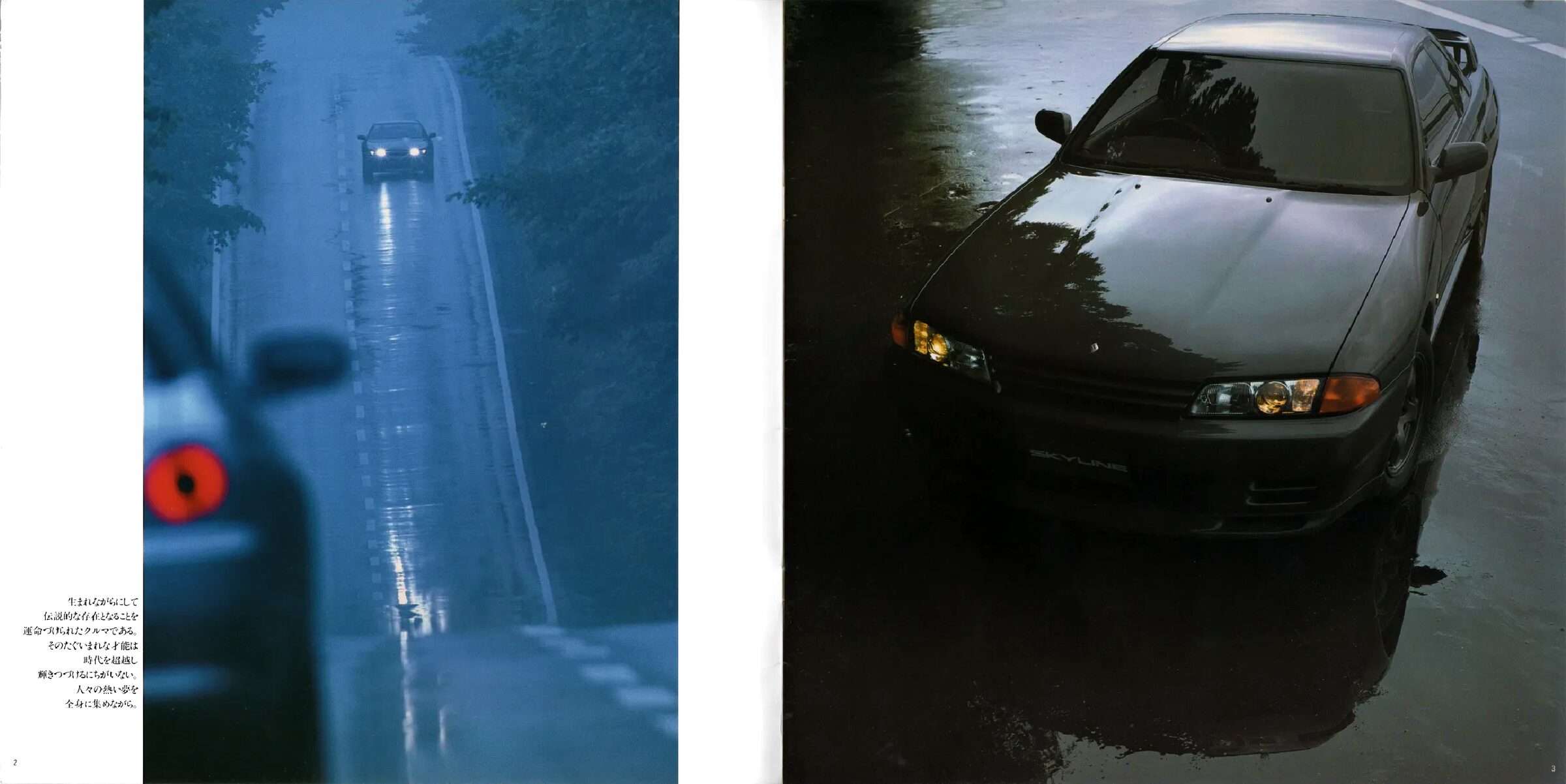
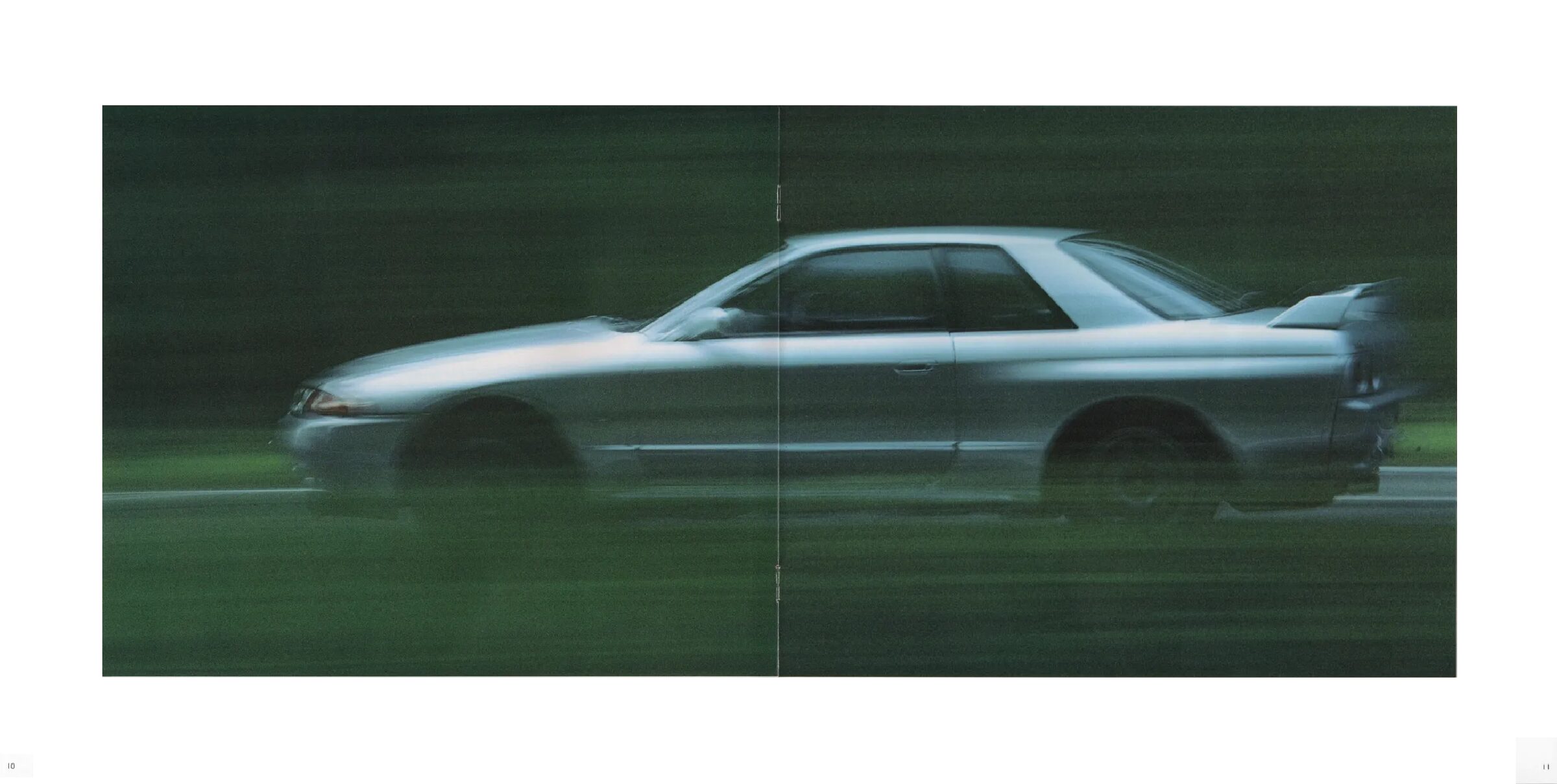
A car destined from birth to become a legend. That rare talent will surely transcend the times and keep shining, gathering the fervent dreams of people in every inch of the body.
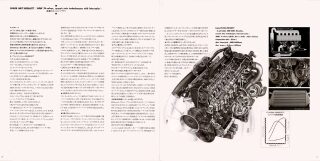
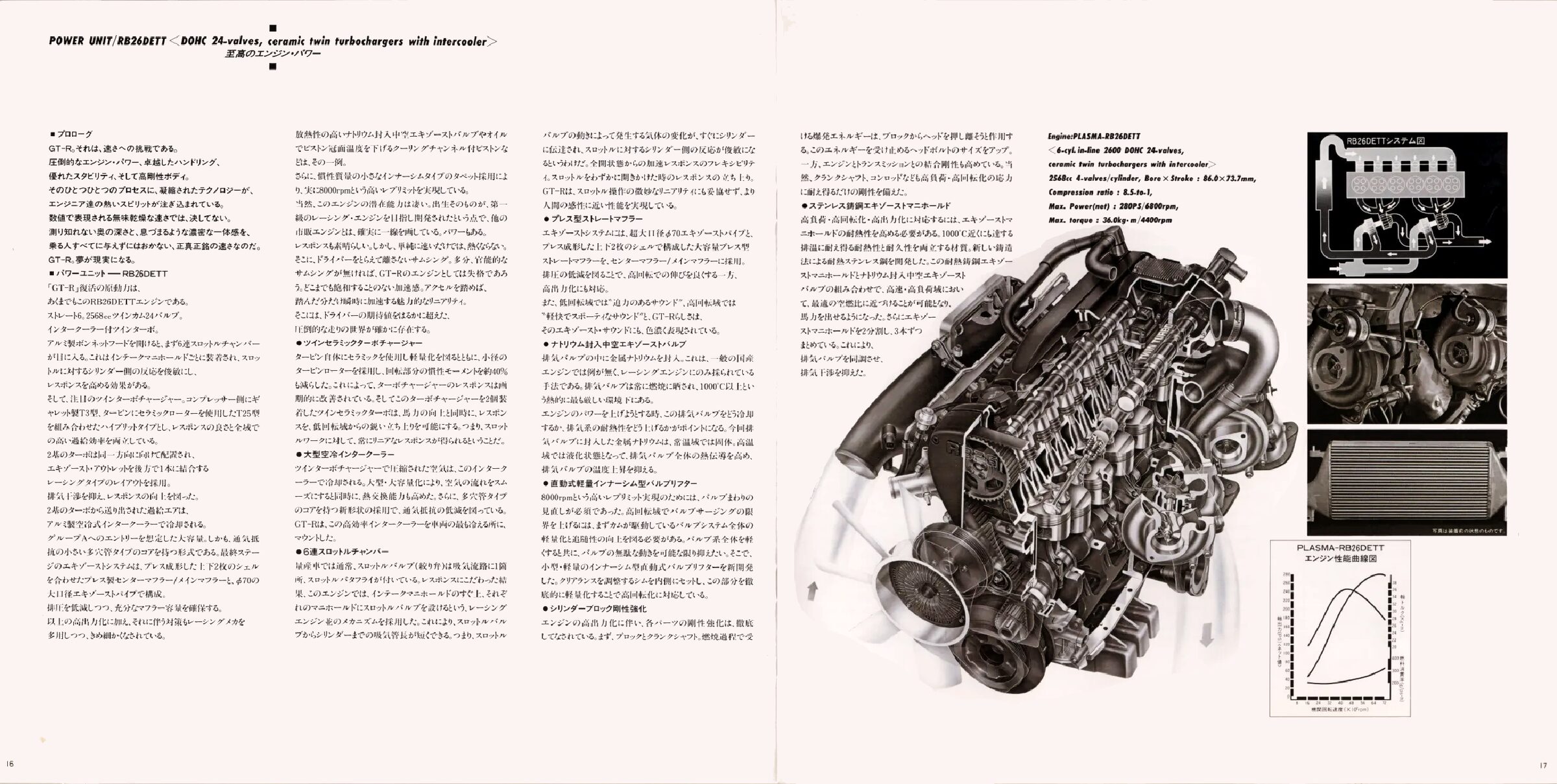
POWER UNIT/RB26DETT 〈DOHC 24-valves, ceramic twin turbochargers with intercooler〉
The ultimate engine power
Prologue
GT-R. A challenge to speed.
Overwhelming engine power, outstanding handling, excellent stability and a highly rigid body. Into every one of these processes, concentrated technology, the engineers have poured their passionate spirit.
This is never a dry speed expressed in figures. An immeasurable depth, and a dense, breathtaking sense of unity: this is genuine speed, which cannot fail to give them to everyone who rides in the car.
GT-R. A dream comes true.
Power unit — RB26DETT
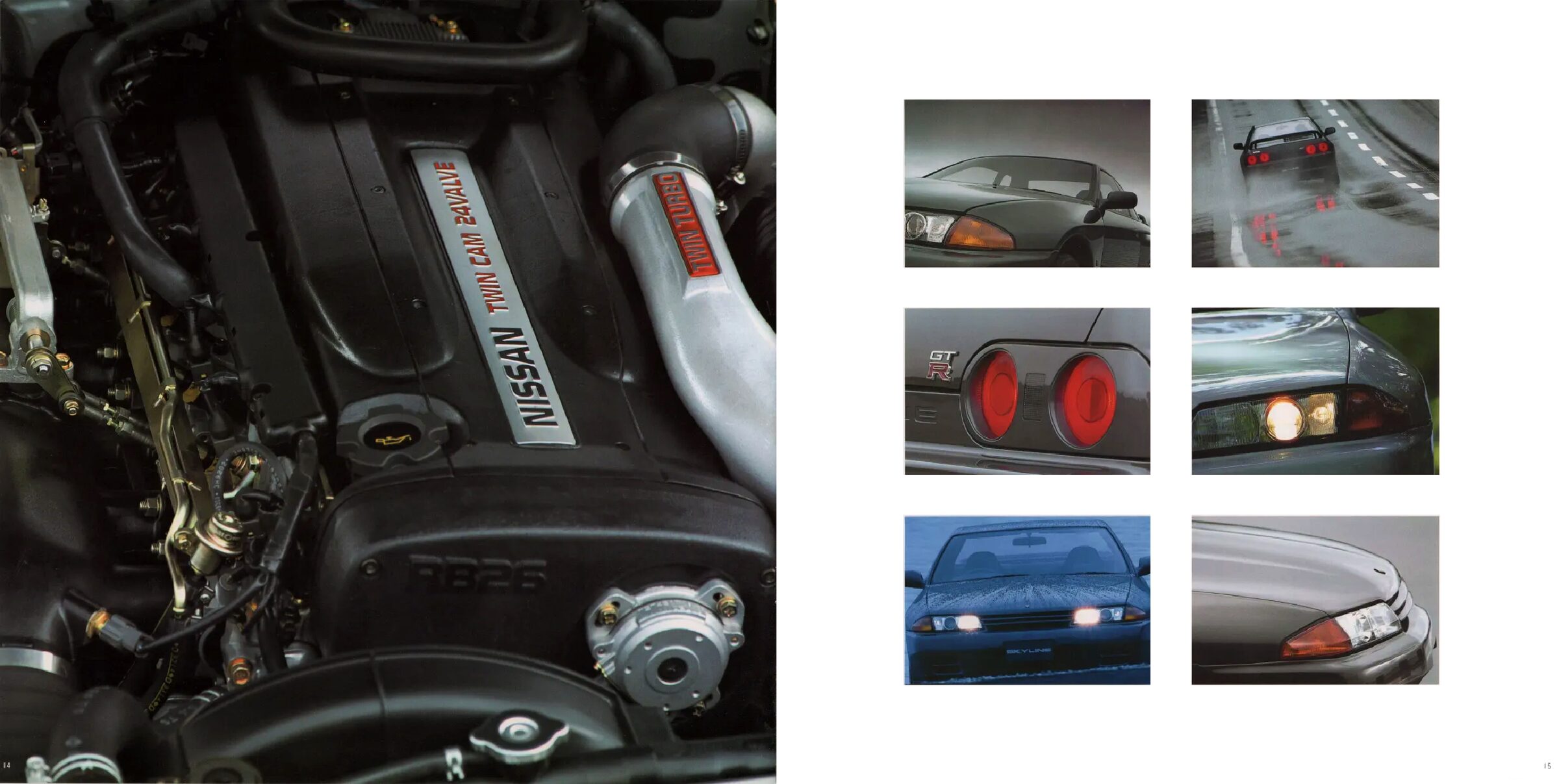
The driving force behind the revival of the “GT-R” is, above all, this RB26DETT engine.
Straight six. 2,568 cc twin cam, 24 valves.
Twin turbo with intercooler.
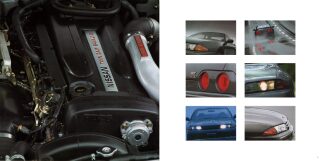
Open the aluminum hood and the first thing you see is the six throttle chambers. Fitted one to each intake manifold runner, they sharpen the reaction of the cylinders to the throttle and improve response.
Then the twin turbochargers, the center of attention. A hybrid type combining a Garrett T3 on the compressor side with a T25 using a ceramic rotor on the turbine side, they combine good response with high charging efficiency across the rev range.
The two turbos face the same direction, in a racing-type layout whose exhaust outlets join into one at the rear.
This holds down exhaust interference and improves response.
The charged air sent from the two turbos is cooled by an aluminum air-cooled intercooler.
A large capacity, designed with an entry into Group A in mind. And the core is a multi-tube type with low airflow resistance. The final stage of the exhaust system is a pressed center muffler/main muffler, made by joining upper and lower pressed shells, and a large-diameter φ70 exhaust pipe.
Back pressure is reduced while ample muffler capacity is kept.
Along with this higher output, the measures it calls for have been carefully taken, making wide use of racing mechanisms.
Pistons with a cooling channel, which lower the piston crown temperature with oil, and sodium-filled hollow exhaust valves, which dissipate heat well, are one example.
In addition, inner-shim tappets with a low inertial mass achieve a rev limit as high as 8,000 rpm.
Naturally, the potential of this engine is formidable. Developed from the start with a first-class racing engine as the goal, it is clearly set apart from other production engines. There is power. The response is superb, too. But mere speed does not excite. There has to be a “something” that captures the driver and never lets go. Without that sensual something, it would probably not deserve to be a GT-R engine. Acceleration that never runs out. Press the accelerator, and an appealing linearity accelerates the car at once, exactly as far as you pressed.
There, a world of overwhelming driving that far exceeds the expectations of the driver truly exists.
Twin ceramic turbochargers
The turbine is made of ceramic to make it lighter, and a small-diameter turbine rotor reduces the moment of inertia of the rotating parts by about 40%. This dramatically improves turbocharger response. And the twin ceramic turbo, fitting two of these turbochargers, raises horsepower while giving a sharp rise in response from low revs. In other words, the response to throttle work is always linear.
Large air-cooled intercooler
Air compressed by the twin turbochargers is cooled by this intercooler. Larger, with a larger capacity, it smooths the airflow and also has a greater heat exchange capacity. And a new design with a multi-tube core reduces airflow resistance. The GT-R mounts this high-efficiency intercooler in the coolest place on the car.
Six throttle chambers
A production car usually has one throttle butterfly, the throttle valve, at one point in the intake tract. Particular about response, this engine has a racing-engine mechanism, with a throttle valve on each manifold runner just above the intake manifold. This shortens the intake tract from throttle valve to cylinder. In other words, the change in the gas made by the movement of the throttle valve reaches the cylinder at once, so the cylinder reacts sharply to the throttle. The flexibility of acceleration response from a closed throttle. The rise in response when the throttle is barely opened. The GT-R makes no compromise even on the subtle linearity of throttle control, achieving performance closer to human senses.
Pressed straight muffler
The exhaust system has an extra-large φ70 exhaust pipe, and a large-capacity pressed straight muffler, built from upper and lower pressed shells, for the center muffler/main muffler. Reducing back pressure improves the stretch at high revs, and also handles the higher output.
And with a “powerful sound” at low revs and a “light, sporty sound” at high revs, the character of the GT-R is strongly expressed in the exhaust sound, too.
Sodium-filled hollow exhaust valves
Metallic sodium is sealed inside the exhaust valves. This technique is unknown in ordinary Japanese engines and used only in racing engines. The exhaust valves are always exposed to combustion, in the thermally harshest environment, above 1,000°C.
When raising engine power, the key is how to cool these exhaust valves and how to raise the heat resistance of the exhaust system. The metallic sodium sealed in the exhaust valves here is solid at room temperature. At high temperatures it becomes liquid, increasing heat conduction through the whole exhaust valve and holding down the rise in exhaust valve temperature.
Direct-acting lightweight inner-shim valve lifters
A rev limit as high as 8,000 rpm called for a rethink of the valve train. To raise the valve surging limit at high revs, the whole valve system driven by the cams must first be made lighter and follow better. The aim was to lighten the whole valve system while holding wasted valve movement down as far as possible. So a small, light inner-shim direct-acting valve lifter was newly developed. The shim that adjusts the clearance is set on the inside, and this part is thoroughly lightened to handle high revs.
Stiffer cylinder block
With the higher engine output, every part has been thoroughly stiffened. First, the block and crankshaft. The explosive energy of combustion acts to push the head away from the block. The head bolts that take this energy are larger. The joint between engine and transmission is also made stiffer. Naturally, the crankshaft, connecting rods and other parts have the rigidity to withstand high loads and high revs.
Stainless cast steel exhaust manifold
High loads, high revs and high output call for an exhaust manifold with greater heat resistance: a material with the heat resistance and durability to withstand exhaust temperatures approaching 1,000°C. A heat-resistant stainless steel made by a new casting method was developed. Combining this heat-resistant cast steel exhaust manifold with the sodium-filled hollow exhaust valves brings the air-fuel ratio close to the optimum in the high-speed, high-load range, so more power can be produced. The exhaust manifold is also split in two, grouping three cylinders each. This synchronizes the exhaust valves and holds down exhaust interference.
Engine:PLASMA-RB26DETT
〈6-cyl. in-line 2600 DOHC 24-valves, ceramic twin turbochargers with intercooler〉
2568cc 4-valves/cylinder, Bore×Stroke : 86.0×73.7mm,
Compression ratio : 8.5-to-1,
Max. Power(net) : 280PS/6800rpm,
Max. torque : 36.0kg-m/4400rpm
RB26DETT system diagram
The photos show the parts before fitting.
PLASMA-RB26DETT engine performance curves
The graph is labeled:
- Shaft output (PS) (net)
- Shaft torque (kg·m)
- Fuel consumption rate (g/PS·h)
- Engine speed (×10² rpm)
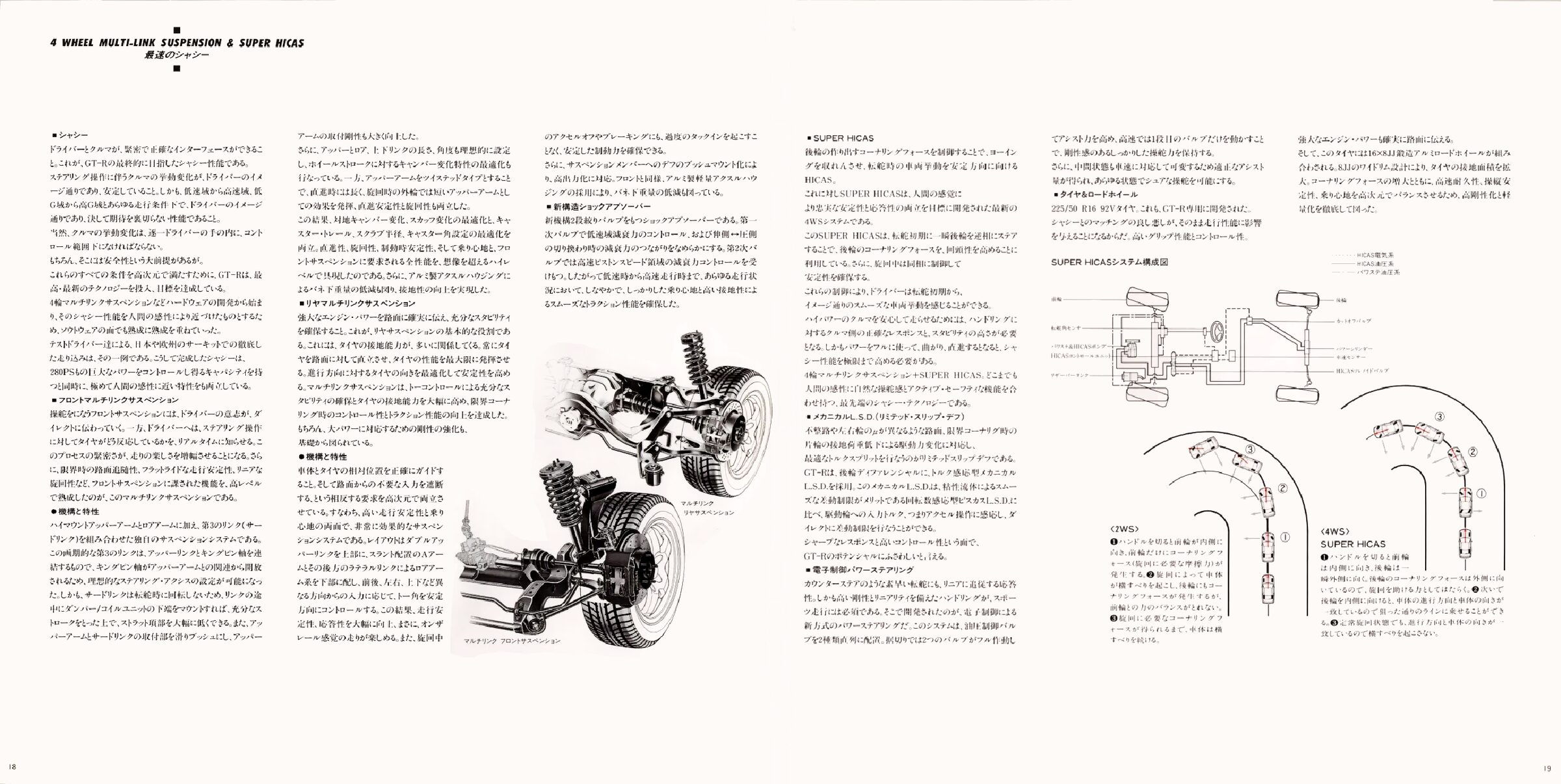
4 WHEEL MULTI-LINK SUSPENSION & SUPER HICAS
The fastest chassis
Chassis
A close, precise interface between driver and car. This is the chassis performance the GT-R finally aimed for.
The behavior of the car under steering is as the driver imagines, and stable. And under every driving condition, from low to high speed and from low G to high G, the car behaves as the driver imagines, never betraying expectations.
Naturally, the behavior of the car must always be within the control of the driver.
Of course, safety is the overriding premise.
To meet all these conditions at a high level, the GT-R brings in the highest and latest technology, and achieves the goal.
Starting with the development of hardware such as the 4-wheel multi-link suspension, the software was also refined again and again to bring chassis performance closer to human senses.
Thorough running by test drivers on circuits in Japan and Europe is one example. The chassis completed in this way has the capacity to control as much as 280 PS of huge power, and at the same time characteristics extremely close to human senses.
Front multi-link suspension
The front suspension, which does the steering, passes on the intentions of the driver directly. At the same time, the driver is told in real time how the tires are responding to the steering. The closeness of this process multiplies the pleasure of driving. And the functions asked of the front suspension, such as following the road at the limit, flat-ride stability and linear turning, were refined to a high level: this is the multi-link suspension.
Mechanism and characteristics
A unique suspension system combining a high-mount upper arm and a lower arm with a third link (the “third link”). This innovative third link connects the upper link to the kingpin axis, and since the kingpin axis is freed from the upper arm, an ideal steering axis can be set. Moreover, the third link does not rotate when steering, so mounting the lower end of the damper/coil unit partway along the link gives ample stroke while lowering the strut top a great deal. The upper arm and third link are mounted on sliding bushes, which also greatly increases the mounting rigidity of the upper arm.
The lengths and angles of the upper and lower links are also ideally set, optimizing camber change against wheel stroke. And the twisted upper arm acts as a long upper arm when running straight and as a short one on the outer wheel when turning, giving both straight-line stability and cornering.
As a result, camber change and scuff change are optimized, together with the caster trail, scrub radius and caster angle. Straight-line stability, cornering, stability under braking and ride comfort: every performance asked of the front suspension is realized at a level beyond imagination. Aluminum axle housings also reduce unsprung weight and improve road holding.
Rear multi-link suspension
To put huge engine power down on the road surely, and to secure ample stability: this is the basic role of the rear suspension. The grip of the tires has a great deal to do with it. Keeping the tires always upright to the road draws the most from the tires. Optimizing the direction of the tires against the direction of travel increases stability. The multi-link suspension secures ample stability through toe control and greatly increases tire grip, improving control and traction when cornering at the limit.
Of course, the strength to handle high power was also built in from the foundations.
Mechanism and characteristics
Guiding the position of the body against the tires precisely, while blocking unwanted input from the road: these conflicting demands are met at a high level. In other words, this suspension system is highly effective for both high driving stability and ride comfort. The layout places a double upper link at the top and, at the bottom, a lower arm system of a slanted A-arm and a lateral link behind it, controlling the toe angle in the stable direction in response to input from different directions: front and rear, left and right, up and down. As a result, driving stability and response are greatly improved, for a truly on-rails drive. And even when lifting off or braking mid-corner, stable braking force is kept without excessive tuck-in.
The differential is also bush-mounted to the suspension member to handle the higher output. As at the front, light aluminum axle housings reduce unsprung weight.
New shock absorbers
Shock absorbers with a new two-stage orifice valve mechanism. The first valve controls damping in the low-speed range and smooths the change in damping force when switching between extension ↔ compression. The second valve takes over damping force control in the high piston-speed range. So in every driving situation, from low to high speed, the car keeps a supple, firm ride and smooth traction with high road holding.
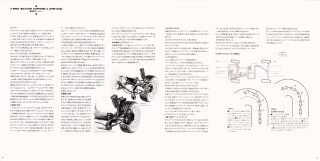
The drawings are labeled:
- Multi-link rear suspension
- Multi-link front suspension
SUPER HICAS
HICAS controls the cornering force the rear wheels produce, settling yawing and steering the behavior of the car in a stable direction when turning.
SUPER HICAS, in turn, is the latest 4WS system, developed to give stability and response more faithful to human senses.
This SUPER HICAS steers the rear wheels in the opposite phase for an instant at the start of a turn, using the cornering force of the rear wheels to sharpen turn-in. Then, during the turn, it controls them in the same phase to keep the car stable.
Through this control, the driver feels smooth vehicle behavior, as imagined, from the start of a turn.
To drive a high-powered car with confidence, the car must respond accurately to the steering and be highly stable. And to corner and run straight at full power, chassis performance must be raised to the limit.
4-wheel multi-link suspension + SUPER HICAS. The most advanced chassis technology, combining a steering feel natural to human senses with active safety.
Mechanical L.S.D. (limited-slip differential)
A limited-slip differential gives the best torque split, handling the change in drive force when the load on one wheel drops on rough roads, roads where μ differs from left to right, and cornering at the limit. The GT-R has a torque-sensing mechanical L.S.D. in the rear differential. Compared with a rev-sensing viscous L.S.D., whose merit is smooth differential limiting through a viscous fluid, this mechanical L.S.D. limits differential action directly in response to the input torque to the driving wheels, in other words to the accelerator.
With sharp response and high controllability, it is fitting for the potential of the GT-R.
Electronically controlled power steering
Handling with high rigidity and linearity, following even quick steering such as countersteer linearly, is essential for sports driving. So a new electronically controlled power steering was developed. This system has two kinds of hydraulic control valves arranged in series. When steering at a standstill, both valves work fully for more assist, and at high speed only the first-stage valve works, keeping a firm steering force with a sense of rigidity. In between, the assist varies with vehicle speed, so the right amount is obtained, for crisp steering in every situation.
Tires & road wheels
225/50 R16 92V tires. These too were developed for the GT-R alone, because how well they match the chassis directly affects driving performance. High grip and controllability. The huge engine power is put down on the road surely. And these tires are combined with 16×8JJ forged aluminum road wheels. The wide 8JJ rim design enlarges the contact area of the tires. Together with more cornering force, high-speed durability, handling stability and ride comfort are balanced at a high level, with thorough stiffening and lightening.
SUPER HICAS system layout
The diagram is labeled:
- Front wheels
- Steering angle sensor
- Power steering & HICAS pump
- HICAS control unit
- Reservoir tank
- Rear wheels
- Cut-off valve
- Power cylinder
- Vehicle speed sensor
- HICAS solenoid valve
Key:
- HICAS electrical
- HICAS hydraulic
- Power steering hydraulic
〈2WS〉
❶ When the steering wheel is turned, the front wheels point inward, and cornering force (the friction needed to turn) is produced by the front wheels alone. ❷ Turning makes the body slip sideways, and the rear wheels produce cornering force too, but it is not balanced with the force of the front wheels. ❸ The body keeps slipping sideways until the cornering force needed to turn is obtained.
〈4WS〉 SUPER HICAS
❶ When the steering wheel is turned, the front wheels point inward and the rear wheels point outward for an instant. The cornering force of the rear wheels points outward, so it acts as a force that helps the car turn. ❷ Then the rear wheels are turned inward; the direction of travel and the direction the body faces coincide, so the car can be put on exactly the line intended. ❸ Even in steady cornering, the direction of travel and the direction the body faces coincide, so the car does not slip sideways.
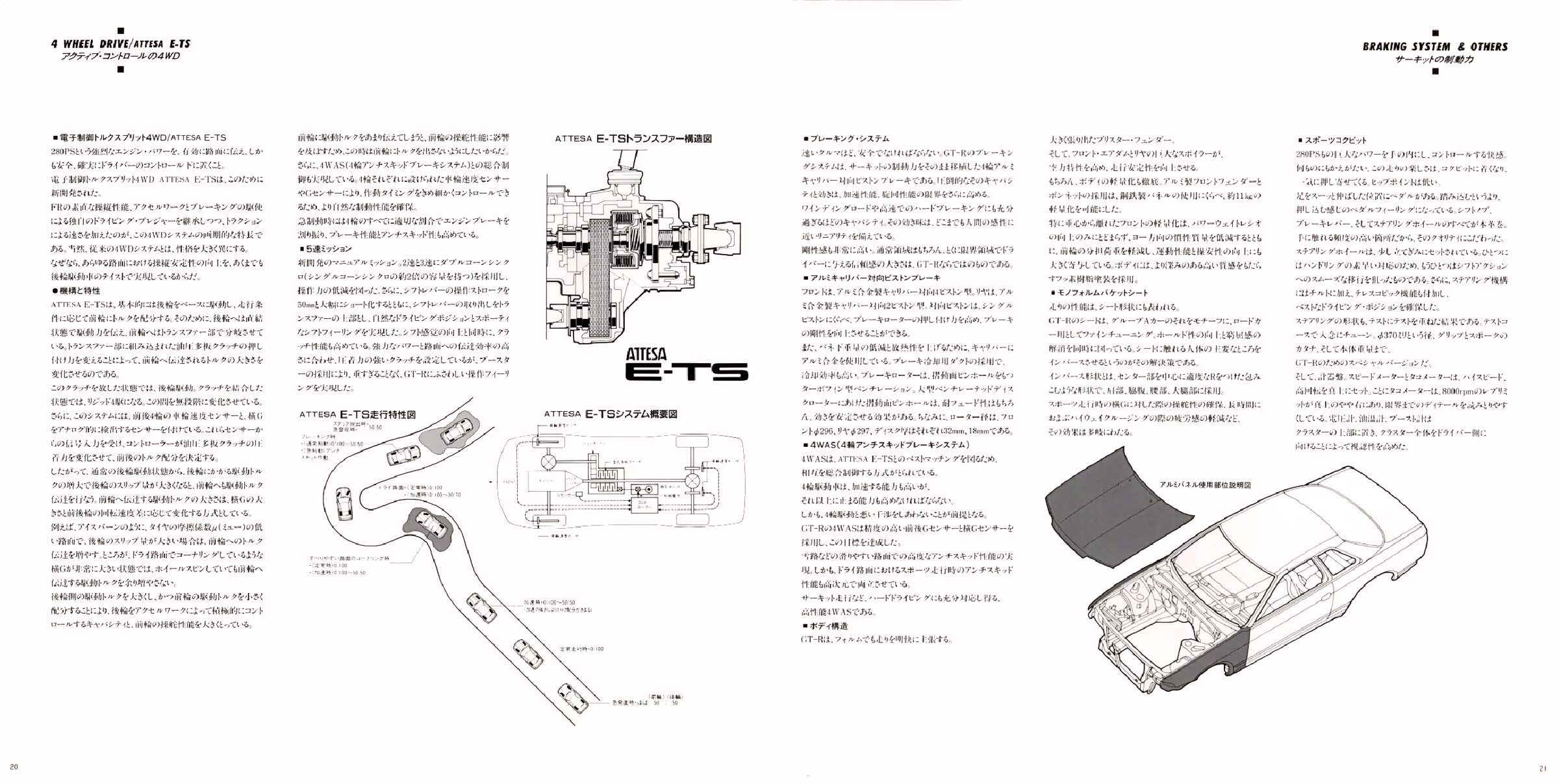
4 WHEEL DRIVE/ATTESA E-TS
Actively controlled 4WD
Electronically controlled torque-split 4WD/ATTESA E-TS
To put the strong engine power of 280 PS down on the road effectively, while keeping it safely and surely under the control of the driver.
The electronically controlled torque-split 4WD ATTESA E-TS was newly developed for this.
Keeping the honest handling of an FR car and the unique driving pleasure of using throttle and brakes, and adding the speed of traction: this is the groundbreaking feature of this 4WD system. Naturally, it differs greatly in character from earlier 4WD systems.
That is because it achieves greater handling stability on every road surface while keeping, to the end, the feel of a rear-wheel-drive car.
Mechanism and characteristics
ATTESA E-TS basically drives the rear wheels, and distributes torque to the front wheels as driving conditions require. To do so, drive goes directly to the rear wheels, and branches off to the front wheels at the transfer. Varying the pressure on the hydraulic multi-plate clutch built into the transfer varies the torque sent to the front wheels.
With this clutch released, the car is rear-wheel drive. With the clutch engaged, it becomes rigid 4WD. In between, it varies steplessly.
The system also has wheel speed sensors on all four wheels and a sensor that detects lateral G in analog form. Receiving the signals from these sensors, the controller varies the pressure on the hydraulic multi-plate clutch and decides the front-rear torque split.
So from normal rear-wheel drive, when more drive torque on the rear wheels makes them slip more, drive torque is also sent to the front wheels. The drive torque sent to the front wheels varies with the size of lateral G and the difference in speed between front and rear wheels.
For example, on a surface with a low friction coefficient μ (mu), such as an icy road, when the rear wheels slip a lot, more torque goes to the front wheels. But when lateral G is very large, as when cornering on a dry road, little more drive torque goes to the front wheels even if the wheels spin.
By giving the rear wheels a large share of the drive torque and the front wheels a small share, the car has the capacity to control the rear wheels actively with the throttle, and the front wheels keep plenty of steering performance.
Sending too much drive torque to the front wheels affects their steering performance, which is why, at such times, the aim is to keep torque away from the front wheels.
The system is also controlled together with 4WAS (4-wheel anti-skid brake system). Wheel speed sensors on each of the four wheels and G sensors control the timing finely, giving more natural braking.
Under hard braking, engine braking is shared out in the right proportion among all four wheels, improving braking performance and anti-skid performance.
5-speed transmission
A newly developed manual transmission. 2nd and 3rd have double-cone synchros (with about twice the capacity of a single-cone synchro), reducing shift effort. The shift lever stroke is also greatly shortened, to 50 mm, and the shift lever comes out of the top of the transfer, for a natural driving position and a sporty shift feel. Along with the better shift feel, clutch performance is also improved. To match the strong power and the efficient transmission of drive to the road, a clutch with a strong clamping force is used, but a booster keeps it from being too heavy, giving an operating feel worthy of the GT-R.
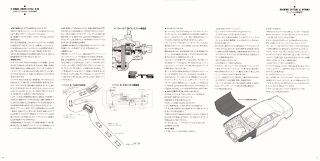
ATTESA E-TS transfer cutaway
ATTESA E-TS
ATTESA E-TS driving characteristics
The torque split (front : rear) in each condition:
- Escaping when stuck, climbing a steep hill: 50:50
- Braking: (normal braking) 0:100 to 50:50; (hard braking) anti-skid operates
- Dry road: (steady) 0:100; (accelerating) 0:100 to 30:70
- Cornering on a slippery road: (steady) 0:100; (accelerating) 0:100 to 50:50
- Accelerating: 0:100 to 50:50 (the torque split depends on how hard the car accelerates)
- Steady driving: 0:100
- Sudden start: about 50:50
ATTESA E-TS system outline
The diagram is labeled:
- FRONT
- Wheel speed sensors
- Hydraulic multi-plate clutch
- G sensor
- Hydraulic unit
- Controller
- [illegible] (the remaining labels)
BRAKING SYSTEM & OTHERS
Circuit braking power
Braking system
The faster the car, the safer it must be. The braking system of the GT-R is a 4-wheel aluminum caliper opposed-piston brake, transplanting circuit braking power as it is. That overwhelming capacity and effect push the limits of acceleration and cornering further still.
Capacity more than enough even for hard braking on winding roads and at high speed. The braking feel has a linearity close to human senses all the way.
The sense of rigidity is also very high. The great confidence it gives the driver, in normal driving and above all at the limit, is something only the GT-R offers.
Aluminum caliper opposed-piston brakes
At the front, aluminum-alloy calipers with four opposed pistons. At the rear, aluminum-alloy calipers with two opposed pistons. Compared with a single piston, opposed pistons press harder on the brake rotor and make the brake stiffer.
To reduce unsprung weight and dissipate heat better, the calipers are also aluminum alloy. Brake cooling ducts give high cooling efficiency, too. The brake rotors are turbo-fin ventilated, with pinholes in the friction faces. The pinholes in the friction faces of the large ventilated disc rotors resist fade and also make braking more stable. The rotors are φ296 at the front and φ297 at the rear, and the discs are 32 mm and 18 mm thick.
4WAS (4-wheel anti-skid brake system)
4WAS is controlled together with ATTESA E-TS, for the best match between them.
A 4WD car is good at accelerating, but must be even better at stopping.
And it must not interfere badly with the four-wheel drive.
The 4WAS of the GT-R achieves this with precise front-rear and lateral G sensors.
It achieves advanced anti-skid performance on slippery surfaces such as snowy roads, and anti-skid performance in sports driving on dry roads, both at a high level.
A high-performance 4WAS, fully able to handle hard driving such as circuit driving.
Body structure
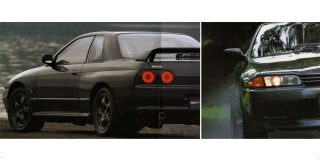
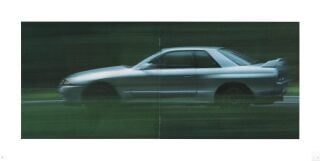
The form of the GT-R, too, clearly declares how the car drives.
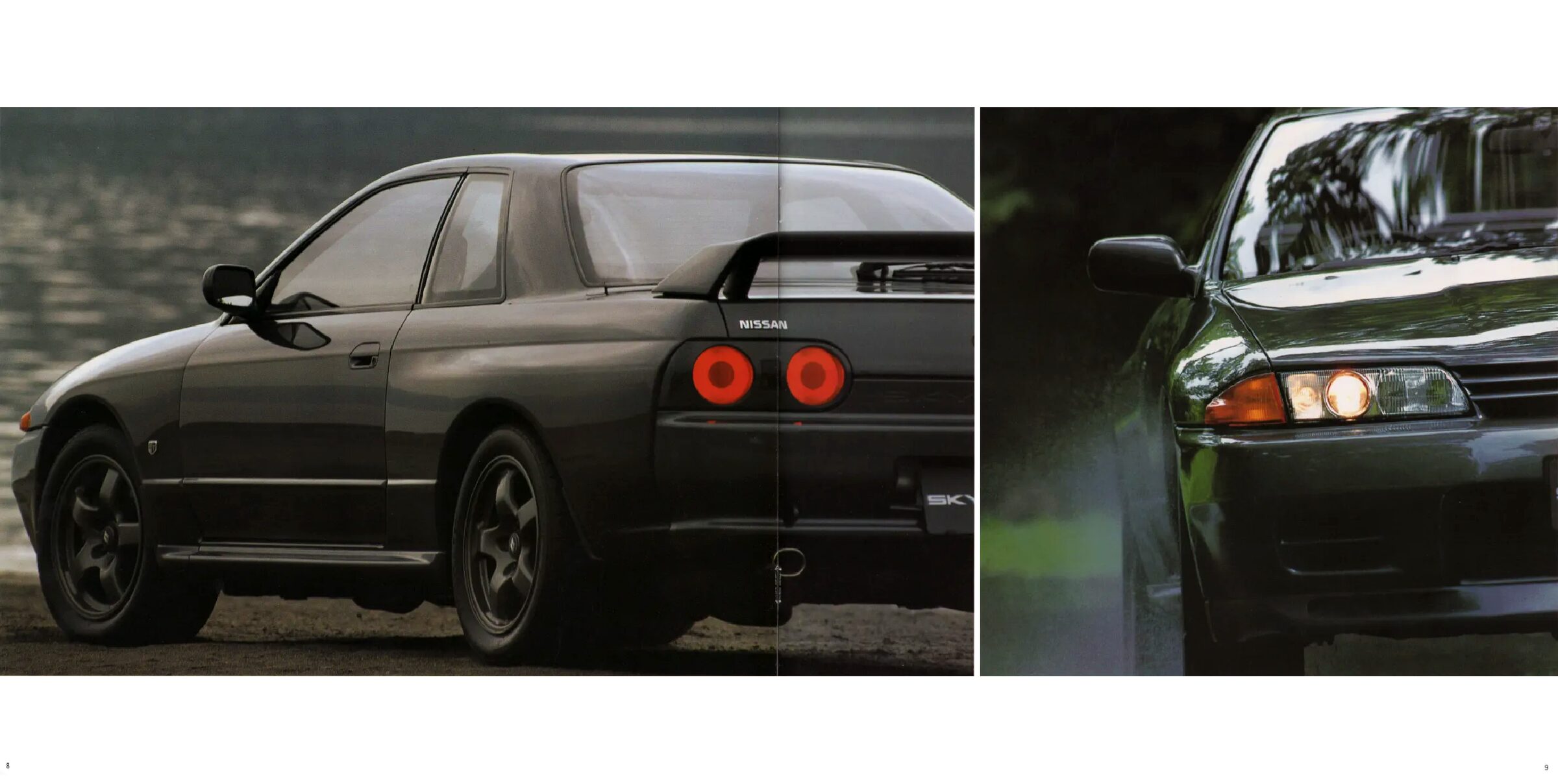
Blister fenders that flare out wide.
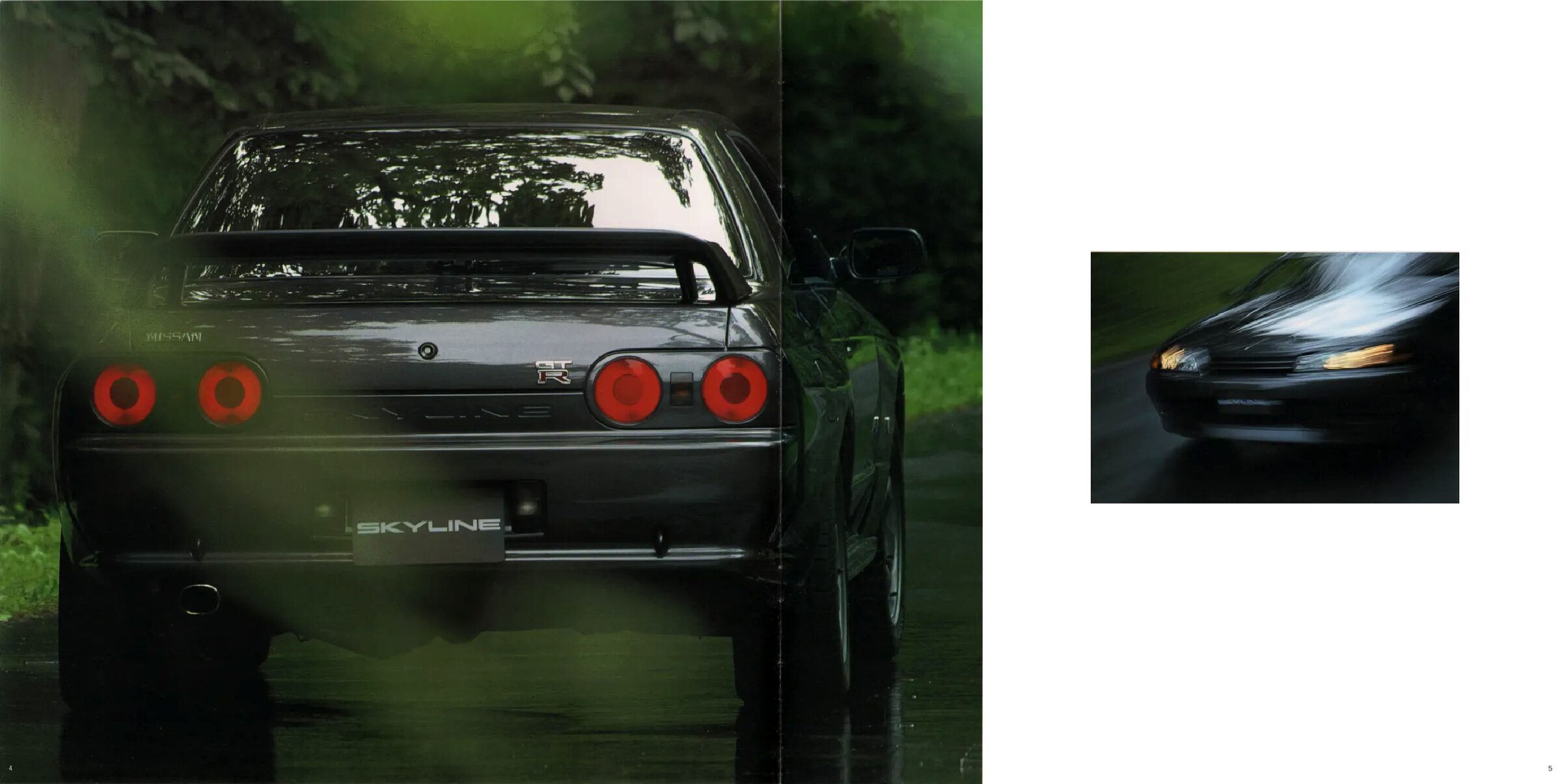
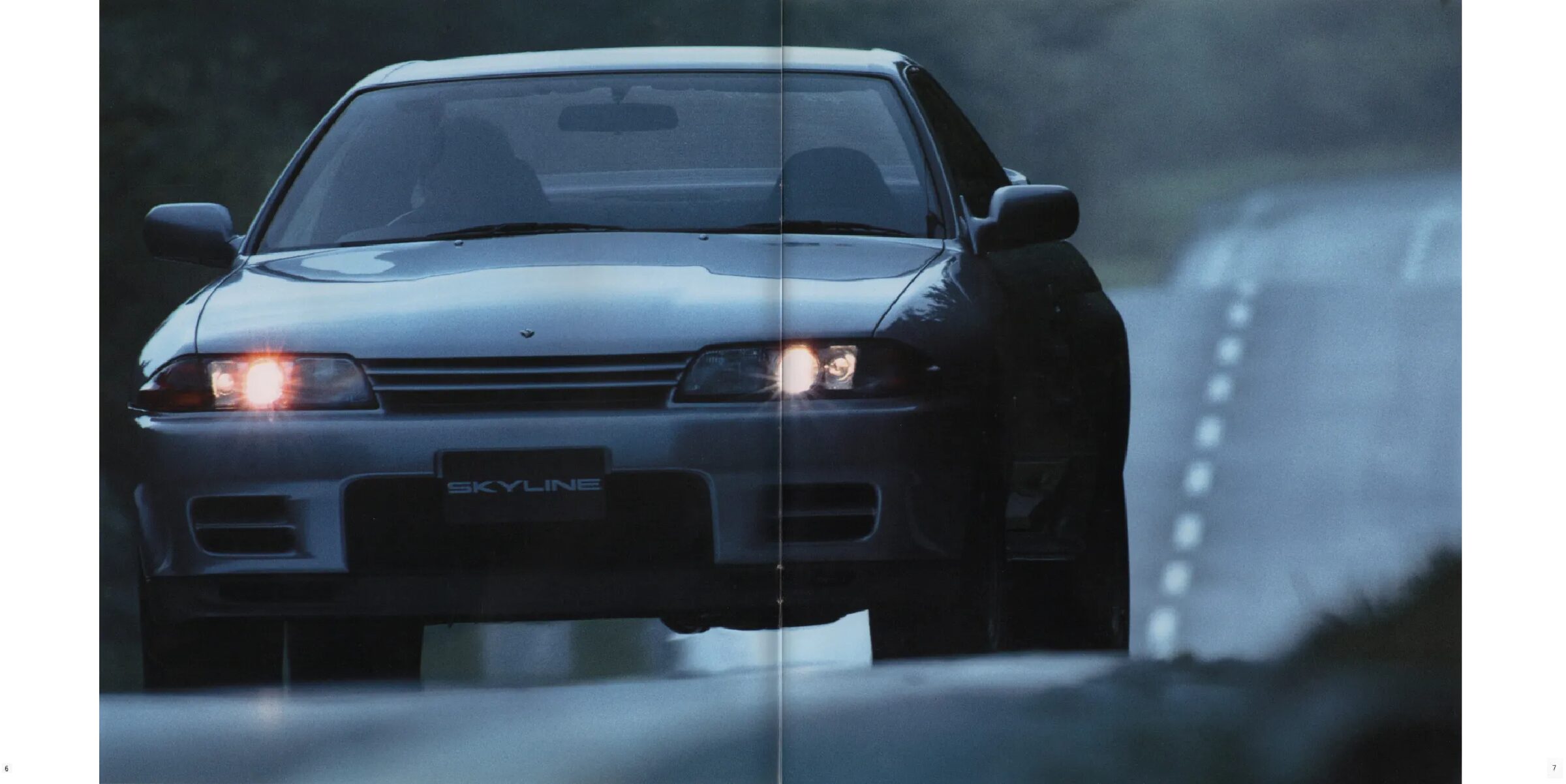
And the front air dam and the huge rear spoiler improve aerodynamics and driving stability.
Of course, the body is thoroughly lightened. Aluminum front fenders and hood save about 11 kg compared with steel panels.
Lightening the front, far from the center of gravity, not only improves the power-to-weight ratio but also reduces the yaw moment of inertia and the load on the front wheels, contributing greatly to better dynamic performance and handling stability. The body is finished in a fluororesin paint with a deeper, high-quality look.
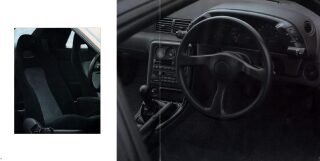
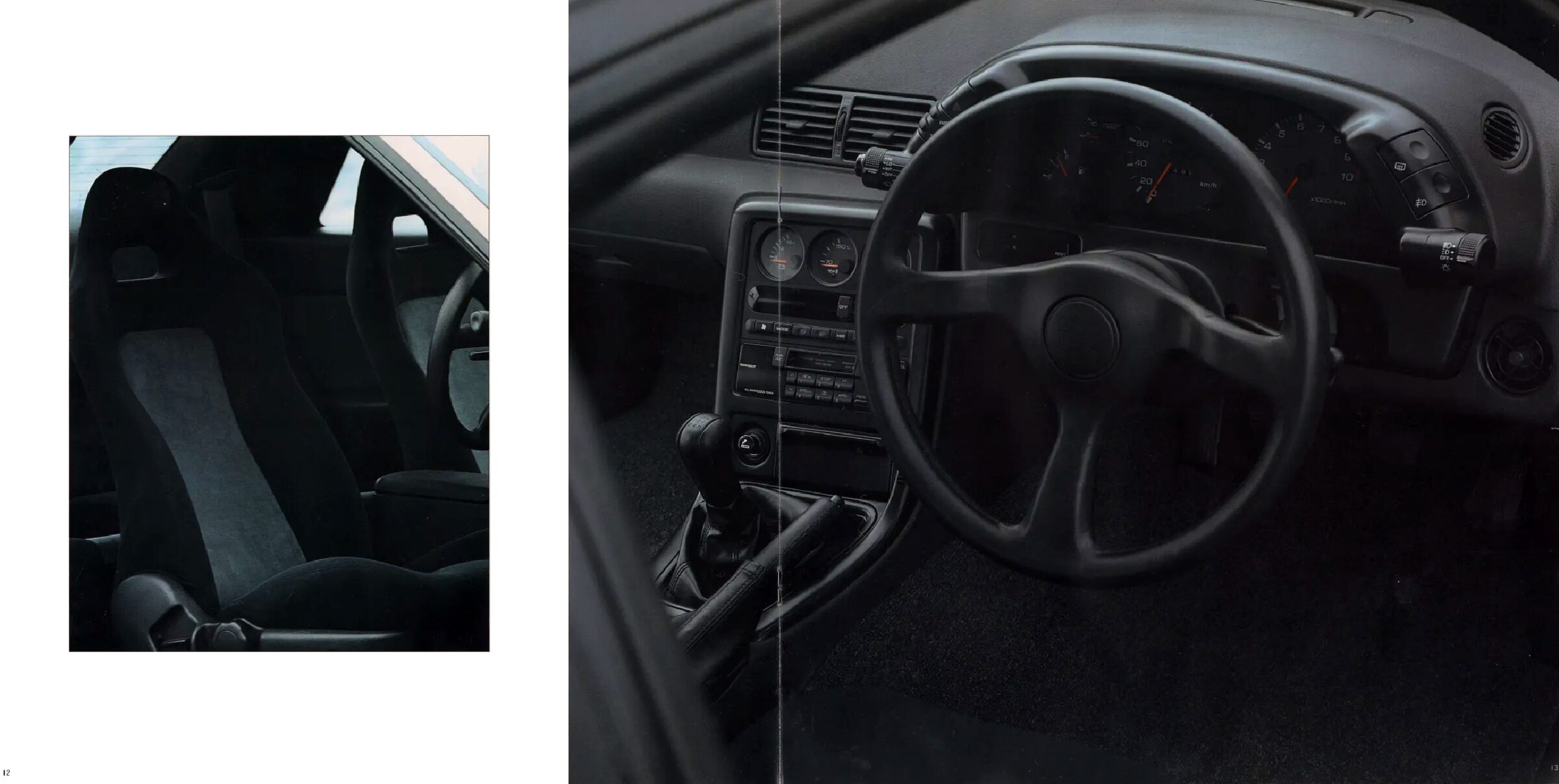
Monoform bucket seats
Driving performance shows in the shape of the seats, too.
The GT-R seats take the Group A car seats as their motif, fine-tuned for a road car. They hold better while feeling less confining. The answer is to make the main areas that touch the body an inverse shape.
The inverse shape is an enveloping shape with a suitable curve around the center, used at the shoulders, flanks, waist and thighs.
The benefits are many, from secure handling against lateral G in sports driving to less fatigue on long highway drives.
Sports cockpit
The pleasure of holding as much as 280 PS of huge power in your hands, under control. This irreplaceable driving pleasure rushes in the moment you sit in the cockpit. The hip point is low.
The pedals are where your legs stretch out naturally. A pedal feel more like pushing in than stepping down. The shift knob, parking brake lever and steering wheel are all genuine leather. These are touched often, so their quality was a special concern. The steering wheel is set slightly upright. One aim is quick handling response, the other a smooth move to the shift lever. The steering also adds telescopic adjustment to tilt, for the best driving position.
The shape of the steering wheel is also the result of test after test. Carefully tuned on the test course. The φ370 mm diameter, the shape of the grip and spokes, and even the weight make a special version for the GT-R.
And the instruments. The speedometer and tachometer read high speed and high revs straight up. On the tachometer in particular, the 8,000 rpm rev limit is just right of the top, making the detail up to the limit easy to read. The voltmeter, oil temperature gauge and boost gauge are at the top of the cluster, and the whole cluster is turned toward the driver for better visibility.
Aluminum panel location diagram
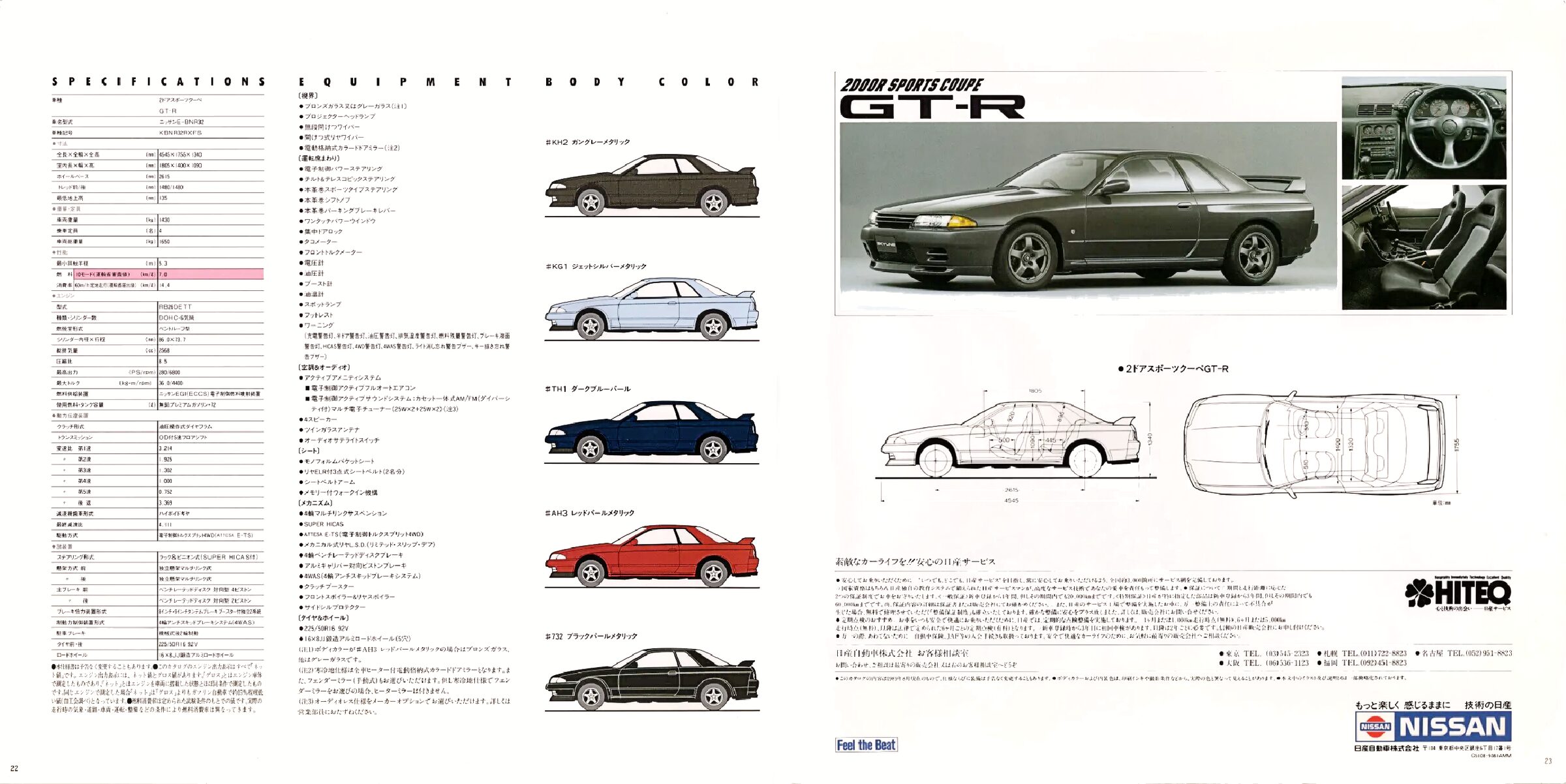
SPECIFICATIONS
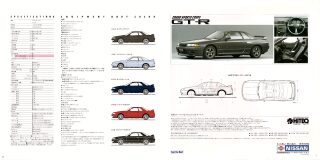
| Model | 2-door sports coupe GT-R |
|---|---|
| Type | Nissan E-BNR32 |
| Model code | KBNR32RXFS |
| Dimensions | |
| Overall length × width × height (mm) | 4,545 × 1,755 × 1,340 |
| Interior length × width × height (mm) | 1,805 × 1,400 × 1,090 |
| Wheelbase (mm) | 2,615 |
| Tread front/rear (mm) | 1,480/1,480 |
| Minimum ground clearance (mm) | 135 |
| Weight and capacity | |
| Vehicle weight (kg) | 1,430 |
| Seating capacity (persons) | 4 |
| Gross vehicle weight (kg) | 1,650 |
| Performance | |
| Minimum turning radius (m) | 5.3 |
| Fuel consumption, 10-mode (Ministry of Transport test figure) (km/L) | 7.0 |
| Fuel consumption, 60 km/h steady speed (figure filed with the Ministry of Transport) (km/L) | 14.4 |
| Engine | |
| Type | RB26DETT |
| Kind, number of cylinders | DOHC, 6 cylinders |
| Combustion chamber | Pent-roof |
| Bore × stroke (mm) | 86.0 × 73.7 |
| Displacement (cc) | 2,568 |
| Compression ratio | 8.5 |
| Maximum power (PS/rpm) | 280/6,800 |
| Maximum torque (kg-m/rpm) | 36.0/4,400 |
| Fuel system | Nissan EGI (ECCS) electronically controlled fuel injection |
| Fuel, tank capacity (L) | Unleaded premium gasoline, 72 |
| Drivetrain | |
| Clutch | Hydraulic diaphragm |
| Transmission | 5-speed floor shift with OD |
| Gear ratio, 1st | 3.214 |
| 2nd | 1.925 |
| 3rd | 1.302 |
| 4th | 1.000 |
| 5th | 0.752 |
| Reverse | 3.369 |
| Final drive gear | Hypoid |
| Final drive ratio | 4.111 |
| Drive system | Electronically controlled torque-split 4WD (ATTESA E-TS) |
| Running gear | |
| Steering | Rack and pinion (with SUPER HICAS) |
| Suspension, front | Independent multi-link |
| Suspension, rear | Independent multi-link |
| Main brakes, front | Ventilated disc, opposed, 4-piston |
| Main brakes, rear | Ventilated disc, opposed, 2-piston |
| Brake booster | 8-inch + 9-inch tandem brake booster, dual hydraulic circuits |
| Braking force control | 4-wheel anti-skid brake system (4WAS) |
| Parking brake | Mechanical, on the 2 rear wheels |
| Tires, front and rear | 225/50R16 92V |
| Road wheels | 16×8JJ forged aluminum road wheels |
- These specifications may change without notice.
- All engine outputs in this catalog are net figures. Engine output is given as a net or a gross figure: “gross” is measured on the engine alone, and “net” under almost the same conditions as with the engine fitted in the car. Measured on the same engine, “net” is about 15% lower than “gross” for a gasoline car (Japan Automobile Manufacturers Association survey).
- Fuel consumption figures are values under set test conditions. Actual fuel consumption varies with the weather, road, vehicle, driving, maintenance and other conditions of actual driving.
EQUIPMENT
Visibility
- Bronze glass or gray glass (Note 1)
- Projector headlamps
- Variable intermittent wipers
- Intermittent rear wiper
- Power-folding body-color door mirrors (Note 2)
Driver's seat area
- Electronically controlled power steering
- Tilt & telescopic steering
- Genuine leather sports steering wheel
- Genuine leather shift knob
- Genuine leather parking brake lever
- One-touch power windows
- Central door locking
- Tachometer
- Front torque meter
- Voltmeter
- Oil pressure gauge
- Boost gauge
- Oil temperature gauge
- Spot lamp
- Footrest
- Warnings (charge warning lamp, door ajar warning lamp, oil pressure warning lamp, exhaust temperature warning lamp, low fuel warning lamp, brake fluid level warning lamp, HICAS warning lamp, 4WD warning lamp, 4WAS warning lamp, lights-on reminder buzzer, key reminder buzzer)
Air conditioning & audio
- Active amenity system
- Electronically controlled active full auto air conditioner
- Electronically controlled active sound system: cassette-integrated AM/FM (with diversity) multi electronic tuner (25W×2+25W×2) (Note 3)
- 4 speakers
- Twin glass antenna
- Audio satellite switch
Seats
- Monoform bucket seats
- 3-point seat belts with rear ELR (2 seats)
- Seat belt arms
- Walk-in mechanism with memory
Mechanism
- 4-wheel multi-link suspension
- SUPER HICAS
- ATTESA E-TS (electronically controlled torque-split 4WD)
- Mechanical rear L.S.D. (limited-slip differential)
- 4-wheel ventilated disc brakes
- Aluminum caliper opposed-piston brakes
- 4WAS (4-wheel anti-skid brake system)
- Clutch booster
- Front spoiler & rear spoiler
- Side sill protectors
Tires & wheels
- 225/50R16 92V
- 16×8JJ forged aluminum road wheels (5 studs)
(Note 1) Bronze glass with the body color #AH3 Red Pearl Metallic, gray glass with the others.
(Note 2) Cold-climate cars all have heated power-folding body-color door mirrors. Fender mirrors (manual) can also be chosen. However, a cold-climate car with fender mirrors has no heated mirrors.
(Note 3) A car without audio can be chosen as a maker option. Ask a sales representative for details.
BODY COLOR
- #KH2 Gun Grey Metallic
- #KG1 Jet Silver Metallic
- #TH1 Dark Blue Pearl
- #AH3 Red Pearl Metallic
- #732 Black Pearl Metallic
2DOOR SPORTS COUPE GT-R
2-door sports coupe GT-R
The dimension drawings are marked:
- Interior length 1,805
- Front headroom 920
- Rear headroom [illegible]
- Front seat 500
- Interior height 1,090
- Rear seat 445
- Wheelbase 2,615
- Overall length 4,545
- Overall height 1,340
- Seat widths 540 and 510
- Interior width 1,400 and 1,320
- Overall width 1,755
Unit: mm
Enjoy a wonderful car life!! Reliable Nissan service
- For your peace of mind: aiming for “Nissan service anytime, anywhere”, we have a service network of about 3,000 locations across Japan, so you can always drive with peace of mind. Nissan service staff, holding national qualifications and trained in Nissan's education system, look after your car responsibly with advanced service skills.
- About the warranty: two warranty schemes, by period and by distance driven, protect your car. 〈General warranty〉 1 year from new registration, up to 20,000 km within that period. 〈Special warranty〉 For parts specially designated by Nissan, 3 years from new registration, up to 60,000 km within that period. For the details of the warranty, see the warranty booklet or ask your dealer. And should a fault arise from a servicing error on a car serviced at a Nissan service shop, we have a “service warranty scheme” to repair it free of charge, adding peace of mind to reliable servicing. For details, ask your dealer.
- Regular inspections recommended: so you can always drive your car safely and comfortably, Nissan carries out regular inspections and servicing. At 1 month or 1,000 km (free) and 6 months or 5,000 km (free), and after that the regular inspections every 6 months required by law (charged). The first vehicle inspection is in the third year after new registration, and every 2 years after that. Please ask your nearest Nissan dealer.
- So you need not panic if something happens: we also arrange car insurance and JAF membership. For a safe and comfortable car life, feel free to talk to your nearest dealer.
HITEQ
Hospitality Immediately Technology Excellent Quality
Where heart meets technology — Nissan Service
Nissan Motor Co., Ltd. Customer Consultation Office
For questions and advice, please contact your nearest dealer or the Customer Consultation Office at right.
- Tokyo TEL. (03) 545-2323
- Sapporo TEL. (011) 722-8823
- Nagoya TEL. (052) 951-8823
- Osaka TEL. (06) 536-1123
- Fukuoka TEL. (092) 451-8823
- The contents of this catalog are as of August 1989, and specifications and equipment may change without notice.
- Body and interior colors may look different from the actual colors because of printing inks and photographic conditions.
- The illustrations and explanatory drawings in the text are partly simplified.
Feel the Beat
More fun, just as you feel it. Nissan, technology.
NISSAN
Nissan Motor Co., Ltd., 6-17-1 Ginza, Chuo-ku, Tokyo 104
G5108-9081AMM
About this sales brochure
Nissan's Japanese brochure for the R32 Skyline GT-R (BNR32), printed in August 1989 as the GT-R returned, covering the RB26DETT twin-turbo engine, the multi-link suspension with SUPER HICAS, ATTESA E-TS four-wheel drive, the brakes and body, with full specifications, equipment and colors.
- Grades and prices: one model, the 2-door sports coupe GT-R (E-BNR32), with a 5-speed manual. No prices are listed.
- Engine: RB26DETT, a 2,568 cc straight-six DOHC 24-valve with ceramic twin turbochargers and an intercooler, 280 PS at 6,800 rpm and 36.0 kg-m at 4,400 rpm (net), with six throttle chambers and a rev limit of 8,000 rpm.
- Drivetrain: ATTESA E-TS electronically controlled torque-split 4WD, a mechanical rear L.S.D. and a 5-speed manual with double-cone synchros on 2nd and 3rd.
- Chassis: 4-wheel multi-link suspension with SUPER HICAS four-wheel steering, electronically controlled power steering, 4WAS anti-skid brakes, and ventilated discs with aluminum opposed-piston calipers, 4-piston front and 2-piston rear.
- Wheels and tires: 16×8JJ forged aluminum wheels with 225/50R16 92V tires.
- Colors: Gun Grey Metallic (KH2), Jet Silver Metallic (KG1), Dark Blue Pearl (TH1), Red Pearl Metallic (AH3), Black Pearl Metallic (732).
- Equipment: aluminum hood and front fenders, front and rear spoilers, projector headlamps, monoform bucket seats, genuine leather steering wheel, shift knob and parking brake lever, tilt and telescopic steering, front torque meter, boost, voltage, oil pressure and oil temperature gauges, and an automatic air conditioner.
- Size: 4,545 mm long, 1,755 mm wide and 1,340 mm high on a 2,615 mm wheelbase, 1,430 kg.
Reproduced for archival and reference purposes. Nissan, its model names, logos and the images in this brochure are the trademarks and copyright of their owners; NENGUN is not affiliated with or endorsed by Nissan. If you hold rights in this material and object to it appearing here, contact us and we will remove it promptly.