MR2
LASREα3S-II TWINCAM 16VALVE TURBO
MAXIMUM POWER:NET225ps/6,000r.p.m. MAXIMUM TORQUE:31.0kg-m/3,200r.p.m.
LASREα3S-II TWINCAM 16VALVE
MAXIMUM POWER:NET165ps/6,800r.p.m. MAXIMUM TORQUE:19.5kg-m/4,800r.p.m.
Your trusted source of JDM parts shipped direct from Japan

Japan · December 1991
Turn for full screen
Nothing to translate on this page.
LASREα3S-II TWINCAM 16VALVE TURBO
MAXIMUM POWER:NET225ps/6,000r.p.m. MAXIMUM TORQUE:31.0kg-m/3,200r.p.m.
LASREα3S-II TWINCAM 16VALVE
MAXIMUM POWER:NET165ps/6,800r.p.m. MAXIMUM TORQUE:19.5kg-m/4,800r.p.m.
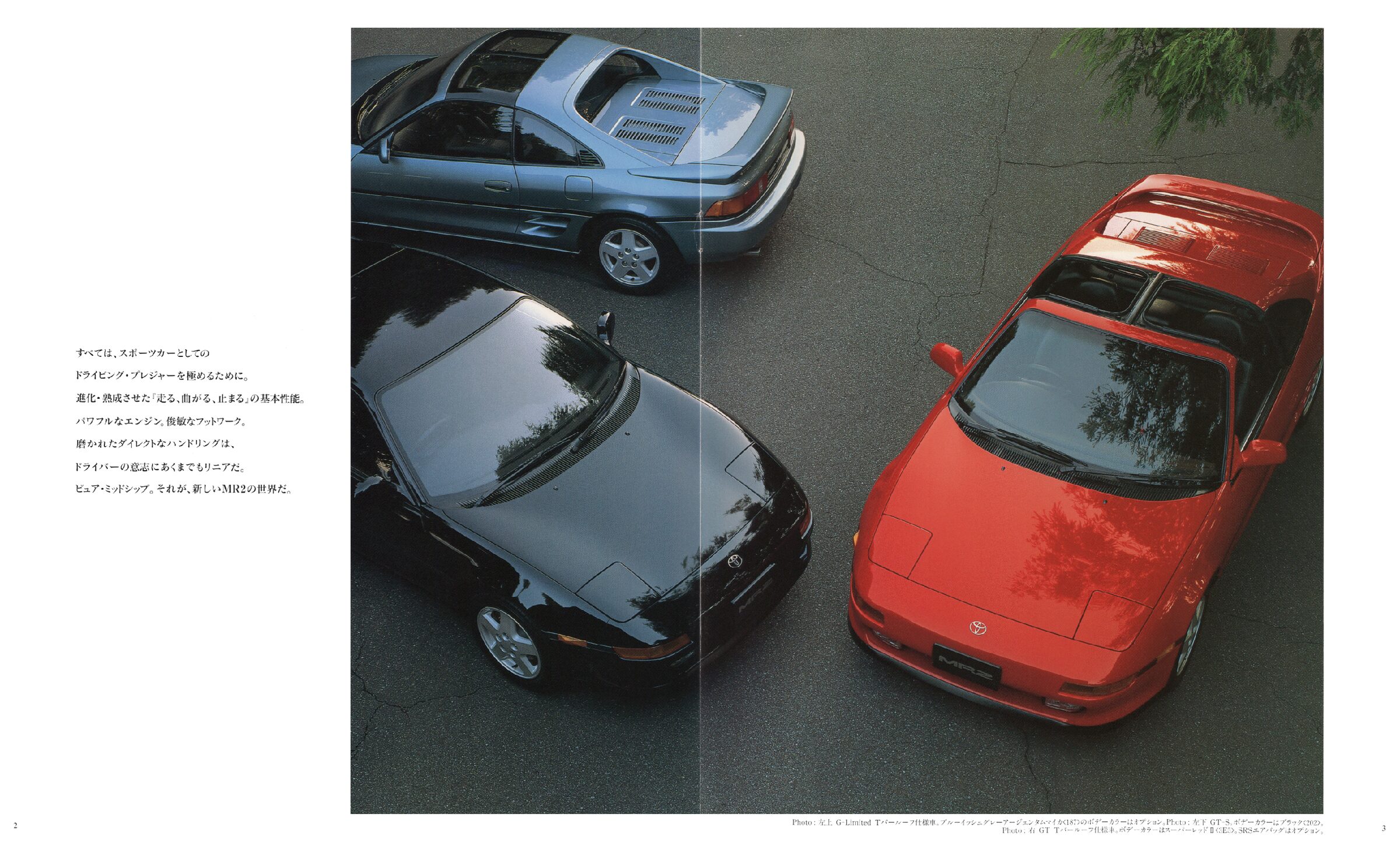
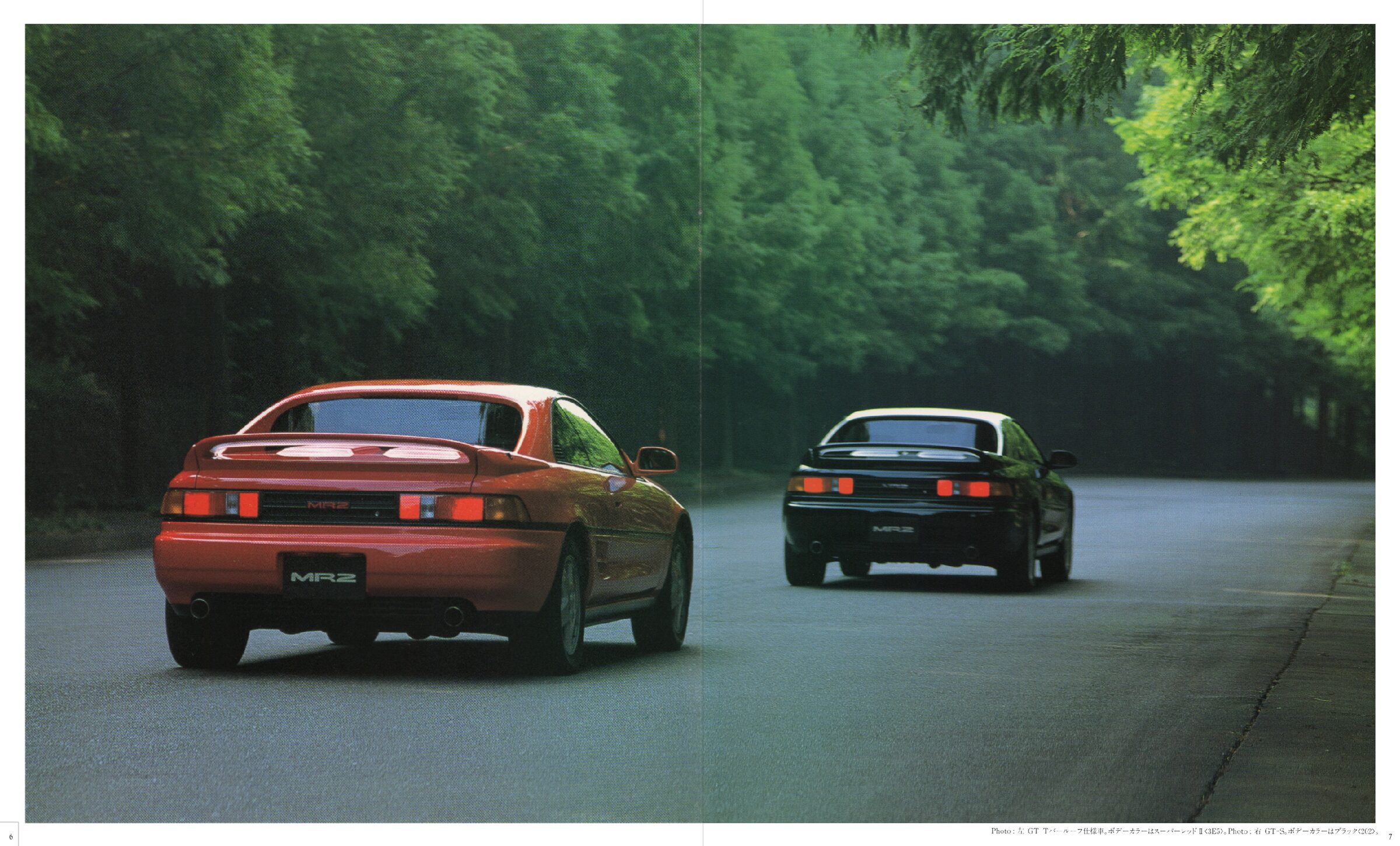
Everything is for the ultimate in driving pleasure as a sports car.
The fundamental performance of “running, turning, stopping”, evolved and matured.
A powerful engine. Agile footwork.
Refined, direct handling, always linear to the driver's will.
Pure midship. That is the world of the new MR2.
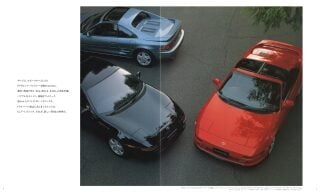
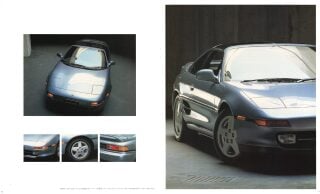
Photo: top left, G-Limited with the T-bar roof. Body color Bluish Gray Argentum Mica (187) is an option. Photo: bottom left, GT-S. Body color Black (202).
Photo: right, GT with the T-bar roof. Body color Super Red II (3E5). The SRS airbag is an option.
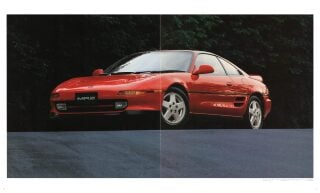
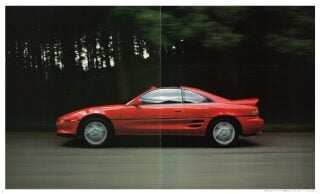
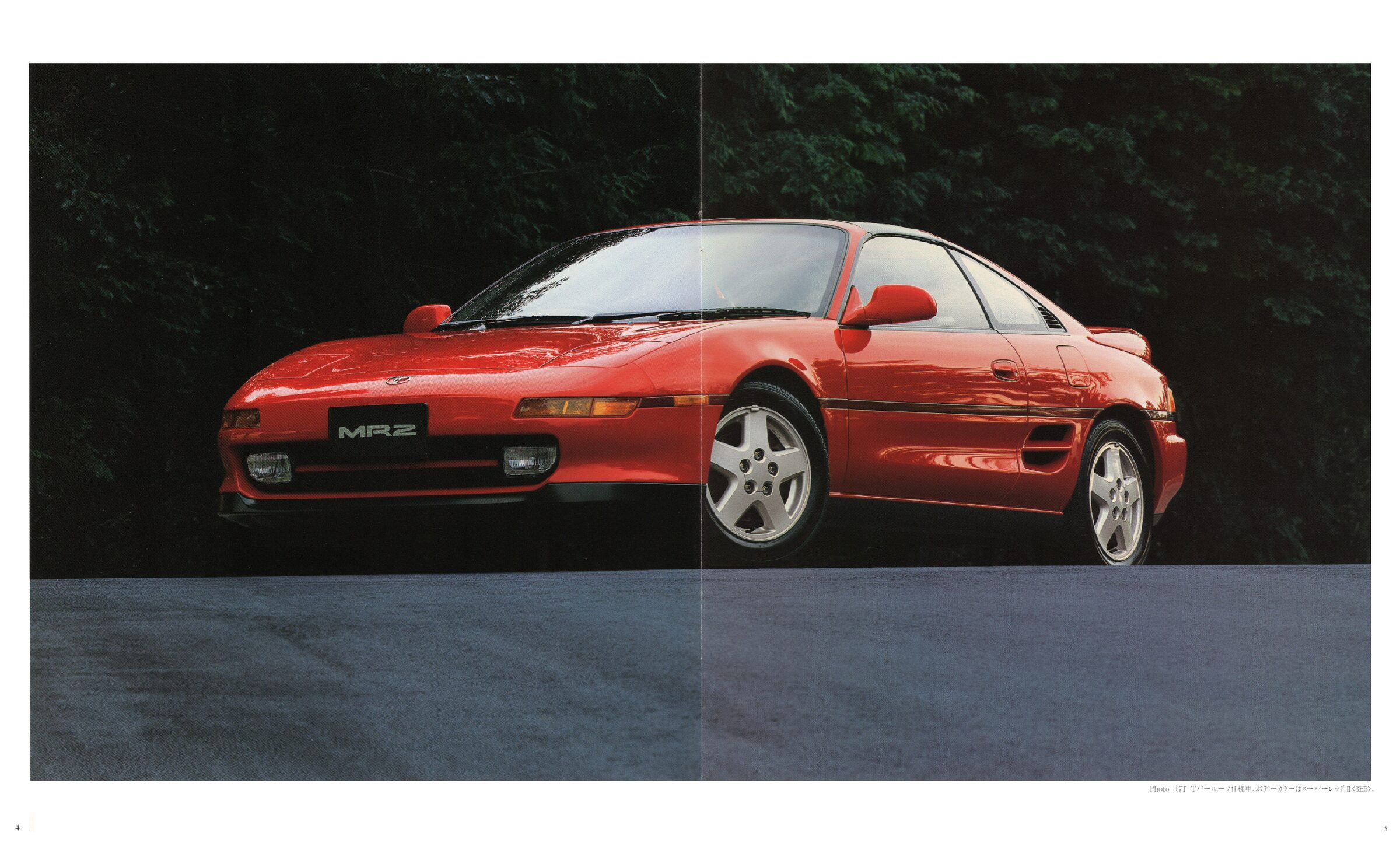
Photo: GT with the T-bar roof. Body color Super Red II (3E5).
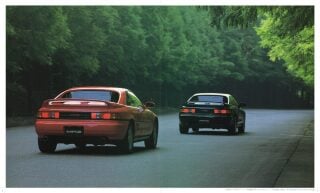
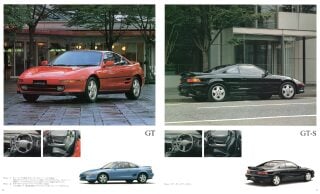
Photo: left, GT with the T-bar roof. Body color Super Red II (3E5). Photo: right, GT-S. Body color Black (202).
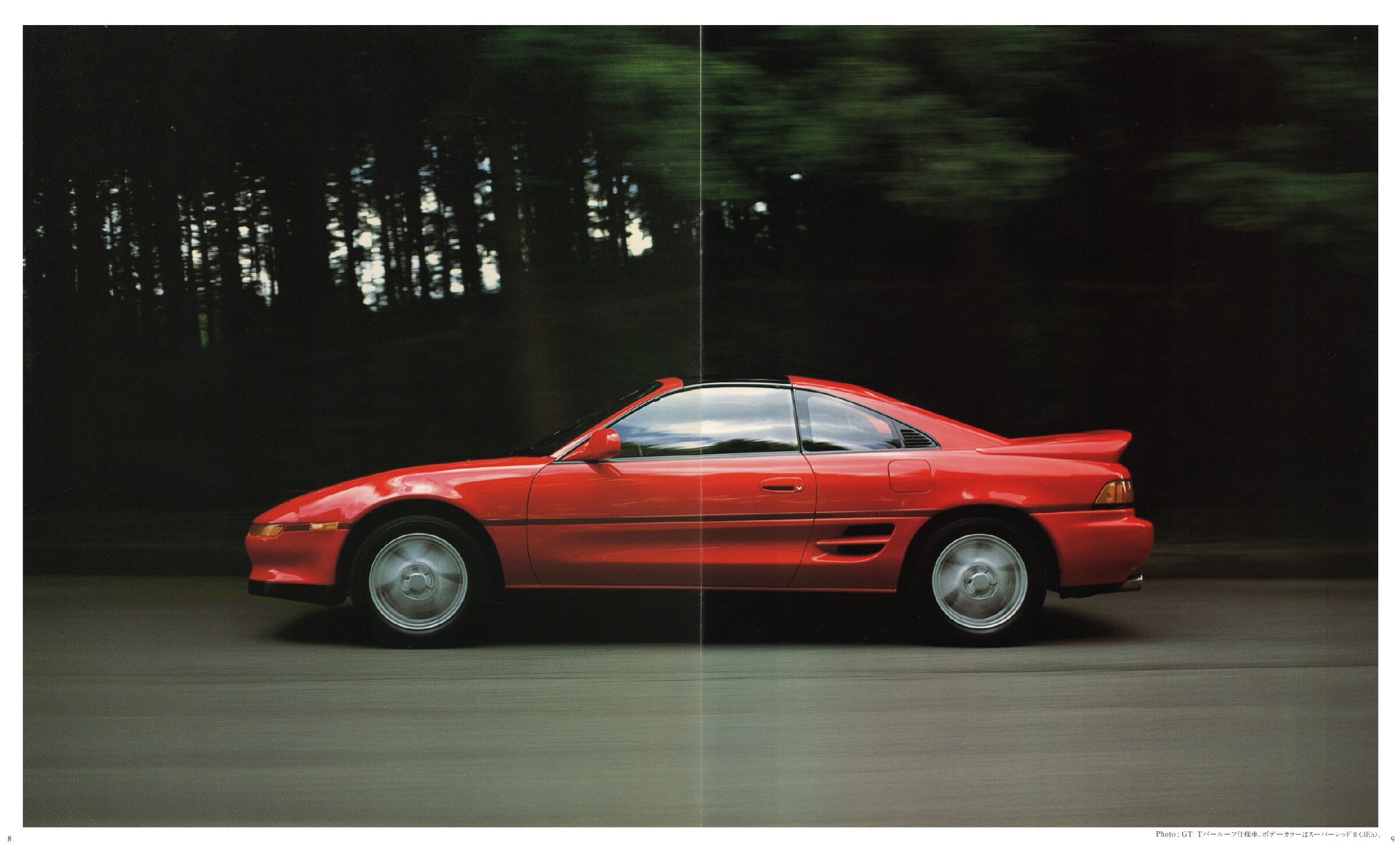
Photo: GT with the T-bar roof. Body color Super Red II (3E5).
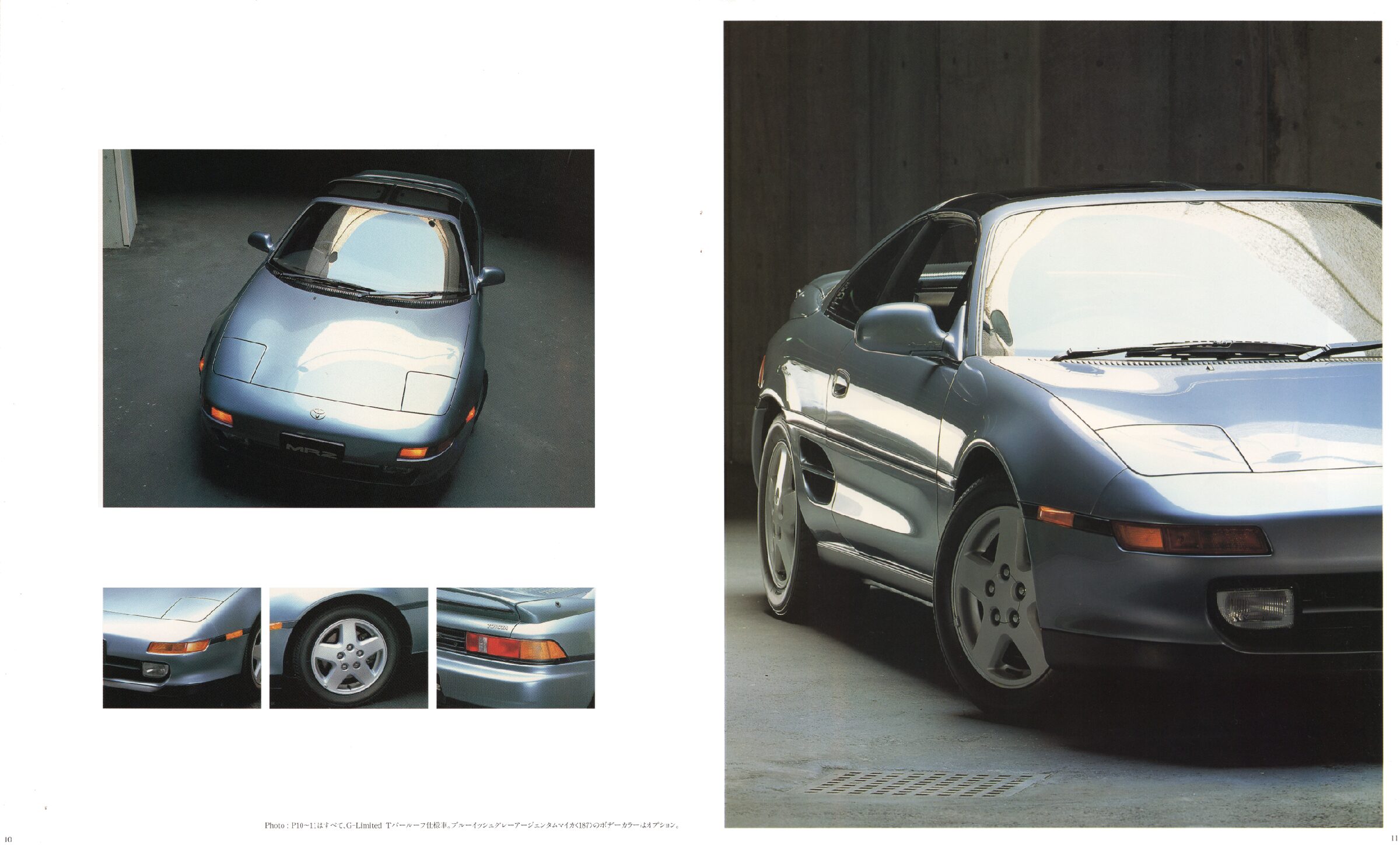
Photo: Pages 10–11 all show the G-Limited with the T-bar roof. Body color Bluish Gray Argentum Mica (187) is an option.
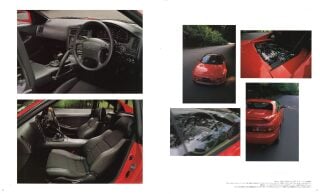
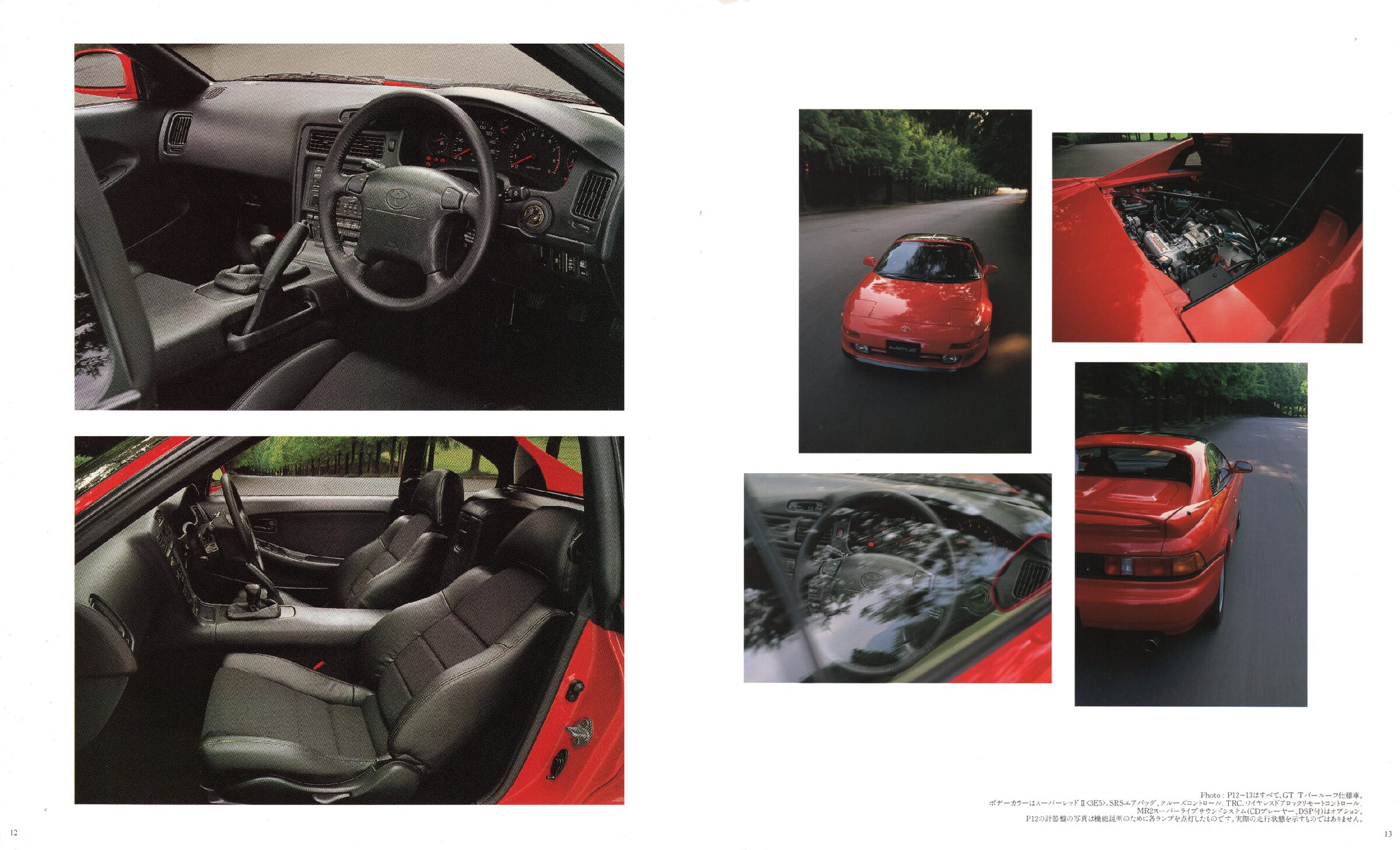
Photo: Pages 12–13 all show the GT with the T-bar roof.
Body color Super Red II (3E5). The SRS airbag, cruise control, TRC, wireless door lock remote control and the MR2 Super Live Sound System (CD player, with DSP) are options.
In the instrument panel photo on page 12, every lamp is lit to explain the functions. It does not show an actual driving condition.
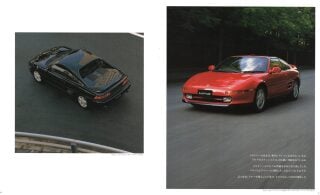
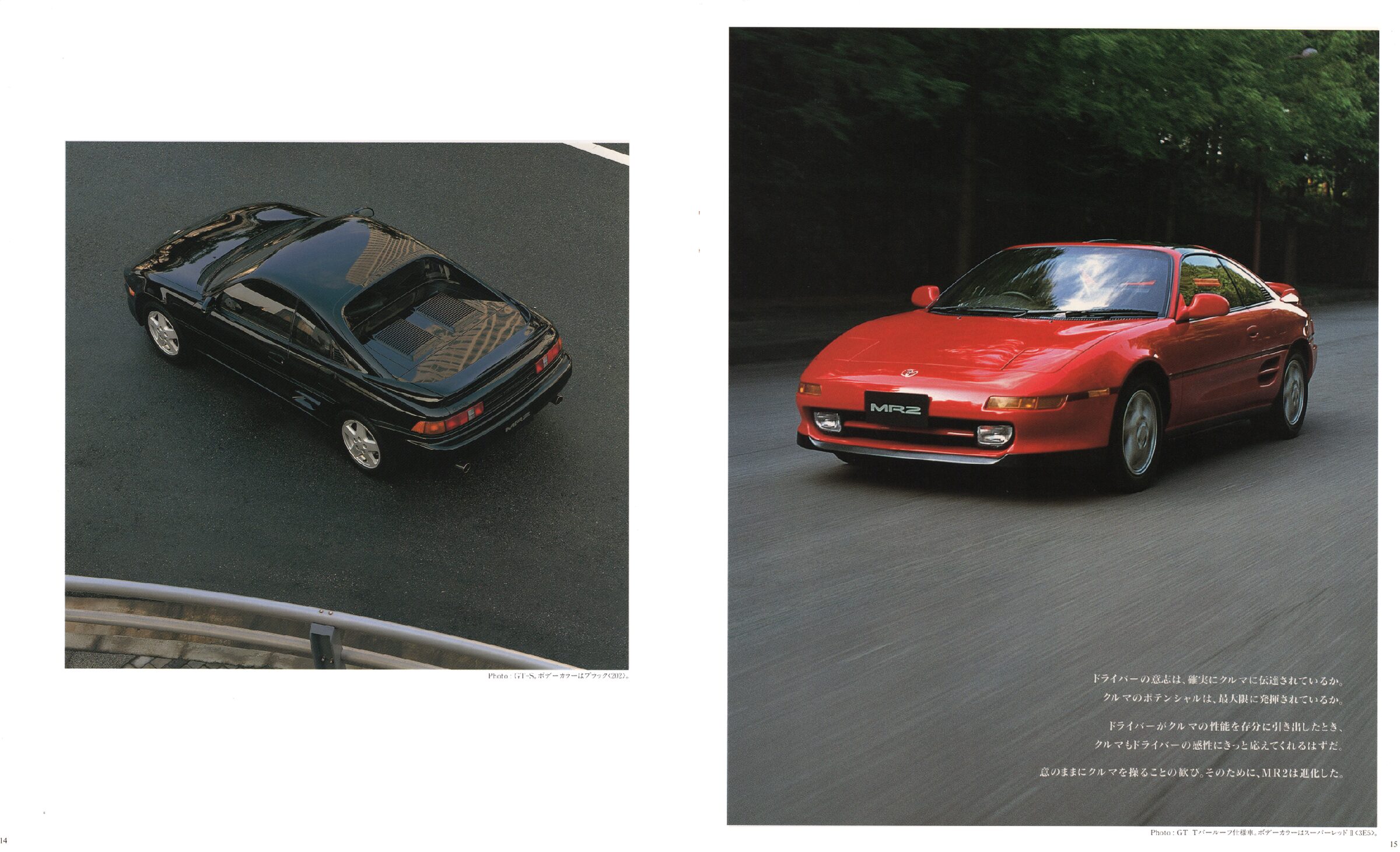
Photo: GT-S. Body color Black (202).
Is the driver's will conveyed to the car, surely?
Is the car's potential drawn out to the full?
When the driver draws out the car's performance to the full,
the car will surely answer the driver's feel too.
The joy of driving a car just as you intend. For this, the MR2 has evolved.
Photo: GT with the T-bar roof. Body color Super Red II (3E5).
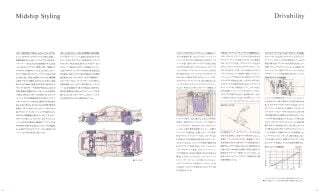
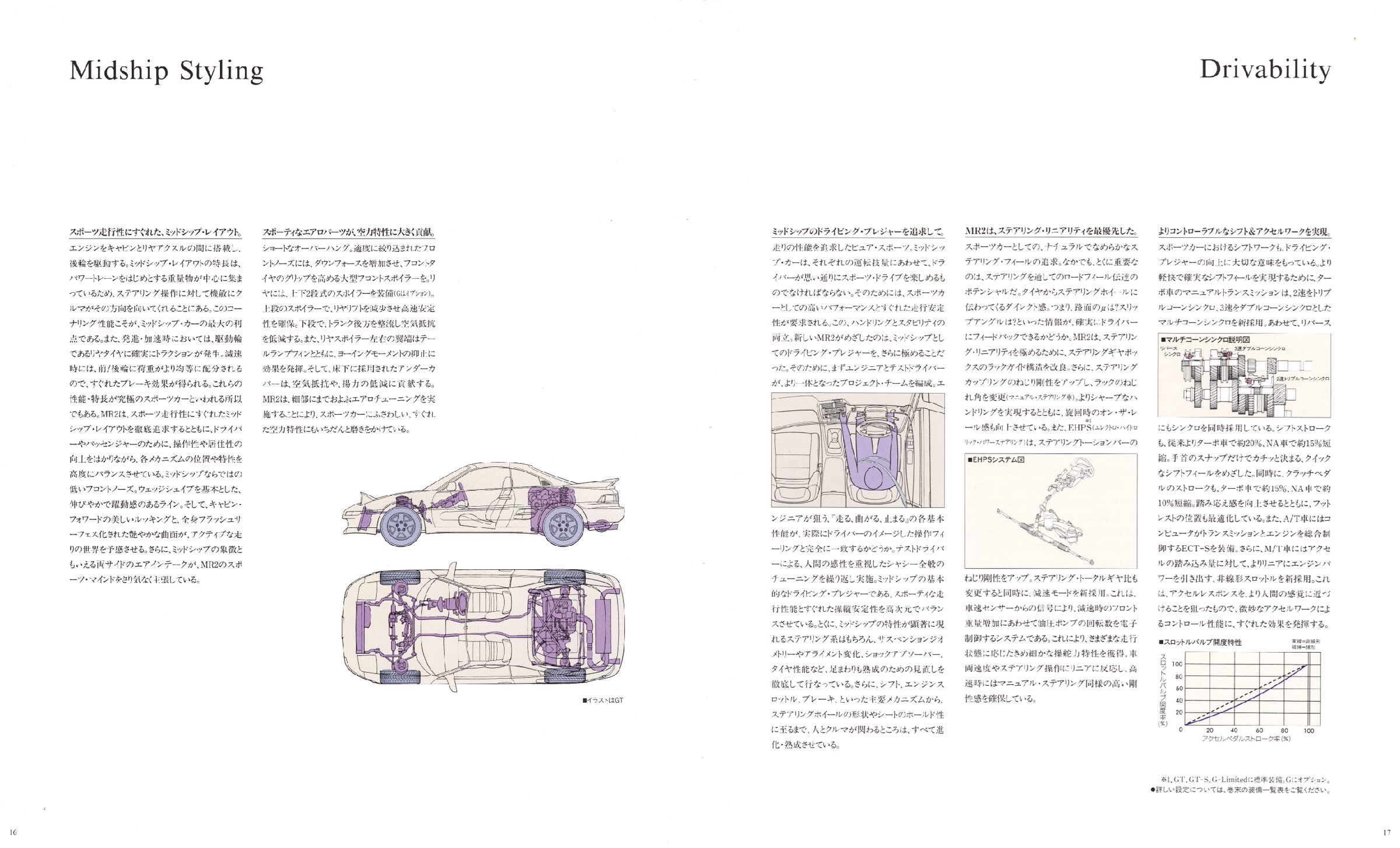
The engine is mounted between the cabin and the rear axle and drives the rear wheels. The strength of the midship layout is that the heavy components, the powertrain first among them, are concentrated at the center, so the car responds sharply to the steering and points where it is turned. This cornering ability is the greatest advantage of a midship car. When moving off and accelerating, traction is reliably generated at the rear tires, the driving wheels. When slowing down, the load is spread more evenly between the front and rear wheels, giving excellent braking. These qualities are also why the layout is called the ultimate for a sports car. The MR2 pursues the midship layout, excellent for sports driving, to the full, and for the driver and passenger, while improving operability and comfort, it balances the position and character of each mechanism to a high degree. A low front nose only a midship can have. Long, dynamic lines based on a wedge shape. And the handsome cab-forward looks and the glossy curved surfaces, flush all over, foretell a world of active driving. The air intakes on both sides, the symbol of the midship, quietly assert the MR2's sporting spirit.
Short overhangs. The moderately tapered front nose carries a large front spoiler that increases downforce and raises the grip of the front tires. At the rear, a two-tier spoiler is fitted (option on the G). The upper tier reduces rear lift for stability at high speed. The lower tier smooths the airflow behind the trunk to reduce drag. The wing tips at each end of the rear spoiler, together with the tail lamp fins, help to suppress the yawing moment. The under cover fitted beneath the floor contributes to lower drag and lift. With aero tuning down to the details, the MR2 has polished the excellent aerodynamics, fit for a sports car, still further.
Illustration shows the GT
A pure sports car in pursuit of driving performance. A midship car must let each driver, whatever the level of skill, enjoy sports driving just as they wish. That demands the high performance and excellent stability of a sports car. Balancing this handling and stability. What the new MR2 aimed for was to take the driving pleasure of a midship even further. To do so, a project team was first formed in which engineers and test drivers worked more closely as one. Do the fundamental qualities the engineers aim for, “running, turning, stopping”, match exactly the feel of control the driver imagines? The test drivers tuned the whole chassis again and again, putting human feel first. The sporty driving performance and excellent handling stability that are the basis of midship driving pleasure are balanced at a higher level. Beyond the steering, where the character of a midship shows most, the suspension geometry and alignment changes, the shock absorbers and the tire performance were all thoroughly reviewed for a more mature chassis. And from the main mechanisms, the shifter, the engine throttle and the brakes, to the shape of the steering wheel and the hold of the seats, everywhere the person and the car meet has been evolved and matured.
In pursuit of the natural, smooth steering feel of a sports car. Most important of all is the potential to convey road feel through the steering: the direct feeling passed from the tires to the steering wheel. In other words, whether information such as “what is the road surface's μ?” and “what is the slip angle?” is fed back to the driver reliably. To perfect steering linearity, the MR2 improves the rack guide structure of the steering gearbox. It also raises the torsional rigidity of the steering coupling and changes the rack's twist angle (manual steering cars), for sharper handling and a better on-the-rail feel when cornering. The EHPS ※1 (Electro-Hydraulic Power Steering) raises the torsional rigidity of the steering torsion bar. Along with a change to the overall steering gear ratio, a new deceleration mode is adopted. This system electronically controls the speed of the hydraulic pump to match the increase in front load when slowing down, from the signal of the vehicle speed sensor. The result is finely tuned steering effort for every driving condition. It responds linearly to vehicle speed and steering input, and at high speed it keeps the firm feel of manual steering.
EHPS system diagram
In a sports car, shifting also matters greatly to driving pleasure. For a lighter, surer shift feel, the manual transmission of the turbo cars newly adopts multi-cone synchros: a triple-cone synchro on 2nd gear and a double-cone synchro on 3rd. A synchro is also added to reverse. The shift stroke is about 20% shorter than before on the turbo cars and about 15% shorter on the NA cars. The aim was a quick shift feel that snaps into place with just a flick of the wrist. The clutch pedal stroke is also about 15% shorter on the turbo cars and about 10% shorter on the NA cars. Pedal feel is improved, and the position of the footrest is optimized too. A/T cars have ECT-S, in which a computer controls the transmission and engine together. M/T cars newly adopt a non-linear throttle, which draws out engine power more linearly for how far the accelerator is pressed. This aims to bring the accelerator response closer to human feel, with an excellent effect on control through delicate accelerator work.
Multi-cone synchro diagram
Throttle valve opening characteristics (solid line = non-linear, dashed line = linear)
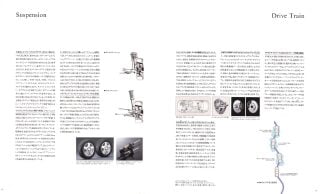
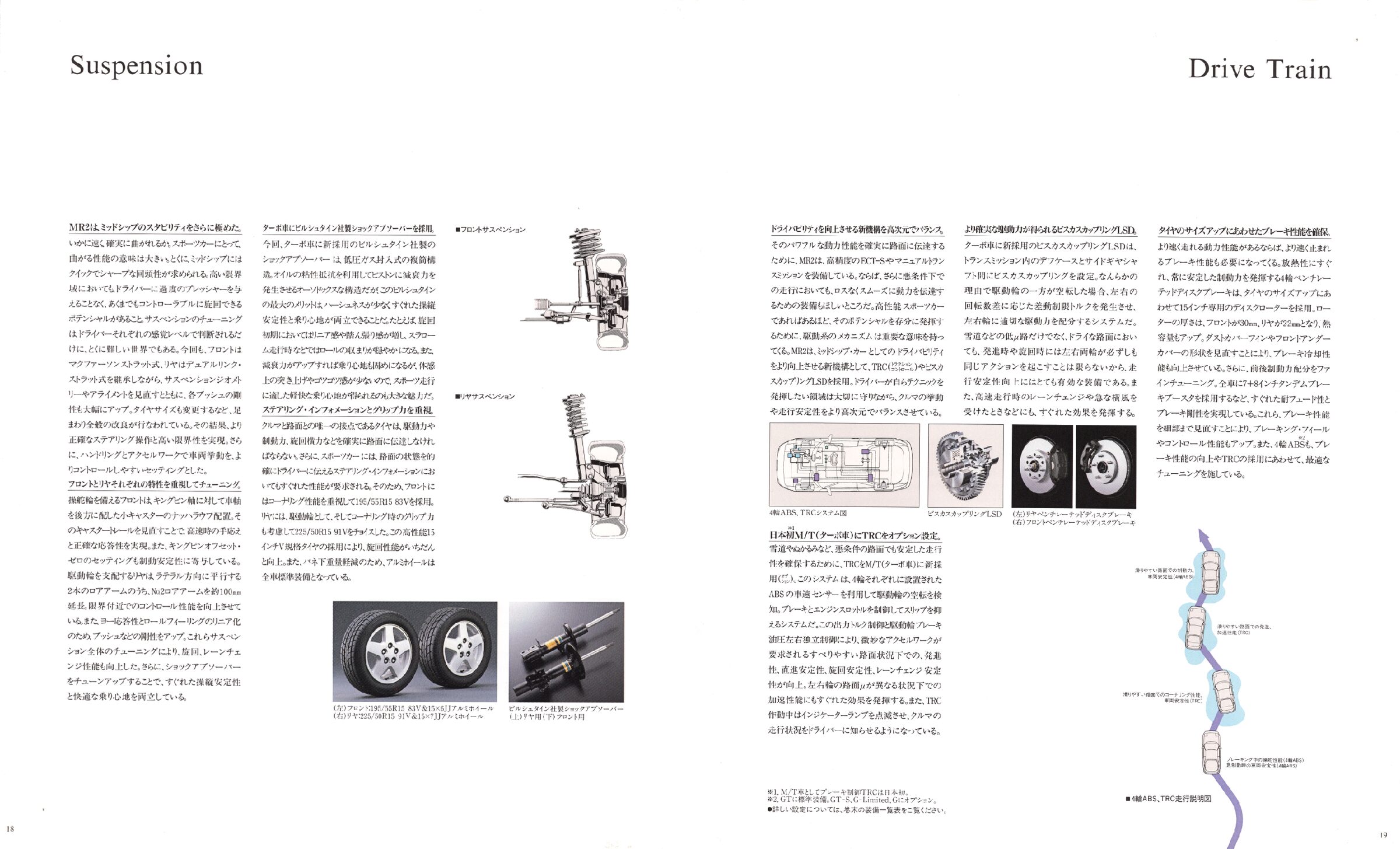
How fast and how surely can it turn? For a sports car, cornering ability means a great deal. A midship car especially needs quick, sharp turning response. It must have the potential to turn while staying controllable, without putting excessive pressure on the driver even near the limit. Suspension tuning is judged by the senses of each driver, which makes it a particularly difficult world. This time again, keeping MacPherson struts at the front and dual-link struts at the rear, the suspension geometry and alignment were reviewed and the rigidity of each bushing greatly raised. The tire sizes were changed too, improving the whole chassis. The result is more precise steering and a high limit. The settings also make the car's behavior easier to control with steering and accelerator work.
The front, which carries the steered wheels, has a small-caster Nachlauf layout, with the axle set behind the kingpin axis. Revising the caster trail gives a firm feel and precise response at high speed. A zero kingpin offset setting also contributes to stability under braking. At the rear, which carries the driving wheels, the No.2 lower arm, one of the two lower arms running parallel in the lateral direction, is lengthened by about 100 mm, improving control near the limit. Bushings and other parts are made more rigid for a linear yaw response and roll feel. Tuning the whole suspension also improved cornering and lane change performance. And tuned-up shock absorbers give both excellent handling stability and a comfortable ride.
The Bilstein shock absorbers newly adopted on the turbo cars this time are low-pressure gas-filled twin-tube units. The design is the orthodox one, using the oil's viscous resistance to give the piston a damping force, but the Bilstein's greatest merit is that it achieves both excellent handling stability and ride with little harshness. For example, linear feel and firmness increase at turn-in, and roll settles smoothly through a slalom. A higher damping force normally makes the ride firmer too, but with little felt jolting or bumpiness, they give a light ride suited to sports driving, another great appeal.
Tires, the only contact between the car and the road, must transmit driving force, braking force and cornering force to the road surface reliably. A sports car also demands excellent performance in steering information that tells the driver the road condition precisely. So the front takes 195/55R15 83V tires, chosen for cornering. The rear, as the driving wheels and with cornering grip in mind too, takes 225/50R15 91V. These high-performance 15-inch V-rated tires greatly improve cornering. Aluminum wheels, to reduce unsprung weight, are standard on all cars.
Front suspension
Rear suspension
To transmit the powerful performance to the road surface reliably, the MR2 has a high-precision ECT-S or manual transmission. Then it should also have equipment that transmits power smoothly and without loss even on bad roads. The higher a sports car's performance, the more the drive train matters for drawing out that potential to the full. As new mechanisms to further raise the drivability of the MR2 as a midship car, the MR2 adopts TRC (Traction Control) and a viscous coupling LSD. While leaving intact the area where the driver wants to use personal technique, they balance the car's behavior and stability at a higher level.
The viscous coupling LSD newly adopted on the turbo cars places a viscous coupling between the differential case in the transmission and the side gear shaft. If one driving wheel spins for any reason, it generates limited-slip torque according to the difference in speed between left and right, sending suitable driving force to each wheel. Not only on low-μ roads such as snow, but on dry roads too, the left and right wheels do not always behave the same when moving off or cornering, so it is very effective for stability. It is also very effective in lane changes at high speed and in sudden crosswinds.
A car that can go faster needs brakes that can stop faster. The 4-wheel ventilated disc brakes, with excellent heat dissipation and consistently stable braking, take dedicated 15-inch disc rotors to match the larger tires. The rotors are 30 mm thick at the front and 22 mm at the rear, with more heat capacity. Revised dust cover fins and front under cover shape improve brake cooling too. The front-rear brake force distribution is fine-tuned. A 7+8-inch tandem brake booster on all cars gives excellent fade resistance and brake rigidity. Reviewing the brakes in detail also improves braking feel and control. And the 4-wheel ABS ※2 is tuned optimally for the improved brakes and the adoption of TRC.
For stable driving even on bad roads such as snow or mud, TRC is newly adopted on M/T (turbo cars) (option). The system uses the ABS wheel speed sensors at each of the four wheels to detect driving wheel spin, then controls the brakes and engine throttle to hold back slip. With this output torque control and independent left and right control of the driving wheels' brake hydraulics, starting, straight-line stability, cornering stability and lane change stability improve on slippery roads that call for delicate accelerator work. It also gives excellent acceleration when the road μ differs between the left and right wheels. While TRC is working, an indicator lamp flashes to tell the driver about the car's condition.
4-wheel ABS and TRC driving diagram
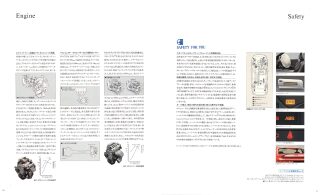
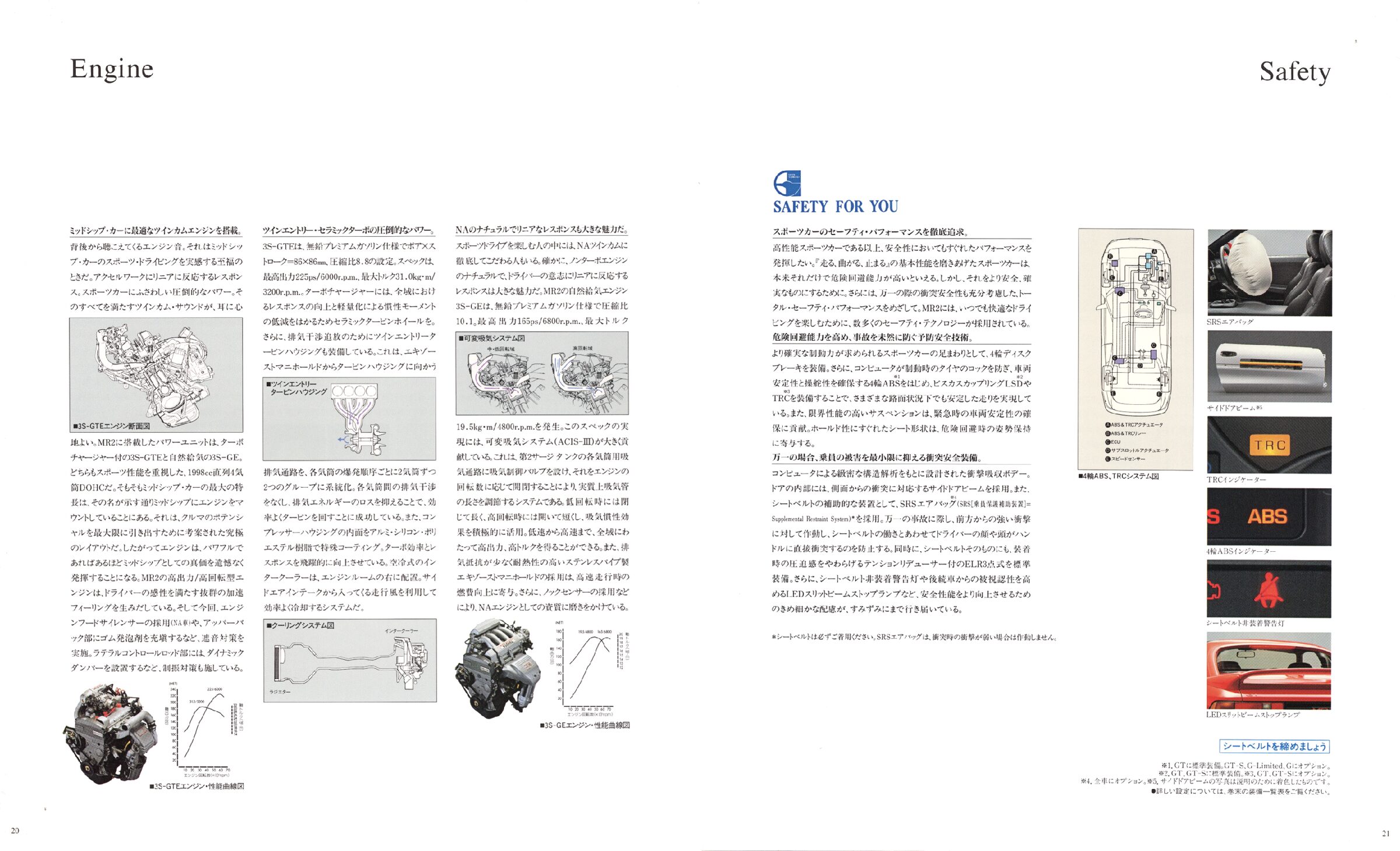
The engine sound from behind you. That is the moment of bliss when you feel the sports driving of a midship car. Response that follows the accelerator linearly. Overwhelming power fit for a sports car. The twin cam sound that satisfies all of these is pleasant to the ear and the heart. The power units in the MR2 are the turbocharged 3S-GTE and the naturally aspirated 3S-GE. Both are 1998 cc inline 4-cylinder DOHC engines built for sports performance. The greatest feature of a midship car is, as the name suggests, that the engine is mounted midship. It is the ultimate layout, devised to draw out the car's potential to the full. So the more powerful the engine, the more fully it shows the true worth of a midship. The MR2's high-output, high-revving engines produce outstanding acceleration feel that satisfies the driver's senses. This time, noise was also reduced, with an engine hood silencer (NA cars) and foamed rubber filling the upper back panel. A dynamic damper is fitted to the lateral control rod, among other measures against vibration.
3S-GTE engine cross section
The 3S-GTE runs on unleaded premium gasoline, with a bore × stroke of 86×86 mm and a compression ratio of 8.8. It produces a maximum output of 225 ps/6000 r.p.m. and maximum torque of 31.0 kg·m/3200 r.p.m. The turbocharger has a ceramic turbine wheel, for better response across the range and a lower moment of inertia from less weight. For no exhaust interference, it also has a twin-entry turbine housing. The exhaust passages from the exhaust manifold to the turbine housing are grouped into two groups of two cylinders each, by firing order. By removing exhaust interference between cylinders and reducing the loss of exhaust energy, it spins the turbine efficiently. The inside of the compressor housing has a special coating of aluminum silicone polyester resin. Turbo efficiency and response are dramatically improved. The air-cooled intercooler sits on the right of the engine compartment, cooled efficiently by the air flowing in through the side air intake while driving.
Twin-entry turbine housing
Cooling system diagram
Among people who enjoy sports driving, some insist on an NA twin cam. Indeed, the natural response of a non-turbo engine, following the driver's will linearly, is a great appeal. The MR2's naturally aspirated 3S-GE runs on unleaded premium gasoline with a compression ratio of 10.1. It produces a maximum output of 165 ps/6800 r.p.m. and maximum torque of 19.5 kg·m/4800 r.p.m. The variable intake system (ACIS-III) contributes greatly to this. Intake control valves in the intake passage for each cylinder of the second surge tank open and close with engine speed, adjusting the effective length of the intake pipe. Closed for a long pipe at low revs and open for a short pipe at high revs, it makes full use of the intake inertia effect. High output and high torque from low speed to high speed, across the range. The stainless steel pipe exhaust manifold, with little exhaust resistance and high heat resistance, contributes to better fuel economy at high speed. A knock sensor, among other things, refines the quality of the NA engine.
Variable intake system diagram
3S-GTE engine performance curves
3S-GE engine performance curves
SAFETY FOR YOU
Being a high-performance sports car, it must show excellent performance in safety too. A sports car with polished fundamentals of “running, turning, stopping” already has a high ability to avoid danger. But to make that safer and surer, and aiming at total safety performance that also fully considers crash safety in an emergency, the MR2 has many safety technologies, so that you can always enjoy comfortable driving.
Four-wheel disc brakes, for the chassis of a sports car, which needs surer braking. With the 4-wheel ABS ※1, in which a computer prevents the tires locking when braking to keep the car stable and steerable, along with the viscous coupling LSD ※2 and TRC ※3, the car drives stably on all kinds of roads. The suspension, with a high limit, contributes to stability in an emergency. Seats with excellent hold help keep the driver's posture when avoiding danger.
An impact-absorbing body designed from precise computer structural analysis. Side door beams inside the doors guard against side impacts. As a supplement to the seatbelts, the SRS airbag ※4 (SRS [supplemental occupant protection device] = Supplemental Restraint System)* is adopted. In an accident it works against a strong frontal impact and, together with the seatbelt, prevents the driver's face and head from hitting the steering wheel directly. The seatbelts themselves are ELR 3-point belts with a tension reducer, which eases the feeling of pressure when worn, as standard. Careful attention reaches every corner to raise safety further, such as the seatbelt warning lamp and the LED slit beam stop lamp, which makes the car easier to see from behind.
*Always wear your seatbelt. The SRS airbag does not deploy in a weak impact.
4-wheel ABS and TRC system diagram
Pictures:
Fasten your seatbelt
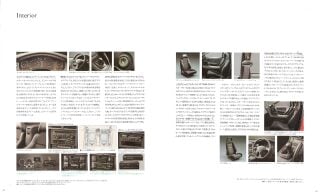
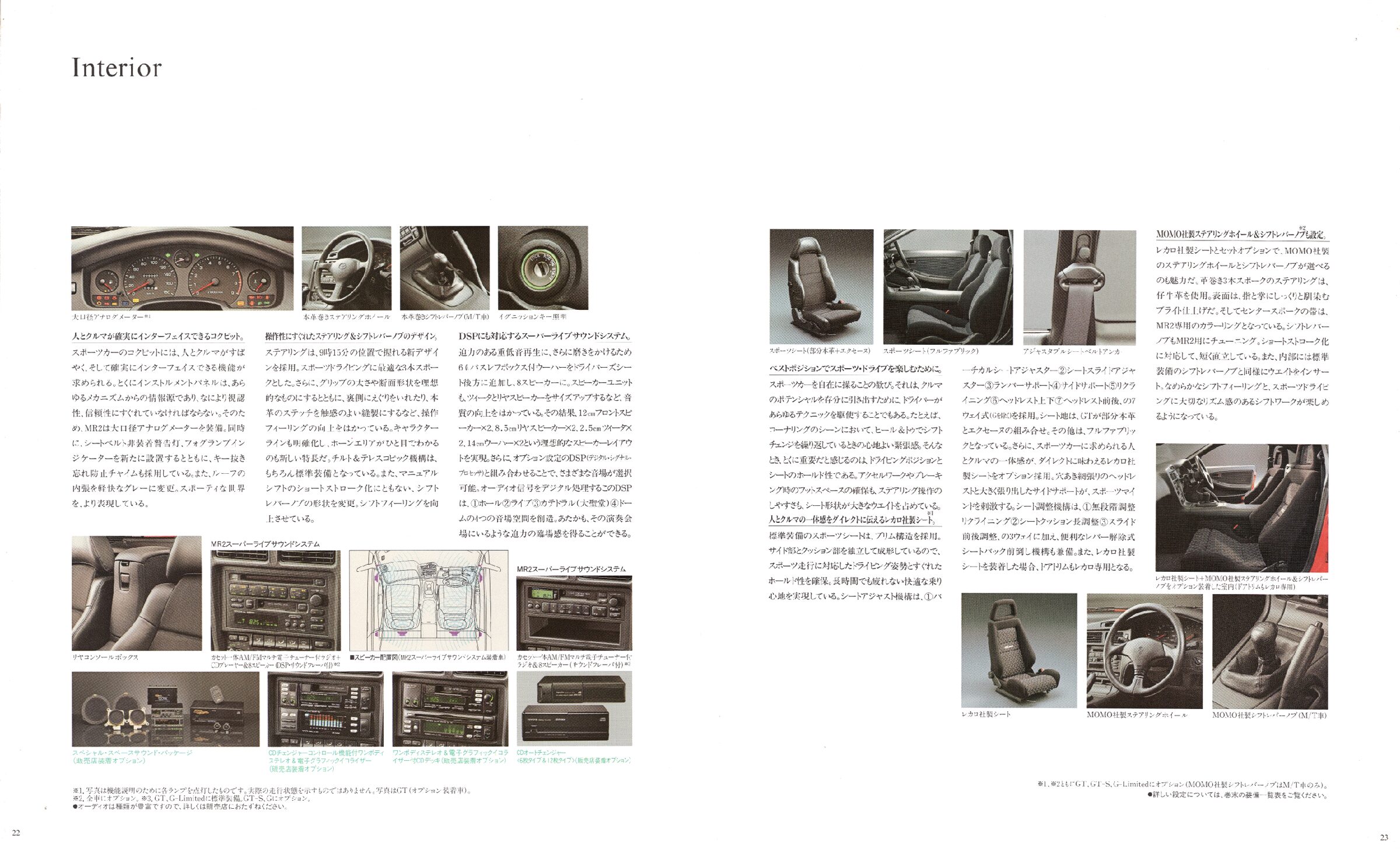
A sports car's cockpit needs to let the person and the car interface quickly and surely. The instrument panel in particular is the source of information from every mechanism, and above all it must be easy to read and reliable. So the MR2 has large-diameter analog meters. A seatbelt warning lamp and a fog lamp indicator are newly added, and a key reminder chime is adopted too. The roof lining is changed to a light gray, expressing a sportier world still more.
The steering wheel is a new design, held at the 9:15 position, with three spokes, ideal for sports driving. The thickness and section shape of the grip are made ideal, with recesses cut into the back and the leather's stitching sewn for a pleasant touch, improving the feel in use. The character line is clearer too, and a new feature is that the horn area can be seen at a glance. Tilt & telescopic is of course standard. With the shorter shift stroke of the manual, the shape of the shift lever knob is changed, improving shift feel.
To refine powerful bass reproduction further, a woofer with a 6ℓ bass reflex box is added behind the driver's seat, making 8 speakers. The speaker units, tweeters and rear speakers are larger, improving sound quality. The result is an ideal speaker layout of 12 cm front speakers ×2, 8.5 cm rear speakers ×2, 2.5 cm tweeters ×2 and 14 cm woofers ×2. Combined with the optional DSP (Digital Signal Processor), various sound fields can be chosen. This DSP, which processes the audio signal digitally, creates four sound spaces: ① Hall ② Live ③ Cathedral ④ Dome. It gives a powerful sense of presence, just as if you were at the concert venue.
Pictures:
The joy of driving a sports car freely. It also means the driver uses every technique to draw out the car's potential to the full. For example, the pleasant tension of repeated heel & toe shifts through a corner. At such moments, what feels particularly important is the driving position and the hold of the seat. Space for the feet when working the accelerator and brakes, and ease of steering: the shape of the seat weighs heavily here too.
The standard sports seat has a prim structure. The side sections and the cushion are molded separately, giving a driving posture suited to sports driving and excellent hold. It gives a comfortable ride that does not tire you even over long hours. Seat adjustment is the 7-way type (except G): ① vertical seat adjuster ② seat slide adjuster ③ lumbar support ④ side support ⑤ reclining ⑥ headrest up and down ⑦ headrest fore and aft. The upholstery on the GT combines partial genuine leather with Ecsaine; the others are full fabric. And Recaro seats are offered as an option, so you can feel directly the oneness of person and car a sports car needs. The headrest with perforated netting and the strongly bolstered side supports stir the sporting spirit. Seat adjustment adds a handy lever-release seatback fold-forward mechanism to the 3 ways of ① stepless reclining ② seat cushion length adjustment ③ slide fore and aft. With Recaro seats fitted, the door trim is Recaro's too.
Another appeal is the choice of a MOMO steering wheel and shift lever knob, as a set option with the Recaro seats. The leather-wrapped 3-spoke steering wheel uses calf leather. The surface has a bright finish that fits the fingers and palm. The band on the center spoke is in a coloring for the MR2 alone. The shift lever knob is also tuned for the MR2. It stands short and upright to suit the short stroke. Inside, a weight is inserted, as in the standard shift lever knob. Smooth shift feel, and shifting with the rhythm so important to sports driving.
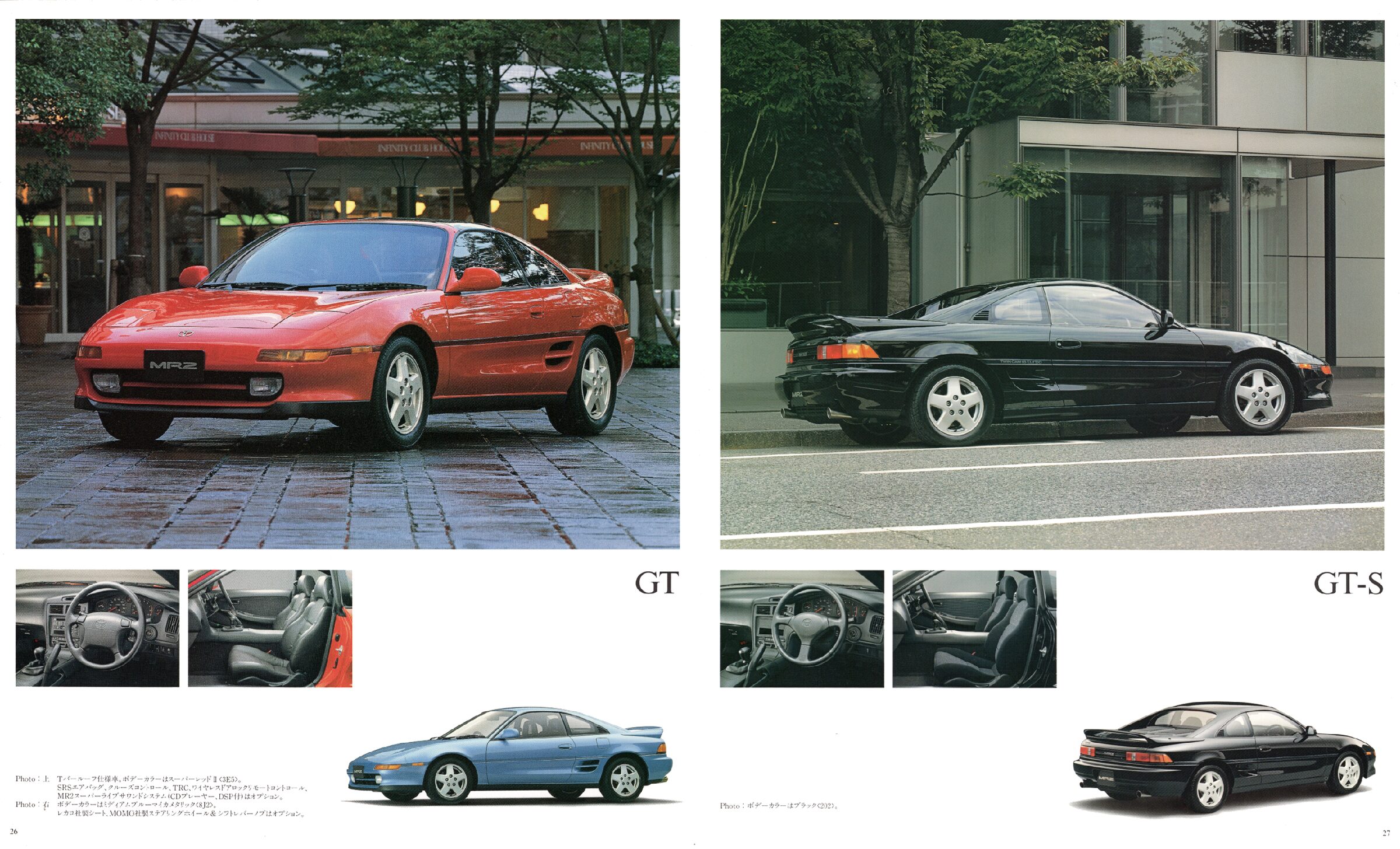
Photo: top. Car with the T-bar roof. Body color Super Red II (3E5).
The SRS airbag, cruise control, TRC, wireless door lock remote control and the MR2 Super Live Sound System (CD player, with DSP) are options.
Photo: right. Body color Medium Blue Mica Metallic (8J2).
The Recaro seats and MOMO steering wheel & shift lever knob are options.
Photo: Body color Black (202).
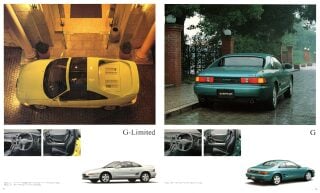
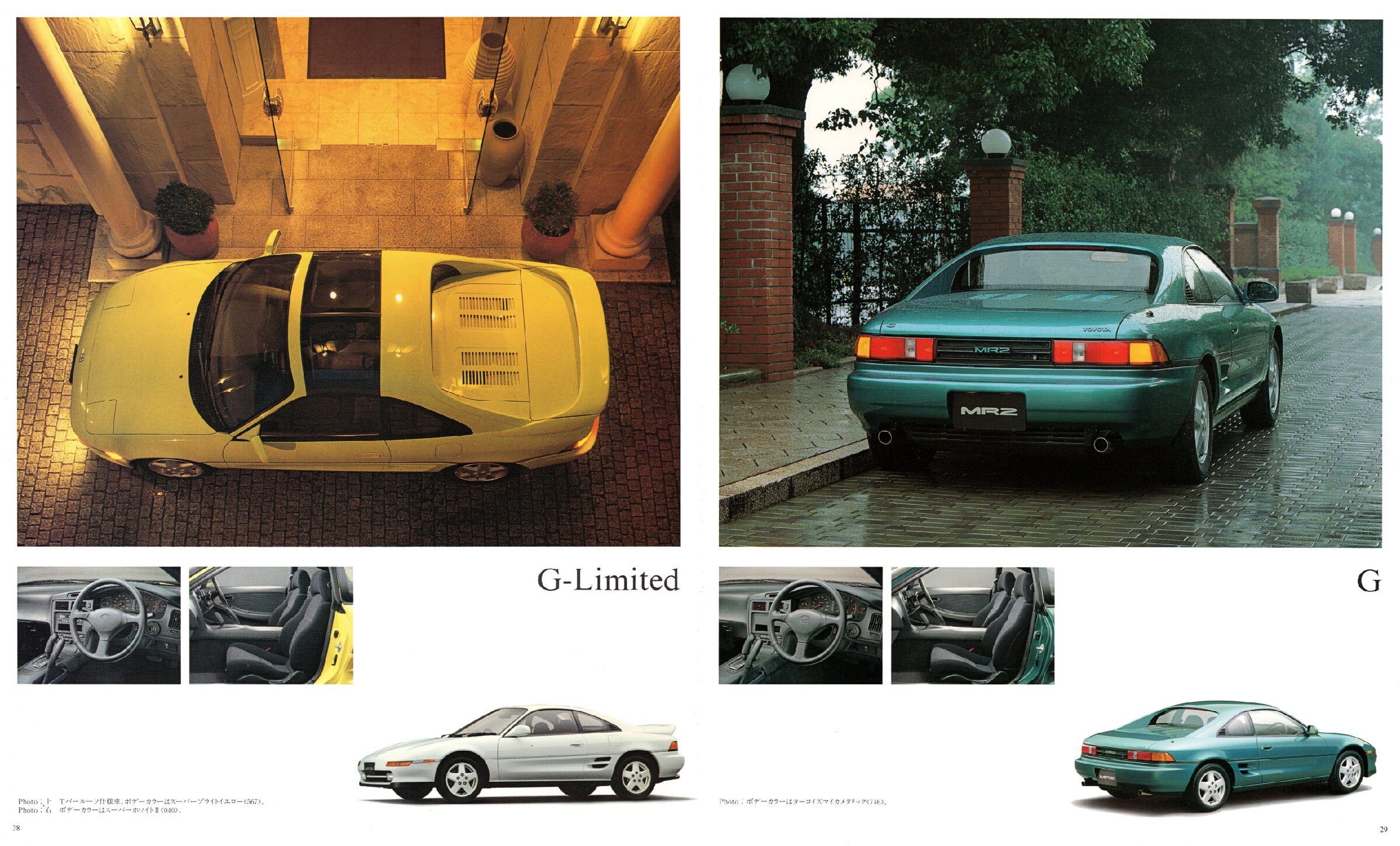
Photo: top. Car with the T-bar roof. Body color Super Bright Yellow (567).
Photo: right. Body color Super White II (040).
Photo: Body color Turquoise Mica Metallic (746).
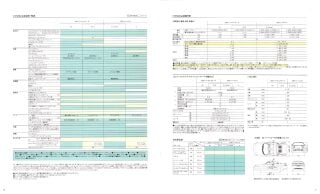
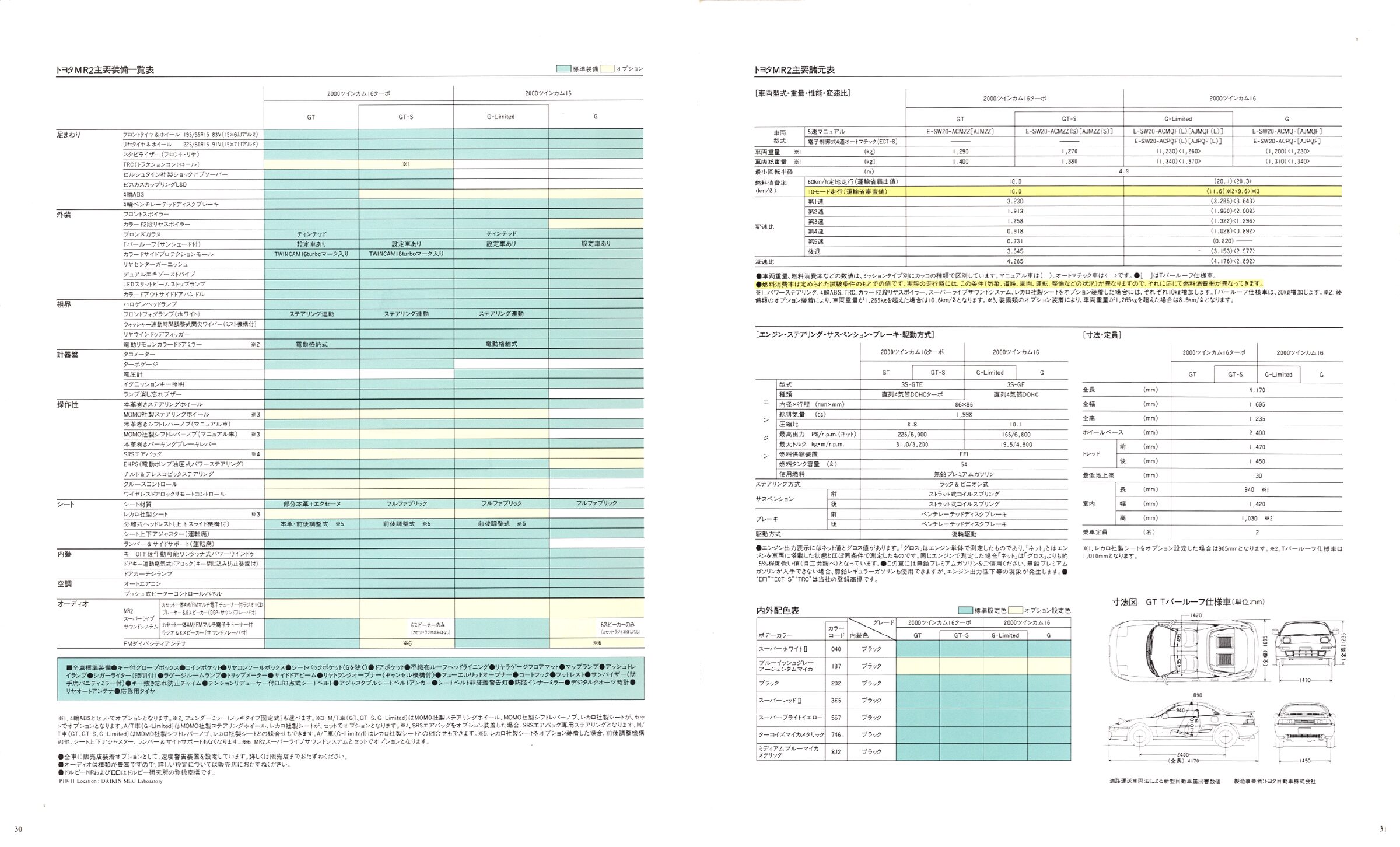
The GT and GT-S are 2000 TWINCAM16 Turbo; the G-Limited and G are 2000 TWINCAM16. Key: Standard, Option.
| Item | GT | GT-S | G-Limited | G | |
|---|---|---|---|---|---|
| Chassis | Front tires & wheels 195/55R15 83V (15×6JJ aluminum) | Standard | Standard | Standard | Standard |
| Rear tires & wheels 225/50R15 91V (15×7JJ aluminum) | Standard | Standard | Standard | Standard | |
| Stabilizers (front and rear) | Standard | Standard | Standard | Standard | |
| TRC (Traction Control) | Option ※1 | Option ※1 | — | — | |
| Bilstein shock absorbers | Standard | Standard | — | — | |
| Viscous coupling LSD | Standard | Standard | — | — | |
| 4-wheel ABS | Standard | Option | Option | Option | |
| 4-wheel ventilated disc brakes | Standard | Standard | Standard | Standard | |
| Exterior | Front spoiler | Standard | Standard | Standard | Standard |
| Colored 2-tier rear spoiler | Standard | Standard | Standard | Option | |
| Bronze glass | Standard: tinted | Standard | Standard: tinted | Standard | |
| T-bar roof (with sunshade) | Standard: on cars offered with it | Standard: on cars offered with it | Standard: on cars offered with it | Standard: on cars offered with it | |
| Colored side protection molding | Standard: with TWINCAM16turbo mark | Standard: with TWINCAM16turbo mark | Standard | Standard | |
| Rear center garnish | Standard | Standard | Standard | Standard | |
| Dual exhaust pipe | Standard | Standard | Standard | Standard | |
| LED slit beam stop lamp | Standard | Standard | Standard | Standard | |
| Colored outside door handles | Standard | Standard | Standard | Standard | |
| Visibility | Halogen headlamps | Standard | Standard | Standard | Standard |
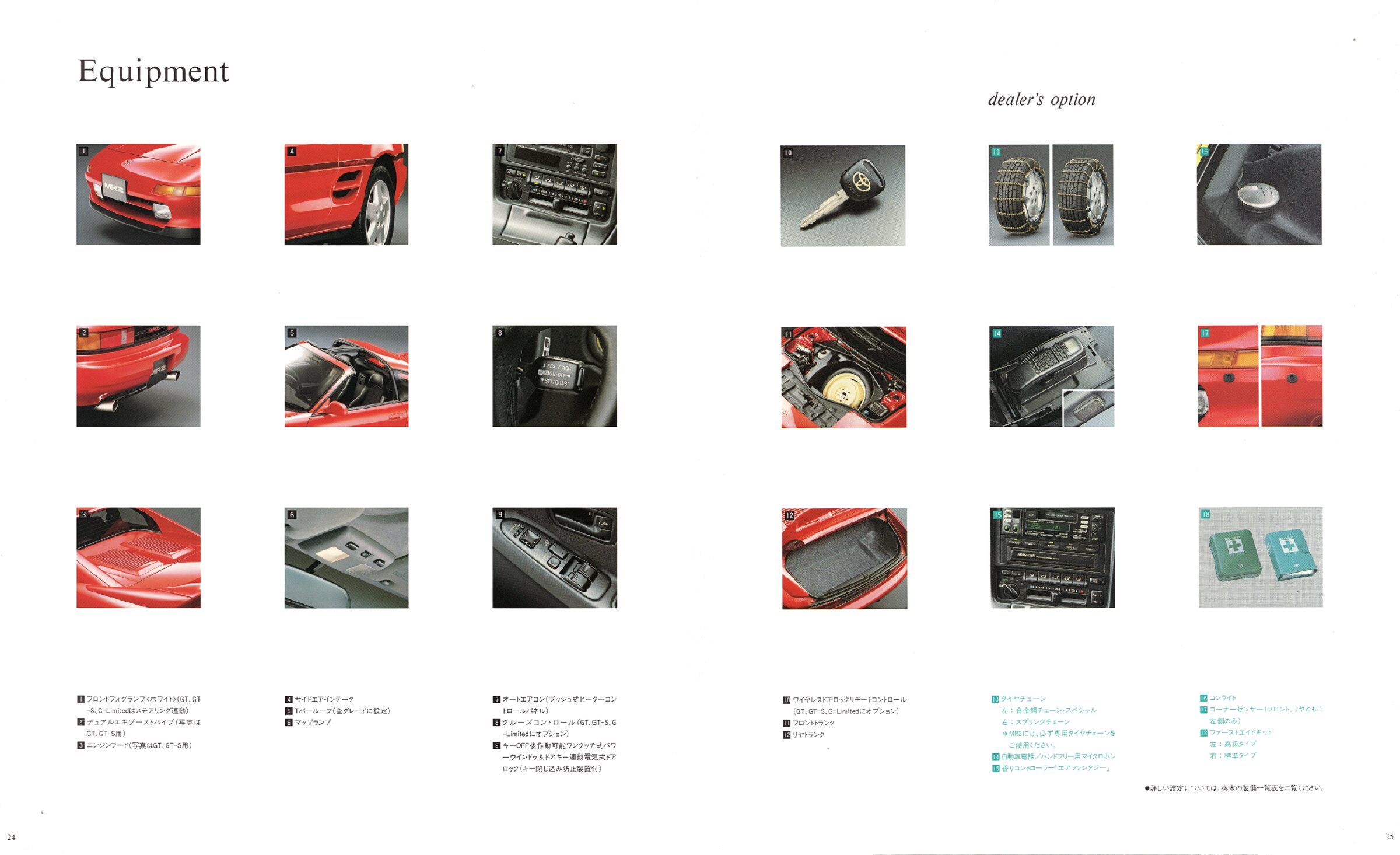
| Front fog lamps (white) | Standard: steering-linked | Standard: steering-linked | Standard: steering-linked | Standard | |
| Washer-linked intermittent wipers with time adjustment (with mist function) | Standard | Standard | Standard | Standard | |
| Rear window defogger | Standard | Standard | Standard | Standard | |
| Power remote-control colored door mirrors ※2 | Standard: power-folding | Standard | Standard: power-folding | Standard | |
| Instruments | Tachometer | Standard | Standard | Standard | Standard |
| Turbo gauge | Standard | Standard | — | — | |
| Voltmeter | — | — | Standard | Standard | |
| Ignition key illumination | Standard | Standard | Standard | Standard | |
| Lamp-off reminder buzzer | Standard | Standard | Standard | — | |
| Operation | Genuine leather-wrapped steering wheel | Standard | Standard | Standard | Standard |
| MOMO steering wheel ※3 | Option | Option | Option | — | |
| Genuine leather-wrapped shift lever knob (manual cars) | Standard | Standard | Standard | Standard | |
| MOMO shift lever knob (manual cars) ※3 | Option | Option | Option | — | |
| Genuine leather-wrapped parking brake lever | Standard | Standard | Standard | Standard | |
| SRS airbag ※4 | Option | Option | Option | Option | |
| EHPS (electric-pump hydraulic power steering) | Standard | Standard | Standard | Option | |
| Tilt & telescopic steering | Standard | Standard | Standard | Standard | |
| Cruise control | Option | Option | Option | — | |
| Wireless door lock remote control | Option | Option | Option | — | |
| Seats | Seat material | Standard: partial genuine leather + Ecsaine | Standard: full fabric | Standard: full fabric | Standard: full fabric |
| Recaro seats ※3 | Option | Option | Option | — | |
| Separate headrests (with up and down slide) | Standard: genuine leather, fore-aft adjustable ※5 | Standard: fore-aft adjustable ※5 | Standard: fore-aft adjustable ※5 | Standard | |
| Seat height adjuster (driver's seat) | Standard | Standard | Standard | Standard | |
| Lumbar & side support (driver's seat) | Standard | Standard | Standard | — | |
| Interior | One-touch power windows that work after key-off | Standard | Standard | Standard | Standard |
| Door key-linked power door locks (with key lock-in prevention) | Standard | Standard | Standard | Standard | |
| Door courtesy lamps | Standard | Standard | Standard | Standard | |
| Air conditioning | Auto air conditioner | Standard | Standard | Standard | Standard |
| Push-type heater control panel | Standard | Standard | Standard | Standard | |
| Audio | MR2 Super Live Sound System: cassette AM/FM multi electronic tuner radio + CD player & 8 speakers (with DSP and Sound Flavor) | Option | Option | Option | Option |
| MR2 Super Live Sound System: cassette AM/FM multi electronic tuner radio & 8 speakers (with Sound Flavor) | Standard | Option: 6 speakers only (no cassette or radio unit) | Standard | Option: 6 speakers only (no cassette or radio unit) | |
| FM diversity antenna | Standard | Option ※6 | Standard | Option ※6 |
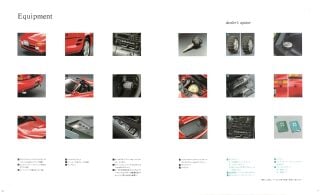
Standard on all cars:
P10-11 Location: DAIKIN MEC Laboratory
| GT (2000 TWINCAM16 Turbo) | GT-S (2000 TWINCAM16 Turbo) | G-Limited (2000 TWINCAM16) | G (2000 TWINCAM16) | |
|---|---|---|---|---|
| Model code: 5-speed manual | E-SW20-ACMZZ [AJMZZ] | E-SW20-ACMZZ(S) [AJMZZ(S)] | E-SW20-ACMQF(L) [AJMQF(L)] | E-SW20-ACMQF [AJMQF] |
| Model code: electronically controlled 4-speed automatic (ECT-S) | — | — | E-SW20-ACPQF(L) [AJPQF(L)] | E-SW20-ACPQF [AJPQF] |
| Vehicle weight ※1 (kg) | 1,290 | 1,270 | (1,230) 〈1,260〉 | (1,200) 〈1,230〉 |
| Gross vehicle weight ※1 (kg) | 1,400 | 1,380 | (1,340) 〈1,370〉 | (1,310) 〈1,340〉 |
| Minimum turning radius (m) | 4.9 | 4.9 | 4.9 | 4.9 |
| Fuel consumption (km/ℓ): 60 km/h constant speed (Ministry of Transport notified figure) | 18.0 | 18.0 | (20.1) 〈20.3〉 | (20.1) 〈20.3〉 |
| Fuel consumption (km/ℓ): 10-mode (Ministry of Transport test figure) | 10.0 | 10.0 | (11.6) ※2 〈9.6〉 ※3 | (11.6) ※2 〈9.6〉 ※3 |
| Gear ratio: 1st | 3.230 | 3.230 | (3.285) 〈3.643〉 | (3.285) 〈3.643〉 |
| Gear ratio: 2nd | 1.913 | 1.913 | (1.960) 〈2.008〉 | (1.960) 〈2.008〉 |
| Gear ratio: 3rd | 1.258 | 1.258 | (1.322) 〈1.296〉 | (1.322) 〈1.296〉 |
| Gear ratio: 4th | 0.918 | 0.918 | (1.028) 〈0.892〉 | (1.028) 〈0.892〉 |
| Gear ratio: 5th | 0.731 | 0.731 | (0.820) — | (0.820) — |
| Gear ratio: reverse | 3.545 | 3.545 | (3.153) 〈2.977〉 | (3.153) 〈2.977〉 |
| Final drive ratio | 4.285 | 4.285 | (4.176) 〈2.892〉 | (4.176) 〈2.892〉 |
| GT | GT-S | G-Limited | G | |
|---|---|---|---|---|
| Engine model | 3S-GTE | 3S-GTE | 3S-GE | 3S-GE |
| Type | Inline 4-cylinder DOHC turbo | Inline 4-cylinder DOHC turbo | Inline 4-cylinder DOHC | Inline 4-cylinder DOHC |
| Bore × stroke (mm×mm) | 86×86 | 86×86 | 86×86 | 86×86 |
| Displacement (cc) | 1,998 | 1,998 | 1,998 | 1,998 |
| Compression ratio | 8.8 | 8.8 | 10.1 | 10.1 |
| Maximum output PS/r.p.m. (net) | 225/6,000 | 225/6,000 | 165/6,800 | 165/6,800 |
| Maximum torque kg·m/r.p.m. | 31.0/3,200 | 31.0/3,200 | 19.5/4,800 | 19.5/4,800 |
| Fuel system | EFI | EFI | EFI | EFI |
| Fuel tank capacity (ℓ) | 54 | 54 | 54 | 54 |
| Fuel | Unleaded premium gasoline | Unleaded premium gasoline | Unleaded premium gasoline | Unleaded premium gasoline |
| Steering | Rack & pinion | Rack & pinion | Rack & pinion | Rack & pinion |
| Suspension: front | Strut with coil springs | Strut with coil springs | Strut with coil springs | Strut with coil springs |
| Suspension: rear | Strut with coil springs | Strut with coil springs | Strut with coil springs | Strut with coil springs |
| Brakes: front | Ventilated disc brakes | Ventilated disc brakes | Ventilated disc brakes | Ventilated disc brakes |
| Brakes: rear | Ventilated disc brakes | Ventilated disc brakes | Ventilated disc brakes | Ventilated disc brakes |
| Drive | Rear-wheel drive | Rear-wheel drive | Rear-wheel drive | Rear-wheel drive |
| GT | GT-S | G-Limited | G | |
|---|---|---|---|---|
| Overall length (mm) | 4,170 | 4,170 | 4,170 | 4,170 |
| Overall width (mm) | 1,695 | 1,695 | 1,695 | 1,695 |
| Overall height (mm) | 1,235 | 1,235 | 1,235 | 1,235 |
| Wheelbase (mm) | 2,400 | 2,400 | 2,400 | 2,400 |
| Tread: front (mm) | 1,470 | 1,470 | 1,470 | 1,470 |
| Tread: rear (mm) | 1,450 | 1,450 | 1,450 | 1,450 |
| Minimum ground clearance (mm) | 130 | 130 | 130 | 130 |
| Interior length (mm) | 940 ※1 | 940 ※1 | 940 ※1 | 940 ※1 |
| Interior width (mm) | 1,420 | 1,420 | 1,420 | 1,420 |
| Interior height (mm) | 1,030 ※2 | 1,030 ※2 | 1,030 ※2 | 1,030 ※2 |
| Seating capacity | 2 | 2 | 2 | 2 |
Key: Standard color, Option color.
| Body color | Color code | Interior color | GT | GT-S | G-Limited | G |
|---|---|---|---|---|---|---|
| Super White II | 040 | Black | Standard | Standard | Standard | Standard |
| Bluish Gray Argentum Mica | 187 | Black | Option | Option | Option | Option |
| Black | 202 | Black | Standard | Standard | Standard | Standard |
| Super Red II | 3E5 | Black | Standard | Standard | Standard | Standard |
| Super Bright Yellow | 567 | Black | Standard | Standard | Standard | Standard |
| Turquoise Mica Metallic | 746 | Black | Standard | Standard | Standard | Standard |
| Medium Blue Mica Metallic | 8J2 | Black | Standard | Standard | Standard | Standard |
Figures as notified for new vehicles under the Road Transport Vehicle Act. Manufacturer: Toyota Motor Corporation.
Specifications and equipment are subject to change without notice. (The contents of this catalog are as of December '91.) Body and interior colors may look different from the actual colors because of photography and printing inks.
Toyota Motor Corporation Customer Consultation Center
For enquiries about this catalog, contact your nearest MR2 dealer or the Customer Consultation Center below.
Head office: 〒461 1-23-22 Izumi, Higashi-ku, Nagoya
TOYOTA AUTO
Slow down and drive safely.
To people. To society. To the Earth. TOYOTA
AC0018-9112
Toyota's Japanese brochure for the SW20 MR2, printed in December 1991, covering the GT and GT-S turbo and the G-Limited and G with engines, chassis, safety, interior, equipment, colors and specifications.
Reproduced for archival and reference purposes. Toyota, its model names, logos and the images in this brochure are the trademarks and copyright of their owners; NENGUN is not affiliated with or endorsed by Toyota. If you hold rights in this material and object to it appearing here, contact us and we will remove it promptly.