New, Used & OEM Parts Search
Can't find what you are looking for? Contact Us and we're happy to help.
Your trusted source of JDM parts shipped from Japan
JDM parts shipped direct from Japan


High performance vehicles need high performance brakes to match. A number of upgraded brake systems and accessories are available to ensure you can stop as fast and consistently as possible.



Brake pads are the simplest change and make the most difference to how the brakes feel, so choose them first, by how hot your driving makes the brakes. A street pad works from cold, stays quiet and makes little dust. A circuit pad keeps its grip at temperatures that would fade a street pad, but may need heat before it bites and usually wears rotors faster on the road.
Japanese pad makers rate each compound by two figures. The friction coefficient, μ (mu), is the braking force a pad produces for a given clamping force: a higher μ gives more stopping for the same pedal pressure. The operating temperature range is where that μ holds. Project Mu, for example, rates its Type PS street pad from 0 to 500°C and its HC+ from 0 to 800°C. Choose a range that covers the heat you make without going far beyond it, since a pad built for very high temperatures can feel weak when cold.
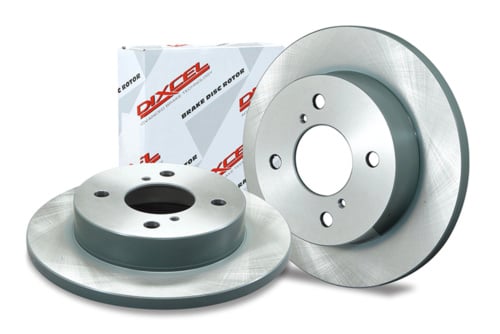
Slotted rotors help clear gas and pad material from between pad and disc. Two-piece rotors bolt an iron friction ring to a lighter centre bell, and the ring can be replaced on its own when worn.
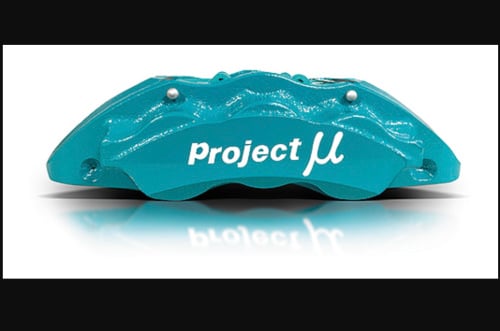
Brake upgrade kits pair larger rotors with multi-piston calipers for more heat capacity, but they need room inside the wheel: check the kit's minimum wheel size and spoke clearance before ordering. A front kit also shifts the balance between front and rear brakes, so match it to how the car is used.
Brake fluid is graded by the US DOT standard, which sets minimum boiling points when new (dry) and after absorbing water (wet): DOT 3 at 205°C dry and 140°C wet, DOT 4 at 230°C and 155°C, and DOT 5.1 at 260°C and 180°C. DOT 3, 4 and 5.1 are glycol-based and absorb moisture over time, so the fluid is changed regularly, and more often on a car that sees track use. DOT 5 is silicone-based and must never be mixed with them.
Braided brake lines swell less under pressure than rubber hoses, for a firmer pedal. Brake cylinder stoppers brace the master cylinder so less pedal travel is lost to the bulkhead flexing.
Brakes are the most safety-critical system on a car. Have them fitted and bled by a qualified mechanic, and bed in new pads and rotors following the pad maker's own procedure before relying on them. Competition pads, rotors and fluid may not suit road use, and the rules on modified brakes differ between countries.