New, Used & OEM Parts Search
Can't find what you are looking for? Contact Us and we're happy to help.
Your trusted source of JDM parts shipped from Japan
JDM parts shipped direct from Japan

Displaying 1 to 20 new parts of 20
1 to 20 of 20




Start with what the gauges show: water temperature, oil temperature and, on a turbo car, intake air temperature each point to a different part. Coolant is handled by the radiator, oil by an oil cooler, charge air by the intercooler, and gearbox and differential oil by their own coolers. A factory system in good condition copes with road use in most climates; overheating on the road is more often a blocked core, a tired cap or a perished hose than a radiator that is too small. Circuit days, drifting and big power increases are where upgrades pay off.
Choose your car with the car selector to see what is listed for it. GReddy, Nismo, HKS, Blitz and Koyo all make cooling parts for Japanese cars.
Aluminium radiators with a thicker core or more rows carry more coolant and shed more heat. Check how much room is left for the fan and any intercooler in front.
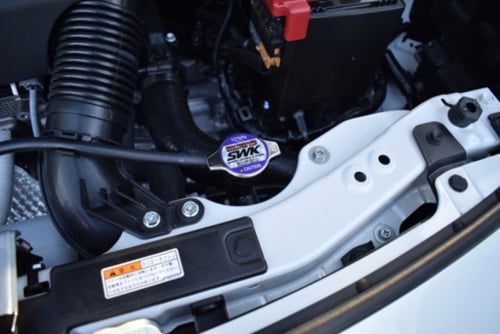
Radiator caps are rated by pressure, in kPa, bar or, from Japanese makers, often kgf/cm² (1.3 kgf/cm² is about 130 kPa). A higher-pressure cap raises the coolant's boiling point; it does not lower the running temperature, and it adds load to the hoses, radiator and seals, so fit one only to a system in good order. Never open a cap on a hot engine.
A low-temperature thermostat opens earlier. Once it is fully open it no longer sets the temperature; the radiator and fans do, so a thermostat alone will not cure overheating under sustained load.
Intercooler kits cool the air leaving the turbo; cooler charge air is denser and less prone to knock. Bar-and-plate cores are generally sturdier and heavier; tube-and-fin cores are lighter. A bigger core and longer intercooler piping add volume for the turbo to fill and can slow response, so size the core for the power. A front-mount core sits ahead of the radiator and warms the air reaching it.
Oil coolers usually connect through a sandwich plate under the oil filter and AN-sized lines, where the dash number is the tube's outside diameter in sixteenths of an inch (-10 AN is 5/8 in). A thermostatic plate keeps oil from running too cold on the road. Track and drift cars often add transmission and LSD coolers, since gear oil heats quickly with sustained load.

